
About this resource
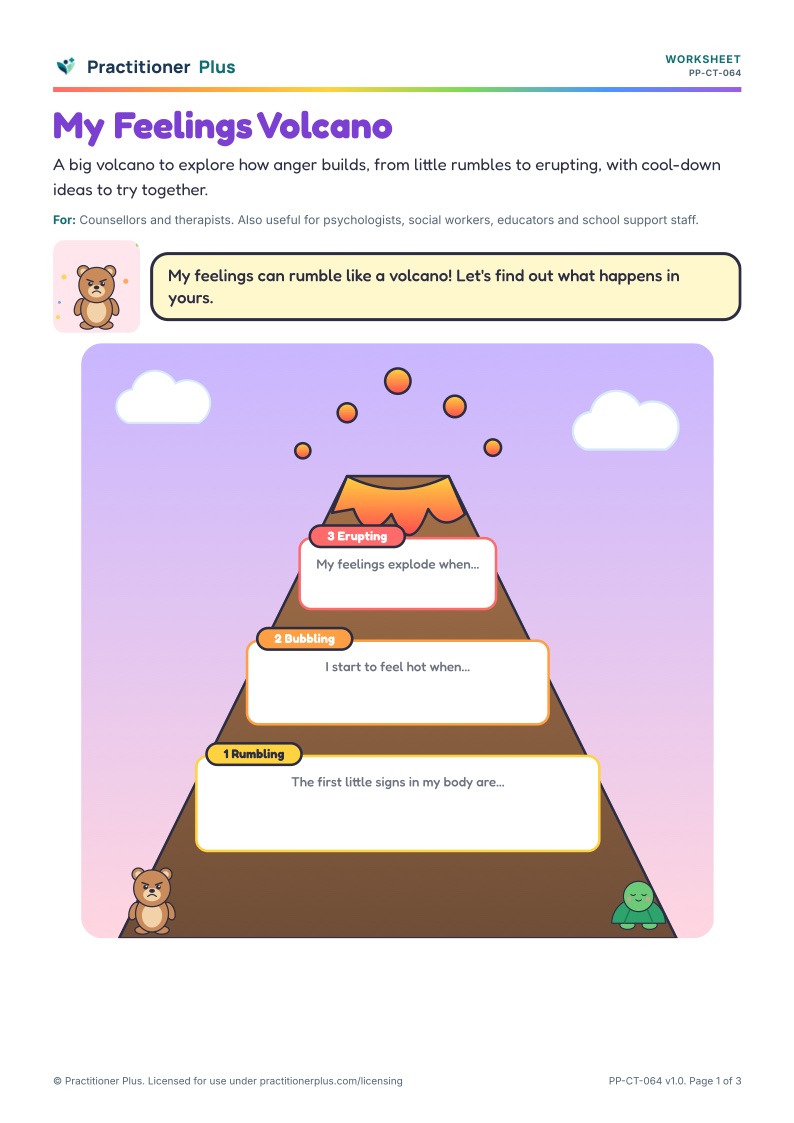
A volcano is a simple way for children to see that big feelings build in stages. Together you explore the first small signs, what makes the feeling bubble and what happens when it erupts, then choose cool-down ideas. Anger is treated as a normal feeling; the aim is noticing it early and finding safe ways to let it out.
Purpose
A big volcano to explore how anger builds, from little rumbles to erupting, with cool-down ideas to try together.
Who it is for
Primary profession: Counsellors and therapists. Also relevant for psychologists, social workers, educators and school support staff.
Client or participant group: Children aged about 4 to 10, working with a counsellor, play therapist or psychologist.
Practice setting: Play therapy, counselling and school wellbeing rooms.
Suggested uses
- Individual play-based sessions
- Building a relationship with a child
- Talking about feelings without pressure
- Sharing ideas with parents or carers, with the child's agreement
Instructions for practitioners
- Explain that all feelings are okay, and that some actions are not.
- Start at the bottom: what are the first signs in your body?
- Write or draw the child's ideas for each level.
- Practise some cool-down ideas together in the room.
- Choose one idea to try at home, and share it with a carer if the child agrees.
Accessibility considerations
Big pictures and few words. Read it aloud, let the child draw or point, and use their own words for feelings. Print in colour if you can, or let the child colour it in.
Scope and limitations
A play-based activity that supports therapy. It is not a stand-alone treatment, a clinical assessment or a validated tool. Follow the child's lead, stop if they become distressed, and follow your child safety procedures if the child discloses harm.
Research basis
Meta-analyses suggest play therapy and child-centred play therapy have positive effects on children's behaviour and wellbeing, although researchers note limits in the quality of some studies. These activities support play-based work and are not validated treatments. Children learn to self-regulate through warm, responsive co-regulation from adults and predictable environments.
- Bratton, S. C., Ray, D., Rhine, T., & Jones, L. (2005). The Efficacy of Play Therapy With Children: A Meta-Analytic Review of Treatment Outcomes. Professional Psychology: Research and Practice, 36(4), 376–390. https://doi.org/10.1037/0735-7028.36.4.376
- Lin, Y., & Bratton, S. C. (2015). A Meta‐Analytic Review of Child‐Centered Play Therapy Approaches. Journal of Counseling & Development, 93(1), 45–58. https://doi.org/10.1002/j.1556-6676.2015.00180.x
- Murray, D. W., Rosanbalm, K., Christopoulos, C., & Hamoudi, A. (2015). Self-regulation and toxic stress: Foundations for understanding self-regulation from an applied developmental perspective (OPRE Report 2015-21). Office of Planning, Research and Evaluation, US Department of Health and Human Services. https://acf.gov/opre/report/self-regulation-and-toxic-stress-foundations-understanding-self-regulation-applied
- Phillips, R. D. (2010). How firm is our foundation? Current play therapy research. International Journal of Play Therapy, 19(1), 13–25. https://doi.org/10.1037/a0017340
- Ray, D. C., Armstrong, S. A., Balkin, R. S., & Jayne, K. M. (2015). CHILD‐CENTERED PLAY THERAPY IN THE SCHOOLS: REVIEW AND META‐ANALYSIS. Psychology in the Schools, 52(2), 107–123. https://doi.org/10.1002/pits.21798
What is included
A 3-page printable A4 PDF, including a practitioner notes page with the research basis (version 1.0).
Originality
Original Practitioner Plus content: wording, activity structure, layout and icons were created for this resource. No third-party worksheets, illustrations or text were reproduced. Illustrations and activities were created for Practitioner Plus; no third-party worksheet or image was used.


