
About this resource
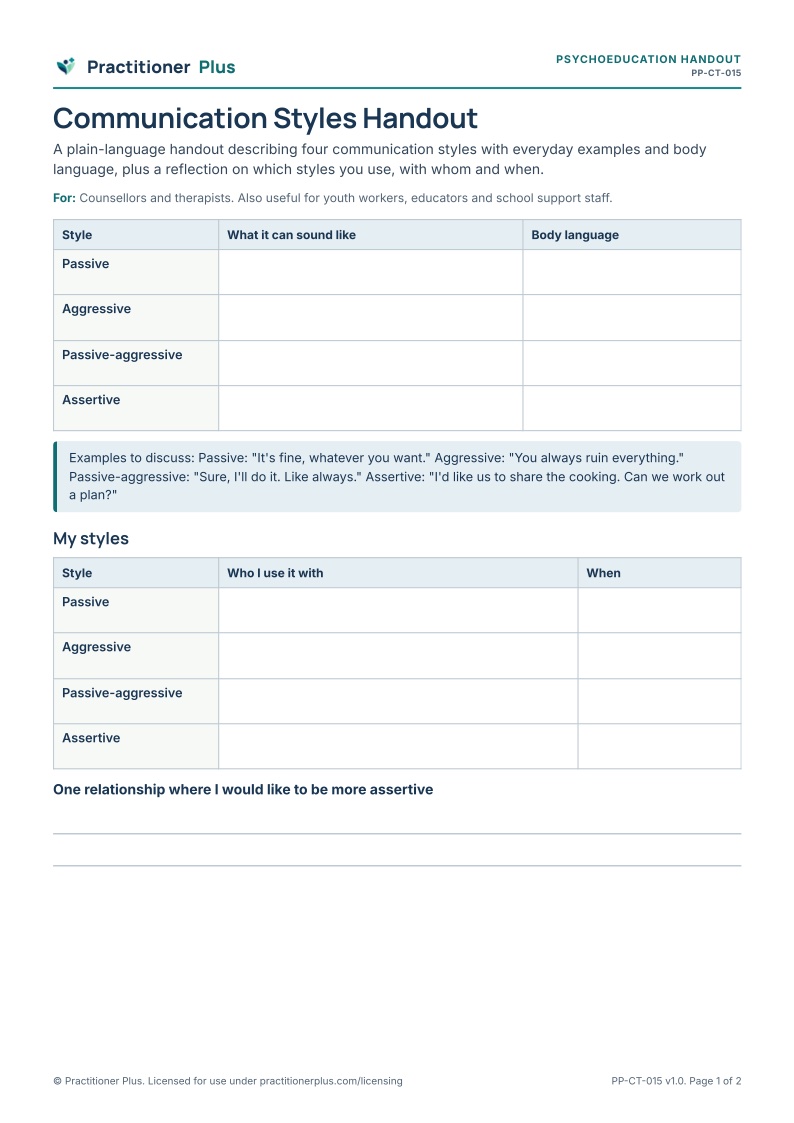
Most people use different communication styles in different situations. This handout describes passive, aggressive, passive-aggressive and assertive communication with everyday examples and typical body language, then invites clients to reflect on which styles they use, with whom and when.
Purpose
To build awareness of communication styles as a first step towards more assertive communication.
Who it is for
Primary profession: Counsellors and therapists. Also relevant for youth workers, educators and school support staff.
Client or participant group: Adolescents and adults exploring how they communicate in relationships.
Practice setting: Individual, couples or group counselling, and skills programs.
Suggested uses
- Psychoeducation before assertiveness practice
- Couples and family work
- Group programs
- Exploring relationship patterns
Instructions for practitioners
- Normalise using different styles in different situations.
- Explore what each style protects or achieves for the client.
- Consider culture: directness varies across cultures and families.
- Follow up with assertiveness practice.
Instructions for clients or participants
- Read the four styles.
- Tick the ones you notice in yourself.
- Write who you use each style with.
Accessibility considerations
Plain language. Examples can be role-played.
Scope and limitations
Psychoeducation. It is not an assessment of communication or personality.
Research basis
Brief psychoeducation can reduce symptoms of depression and psychological distress. Cognitive behavioural therapy (CBT) has a strong research base for anxiety, depression and many related problems; this resource uses CBT techniques to support, not replace, a structured treatment plan.
- Beck, J. S. (2021). Cognitive behavior therapy: Basics and beyond (3rd ed.). Guilford Press.
- Donker, T., Griffiths, K. M., Cuijpers, P., & Christensen, H. (2009). Psychoeducation for depression, anxiety and psychological distress: a meta-analysis. BMC Medicine, 7(1), 79. https://doi.org/10.1186/1741-7015-7-79
- Hofmann, S. G., Asnaani, A., Vonk, I. J. J., Sawyer, A. T., & Fang, A. (2012). The Efficacy of Cognitive Behavioral Therapy: A Review of Meta-analyses. Cognitive Therapy and Research, 36(5), 427–440. https://doi.org/10.1007/s10608-012-9476-1
What is included
A 2-page printable A4 PDF, including a practitioner notes page with the research basis (version 1.0).
Originality
Original Practitioner Plus content: wording, activity structure, layout and icons were created for this resource. No third-party worksheets, illustrations or text were reproduced.


