
About this resource
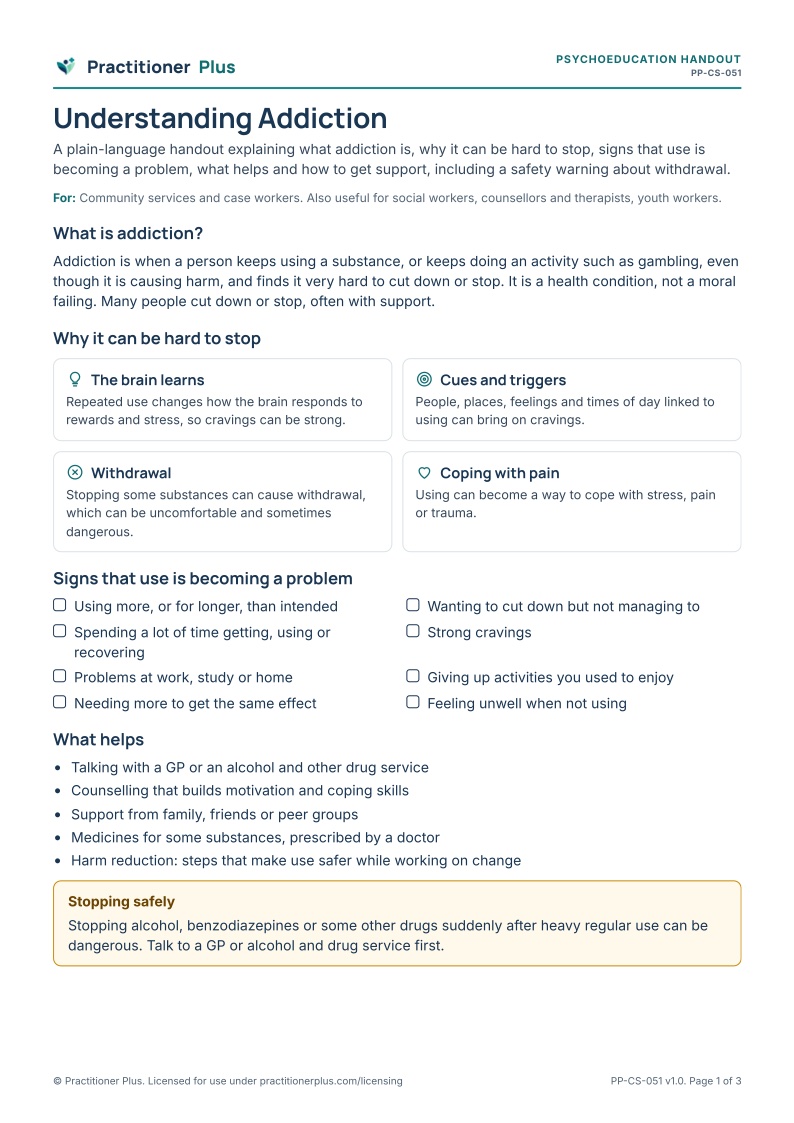
Addiction is a health condition, not a moral failing. This handout explains how repeated use changes the brain's response to rewards and stress, why cues and withdrawal make stopping hard, signs that use is becoming a problem, what helps, and how to get support. It includes a clear warning that stopping some substances suddenly can be dangerous without medical advice.
Purpose
To reduce shame and give clear information about addiction, safety and where to get help.
Who it is for
Primary profession: Community services and case workers. Also relevant for social workers, counsellors and therapists, youth workers.
Client or participant group: Adults and young people concerned about their own or someone else's alcohol, drug or gambling use.
Practice setting: Case management, community services, counselling and alcohol and other drug services.
Suggested uses
- Early conversations about substance use
- Information for families
- Referral to alcohol and other drug services
- Group psychoeducation
Instructions for practitioners
- Use a non-judgemental, curious approach.
- Explore what the person already knows and wants to change.
- Discuss withdrawal safety before any plan to stop.
- Offer referral to a GP or alcohol and other drug service.
- Include harm reduction information where relevant.
Instructions for clients or participants
- Read the handout.
- Tick any signs that fit for you or someone you care about.
- Talk with your worker about next steps.
Accessibility considerations
Plain language. Can be read aloud. Avoids stigmatising terms.
Scope and limitations
General information. It is not an assessment or treatment plan. Withdrawal from some substances can be dangerous and needs medical advice.
Research basis
Research describes addiction as involving lasting changes in the brain's reward, stress and self-control systems, which helps explain cravings and relapse; relapse prevention skills are an established part of treatment. Motivational interviewing has consistent, modest benefits for behaviour change across health and social care settings.
- Hendershot, C. S., Witkiewitz, K., George, W. H., & Marlatt, G. A. (2011). Relapse prevention for addictive behaviors. Substance Abuse Treatment, Prevention, and Policy, 6(1), 17. https://doi.org/10.1186/1747-597x-6-17
- Lundahl, B. W., Kunz, C., Brownell, C., Tollefson, D., & Burke, B. L. (2010). A Meta-Analysis of Motivational Interviewing: Twenty-Five Years of Empirical Studies. Research on Social Work Practice, 20(2), 137–160. https://doi.org/10.1177/1049731509347850
- Miller, W. R., & Rollnick, S. (2013). Motivational Interviewing: Helping People Change (3rd ed.). Guilford Press.
- Volkow, N. D., Koob, G. F., & McLellan, A. T. (2016). Neurobiologic Advances from the Brain Disease Model of Addiction. New England Journal of Medicine, 374(4), 363–371. https://doi.org/10.1056/nejmra1511480
What is included
A 3-page printable A4 PDF, including a practitioner notes page with the research basis (version 1.0).
Originality
Original Practitioner Plus content: wording, activity structure, layout and icons were created for this resource. No third-party worksheets, illustrations or text were reproduced. Written for Practitioner Plus from the research and guidance listed in the research basis; no third-party worksheet was used as a template.


