
About this resource
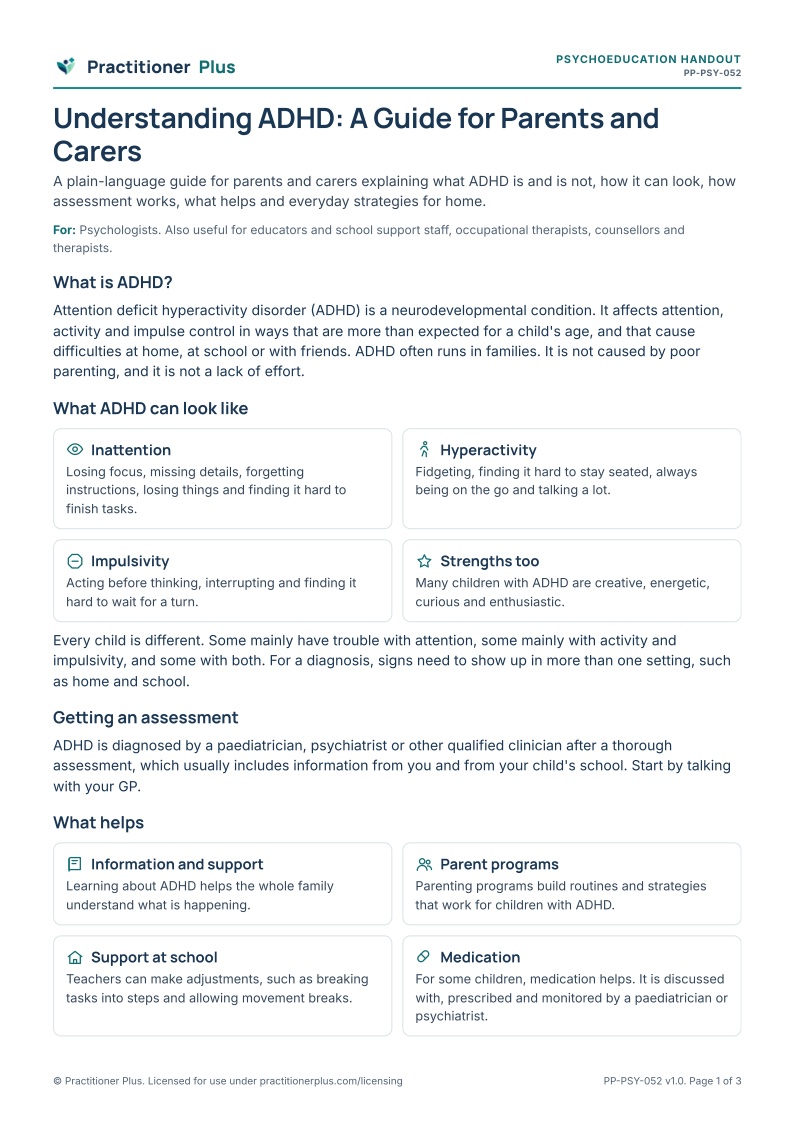
Parents often hear mixed messages about ADHD. This guide explains that ADHD is a neurodevelopmental condition, not the result of poor parenting or lack of effort, describes inattention, hyperactivity and impulsivity alongside common strengths, outlines how assessment works in Australia, and summarises what helps: information, parent programs, school support and, for some children, medication. It ends with everyday strategies for home.
Purpose
To give families clear, accurate information about ADHD and practical strategies for home.
Who it is for
Primary profession: Psychologists. Also relevant for educators and school support staff, occupational therapists, counsellors and therapists.
Client or participant group: Parents and carers of children and teenagers who have, or may have, ADHD.
Practice setting: Psychology, paediatric, school and family support services.
Suggested uses
- After an ADHD diagnosis
- While a family is waiting for assessment
- Parent education groups
- Home and school planning
Instructions for practitioners
- Check what the family already knows and has been told.
- Go through the guide, linking it to the child's own strengths and challenges.
- Choose one or two home strategies to try first.
- Refer to the GP, paediatrician or psychiatrist for assessment or medication questions.
- Connect the family with parent programs and school supports.
Instructions for clients or participants
- Read the guide at your own pace.
- Tick the strategies you would like to try.
- Write down questions for your child's doctor or school.
Accessibility considerations
Plain language. Can be read aloud or worked through with an interpreter.
Scope and limitations
General information. It is not a diagnostic tool and does not replace assessment by a paediatrician, psychiatrist or other qualified clinician. Medication decisions are made with the child's doctor.
Research basis
The Australian ADHD guideline recommends information and support for people with ADHD and their families, with treatment planned with a qualified clinician; behavioural parent programs improve parenting for children with ADHD. Parent support that builds positive interactions, consistent responses and emotional communication improves child behaviour and family wellbeing.
- Australian ADHD Professionals Association. (2022). Australian evidence-based clinical practice guideline for attention deficit hyperactivity disorder (ADHD). AADPA. https://adhdguideline.aadpa.com.au/
- Daley, D., van der Oord, S., Ferrin, M., Danckaerts, M., Doepfner, M., Cortese, S., & Sonuga-Barke, E. J. (2014). Behavioral Interventions in Attention-Deficit/Hyperactivity Disorder: A Meta-Analysis of Randomized Controlled Trials Across Multiple Outcome Domains. Journal of the American Academy of Child & Adolescent Psychiatry, 53(8), 835–847.e5. https://doi.org/10.1016/j.jaac.2014.05.013
- Kaminski, J. W., Valle, L. A., Filene, J. H., & Boyle, C. L. (2008). A meta-analytic review of components associated with parent training program effectiveness. Journal of Abnormal Child Psychology, 36(4), 567–589. https://doi.org/10.1007/s10802-007-9201-9
What is included
A 3-page printable A4 PDF, including a practitioner notes page with the research basis (version 1.0).
Originality
Original Practitioner Plus content: wording, activity structure, layout and icons were created for this resource. No third-party worksheets, illustrations or text were reproduced. Written for Practitioner Plus from the research and guidance listed in the research basis; no third-party worksheet was used as a template.


