
About this resource
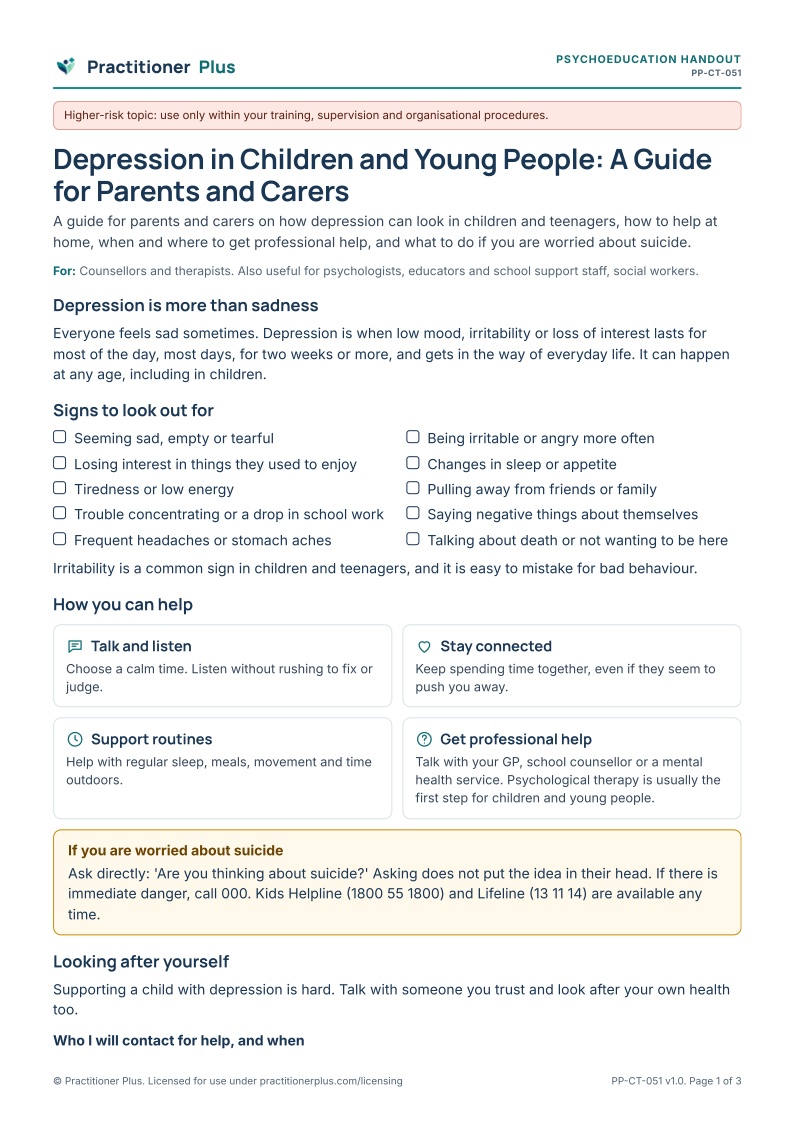
Depression in children and teenagers can be easy to miss, especially when it shows up as irritability or physical complaints. This guide explains the difference between sadness and depression, signs to look out for, practical ways to help at home, how to get professional help, and how to respond if you are worried about suicide.
Purpose
To help caregivers recognise depression, respond supportively and get timely professional help.
Who it is for
Primary profession: Counsellors and therapists. Also relevant for psychologists, educators and school support staff, social workers.
Client or participant group: Parents and carers of children and teenagers who may be depressed.
Practice setting: Counselling, psychology, school wellbeing and family support services.
Suggested uses
- Parent sessions
- School wellbeing referrals
- Family support work
- Waiting list information
Instructions for practitioners
- Use after an initial conversation about the caregiver's concerns.
- Go through the signs and link them to what the caregiver has noticed.
- Agree next steps for professional assessment.
- Complete a risk assessment if there are concerns about suicide or self-harm, and follow your procedures.
- Check how the caregiver is coping and offer support.
Instructions for clients or participants
- Read the guide.
- Tick the signs you have noticed.
- Plan who you will contact for help.
Accessibility considerations
Plain language. Can be read aloud or worked through with an interpreter.
Scope and limitations
General information for caregivers. It is not a diagnostic or risk assessment tool. Children and young people with possible depression should be assessed by a health professional.
Higher-risk topic: use only within your training, supervision and organisational procedures.
Research basis
Guidelines recommend that children and young people with depression are assessed by a health professional and offered psychological therapy first, with families involved in care. Safety planning is an evidence-based brief intervention that reduces suicidal behaviour and increases engagement with care.
- National Institute for Health and Care Excellence. (2019). Depression in children and young people: Identification and management (NICE guideline NG134). https://www.nice.org.uk/guidance/ng134
- Rickwood, D., Deane, F. P., Wilson, C. J., & Ciarrochi, J. (2005). Young people’s help-seeking for mental health problems. Australian e-Journal for the Advancement of Mental Health, 4(3), 218–251. https://doi.org/10.5172/jamh.4.3.218
- Stanley, B., & Brown, G. K. (2012). Safety Planning Intervention: A Brief Intervention to Mitigate Suicide Risk. Cognitive and Behavioral Practice, 19(2), 256–264. https://doi.org/10.1016/j.cbpra.2011.01.001
- Stanley, B., Brown, G. K., Brenner, L. A., Galfalvy, H. C., Currier, G. W., Knox, K. L., Chaudhury, S. R., Bush, A. L., & Green, K. L. (2018). Comparison of the Safety Planning Intervention With Follow-up vs Usual Care of Suicidal Patients Treated in the Emergency Department. JAMA Psychiatry, 75(9), 894. https://doi.org/10.1001/jamapsychiatry.2018.1776
What is included
A 3-page printable A4 PDF, including a practitioner notes page with the research basis (version 1.0).
Originality
Original Practitioner Plus content: wording, activity structure, layout and icons were created for this resource. No third-party worksheets, illustrations or text were reproduced. Written for Practitioner Plus from the research and guidance listed in the research basis; no third-party worksheet was used as a template.


