
About this resource
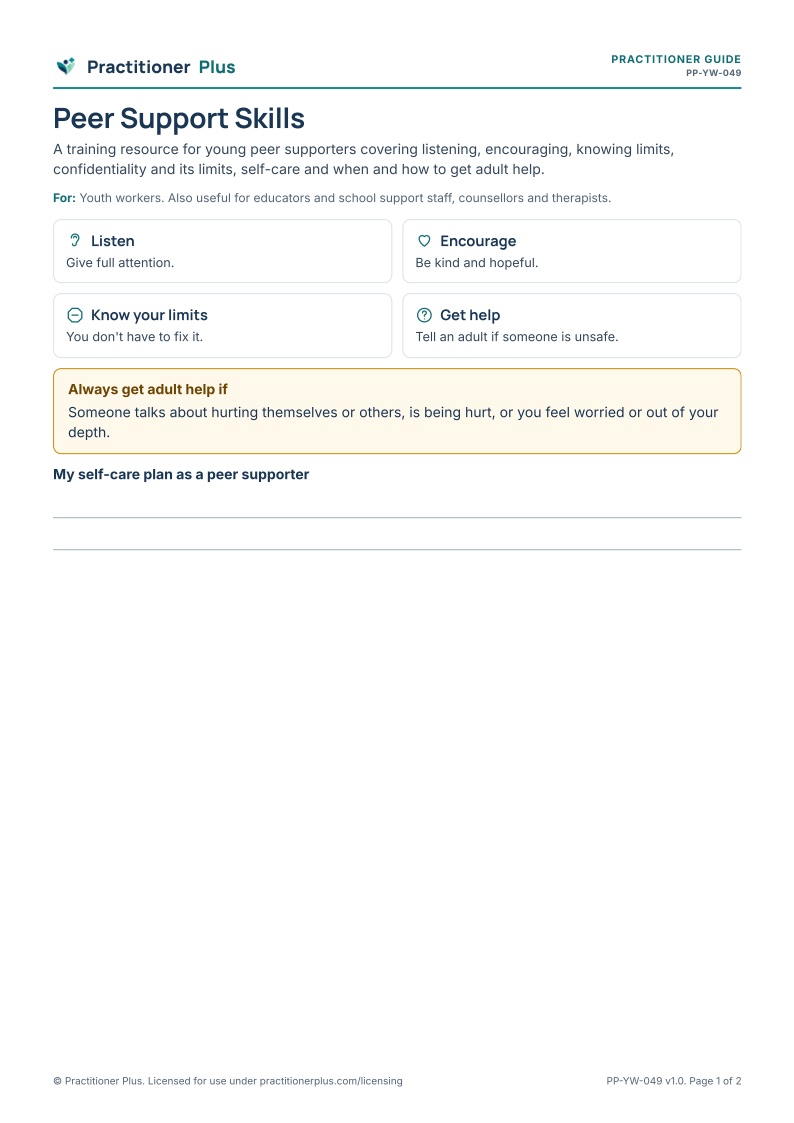
Young people often turn to friends first. This resource trains peer supporters in listening, encouraging, knowing their limits, confidentiality and its limits, looking after themselves and when and how to get adult help.
Purpose
To prepare young people to support peers safely.
Who it is for
Primary profession: Youth workers. Also relevant for educators and school support staff, counsellors and therapists.
Client or participant group: Young people training as peer supporters, and the workers training them.
Practice setting: Youth services and school peer programs.
Suggested uses
- Peer support programs
- Student leadership
- Youth group training
- Mentoring
Instructions for practitioners
- Make clear peer supporters are not counsellors.
- Practise listening skills.
- Be clear about when to get adult help.
- Provide supervision and debriefing.
Accessibility considerations
Use role-play and visuals.
Scope and limitations
A training resource. Peer supporters must have adult supervision and clear referral pathways.
Research basis
Young people are more likely to seek help when they know where to go, trust the person and feel less stigma. School-based social and emotional learning programs improve students' social skills, behaviour and academic results.
- Durlak, J. A., Weissberg, R. P., Dymnicki, A. B., Taylor, R. D., & Schellinger, K. B. (2011). The Impact of Enhancing Students’ Social and Emotional Learning: A Meta-Analysis of School-Based Universal Interventions. Child Development, 82(1), 405–432. https://doi.org/10.1111/j.1467-8624.2010.01564.x
- Rickwood, D., Deane, F. P., Wilson, C. J., & Ciarrochi, J. (2005). Young people’s help-seeking for mental health problems. Australian e-Journal for the Advancement of Mental Health, 4(3), 218–251. https://doi.org/10.5172/jamh.4.3.218
What is included
A 2-page printable A4 PDF, including a practitioner notes page with the research basis (version 1.0).
Originality
Original Practitioner Plus content: wording, activity structure, layout and icons were created for this resource. No third-party worksheets, illustrations or text were reproduced.


