
About this resource
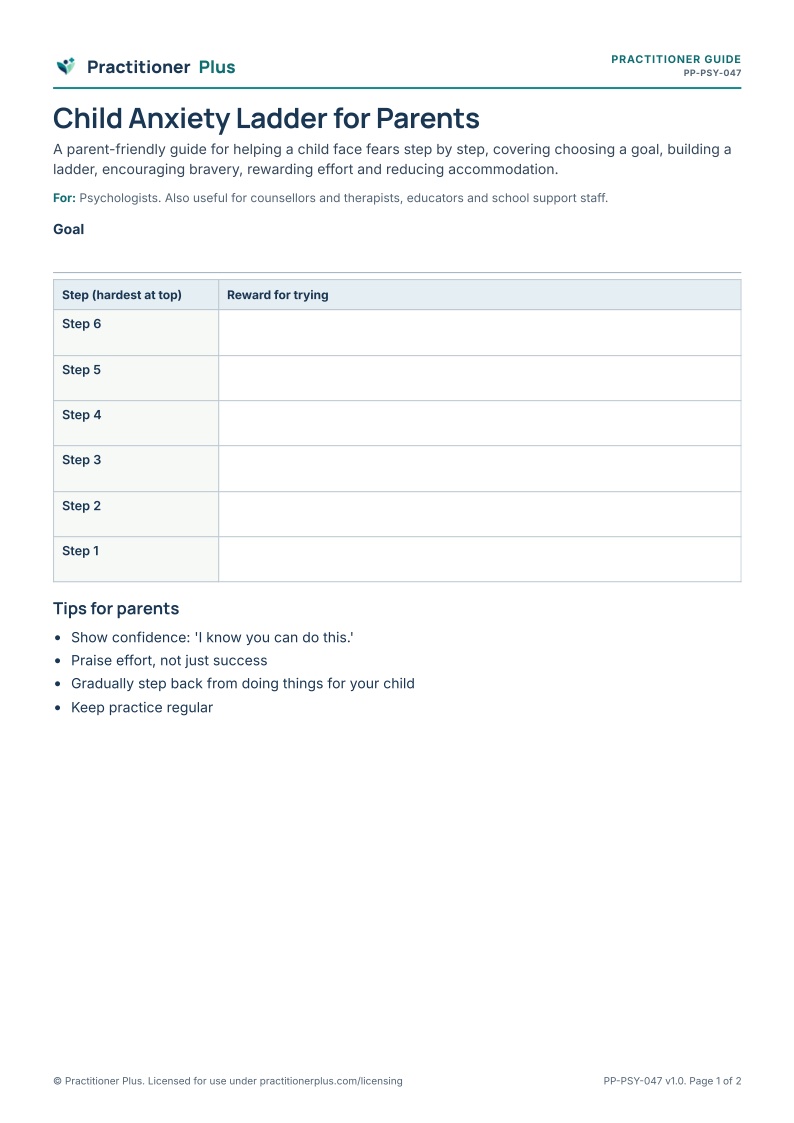
Children overcome fears by facing them step by step with support. This guide helps parents choose a goal, build a ladder with their child, encourage brave behaviour, reward effort and gradually reduce accommodations that keep anxiety going.
Purpose
To help parents support their child to face fears gradually.
Who it is for
Primary profession: Psychologists. Also relevant for counsellors and therapists, educators and school support staff.
Client or participant group: Parents of children aged about 5 to 12 with anxiety, working with a psychologist.
Practice setting: Parent sessions and home practice.
Suggested uses
- Parent-led child anxiety work
- Psychology parent sessions
- Home practice
- School collaboration
Instructions for practitioners
- Build the ladder with the parent and child together.
- Coach parents to express confidence in the child.
- Plan small, regular practice.
- Discuss gradually reducing accommodations.
Instructions for clients or participants
- Choose a goal with your child.
- Build the ladder.
- Practise and praise brave steps.
Accessibility considerations
Use pictures of the ladder with children.
Scope and limitations
An educational guide for use within treatment with a psychologist.
Research basis
Gradual, repeated approach to feared situations is a well-supported part of anxiety treatment; current guidance focuses on learning that feared outcomes are unlikely or manageable, rather than waiting for anxiety to fall. Cognitive behavioural therapy (CBT) has a strong research base for anxiety, depression and many related problems; this resource uses CBT techniques to support, not replace, a structured treatment plan. Parent support that builds positive interactions, consistent responses and emotional communication improves child behaviour and family wellbeing.
- Beck, J. S. (2021). Cognitive behavior therapy: Basics and beyond (3rd ed.). Guilford Press.
- Craske, M. G., Treanor, M., Conway, C. C., Zbozinek, T., & Vervliet, B. (2014). Maximizing exposure therapy: An inhibitory learning approach. Behaviour Research and Therapy, 58, 10–23. https://doi.org/10.1016/j.brat.2014.04.006
- Hofmann, S. G., Asnaani, A., Vonk, I. J. J., Sawyer, A. T., & Fang, A. (2012). The Efficacy of Cognitive Behavioral Therapy: A Review of Meta-analyses. Cognitive Therapy and Research, 36(5), 427–440. https://doi.org/10.1007/s10608-012-9476-1
- Kaminski, J. W., Valle, L. A., Filene, J. H., & Boyle, C. L. (2008). A meta-analytic review of components associated with parent training program effectiveness. Journal of Abnormal Child Psychology, 36(4), 567–589. https://doi.org/10.1007/s10802-007-9201-9
- Kircanski, K., Lieberman, M. D., & Craske, M. G. (2012). Feelings Into Words: Contributions of Language to Exposure Therapy. Psychological Science, 23(10), 1086–1091. https://doi.org/10.1177/0956797612443830
What is included
A 2-page printable A4 PDF, including a practitioner notes page with the research basis (version 1.0).
Originality
Original Practitioner Plus content: wording, activity structure, layout and icons were created for this resource. No third-party worksheets, illustrations or text were reproduced. Reflects widely used parent-supported graded exposure approaches.


