
About this resource
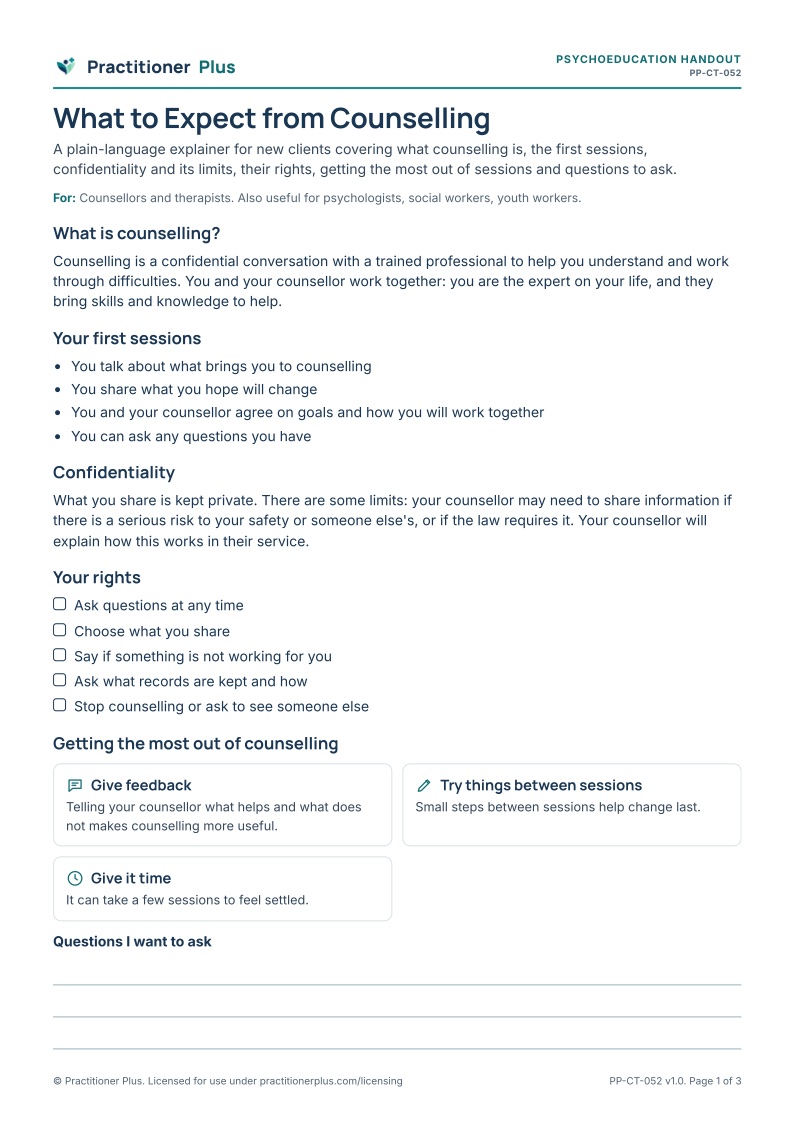
Starting counselling can feel uncertain. Explaining what to expect helps people stay engaged. This explainer covers what counselling is, what happens in the first sessions, confidentiality and when it may need to be broken, the person's rights, how to get the most out of sessions and space for their own questions.
Purpose
To help new clients feel informed and confident to take part in counselling.
Who it is for
Primary profession: Counsellors and therapists. Also relevant for psychologists, social workers, youth workers.
Client or participant group: Adolescents and adults starting counselling or therapy.
Practice setting: Counselling, psychology and community mental health services.
Suggested uses
- Before or at the first session
- Intake packs
- Waiting list information
- Group program orientation
Instructions for practitioners
- Give before or at the first session.
- Explain your own confidentiality limits and organisational policies in person.
- Invite questions and check understanding.
- Ask for feedback early and regularly.
Instructions for clients or participants
- Read the explainer.
- Write down any questions.
- Bring them to your first session.
Accessibility considerations
Plain language. Can be read aloud or provided in other languages with an interpreter.
Scope and limitations
General information. Practitioners must explain their own service's confidentiality, fees and policies, which differ between services.
Research basis
About one in five adults stop therapy early, and a strong working alliance is one of the most consistent predictors of good outcomes, so explaining what to expect and agreeing goals early matters. A strong working alliance and routine progress feedback are among the most consistent predictors of good outcomes in therapy.
- Flückiger, C., Del Re, A. C., Wampold, B. E., & Horvath, A. O. (2018). The alliance in adult psychotherapy: A meta-analytic synthesis. Psychotherapy, 55(4), 316–340. https://doi.org/10.1037/pst0000172
- Lambert, M. J., Whipple, J. L., & Kleinstäuber, M. (2018). Collecting and delivering progress feedback: A meta-analysis of routine outcome monitoring. Psychotherapy, 55(4), 520–537. https://doi.org/10.1037/pst0000167
- Swift, J. K., & Greenberg, R. P. (2012). Premature discontinuation in adult psychotherapy: A meta-analysis. Journal of Consulting and Clinical Psychology, 80(4), 547–559. https://doi.org/10.1037/a0028226
What is included
A 3-page printable A4 PDF, including a practitioner notes page with the research basis (version 1.0).
Originality
Original Practitioner Plus content: wording, activity structure, layout and icons were created for this resource. No third-party worksheets, illustrations or text were reproduced. Written for Practitioner Plus from the research and guidance listed in the research basis; no third-party worksheet was used as a template.


