
About this resource
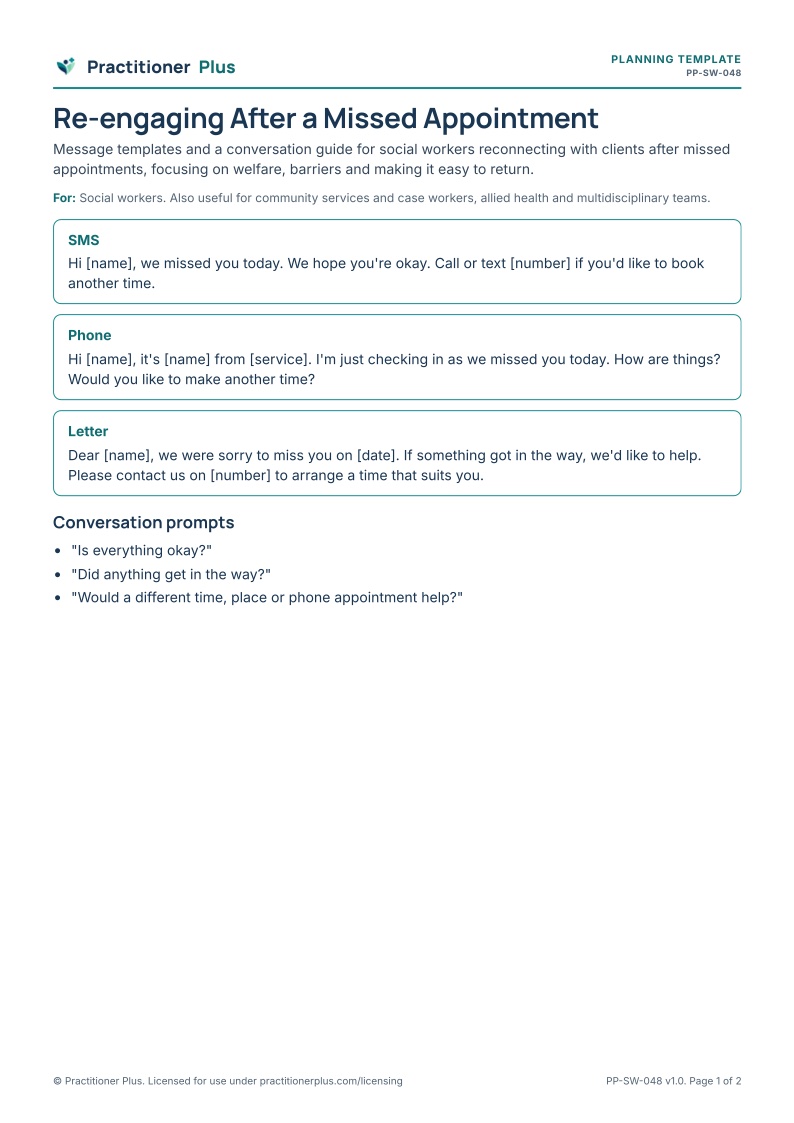
A warm message after a missed appointment can bring people back. This resource provides SMS, phone and letter templates that check on welfare, avoid blame and make it easy to rebook, plus a short conversation guide about barriers.
Purpose
To re-engage clients warmly and understand what got in the way.
Who it is for
Primary profession: Social workers. Also relevant for community services and case workers, allied health and multidisciplinary teams.
Client or participant group: Social workers.
Practice setting: Hospital outpatient, community and mental health services.
Suggested uses
- After missed appointments
- Administrative staff support
- Engagement policies
- Supervision
Instructions for practitioners
- Contact promptly and kindly.
- Avoid blaming language.
- Ask about barriers and adjust.
- Follow your service's welfare check procedures if there are concerns.
Accessibility considerations
Use the client's preferred contact method and language.
Scope and limitations
Communication templates. Follow your service's engagement and duty of care procedures.
Research basis
Case management practice standards describe assessment, planning, coordination, review and planned exits with the person at the centre. A strong working alliance and routine progress feedback are among the most consistent predictors of good outcomes in therapy.
- Case Management Society of Australia and New Zealand. (2013). National standards of practice for case management (3rd ed.). https://www.cmsa.org.au/
- Flückiger, C., Del Re, A. C., Wampold, B. E., & Horvath, A. O. (2018). The alliance in adult psychotherapy: A meta-analytic synthesis. Psychotherapy, 55(4), 316–340. https://doi.org/10.1037/pst0000172
- Lambert, M. J., Whipple, J. L., & Kleinstäuber, M. (2018). Collecting and delivering progress feedback: A meta-analysis of routine outcome monitoring. Psychotherapy, 55(4), 520–537. https://doi.org/10.1037/pst0000167
What is included
A 2-page printable A4 PDF, including a practitioner notes page with the research basis (version 1.0).
Originality
Original Practitioner Plus content: wording, activity structure, layout and icons were created for this resource. No third-party worksheets, illustrations or text were reproduced.


