
About this resource
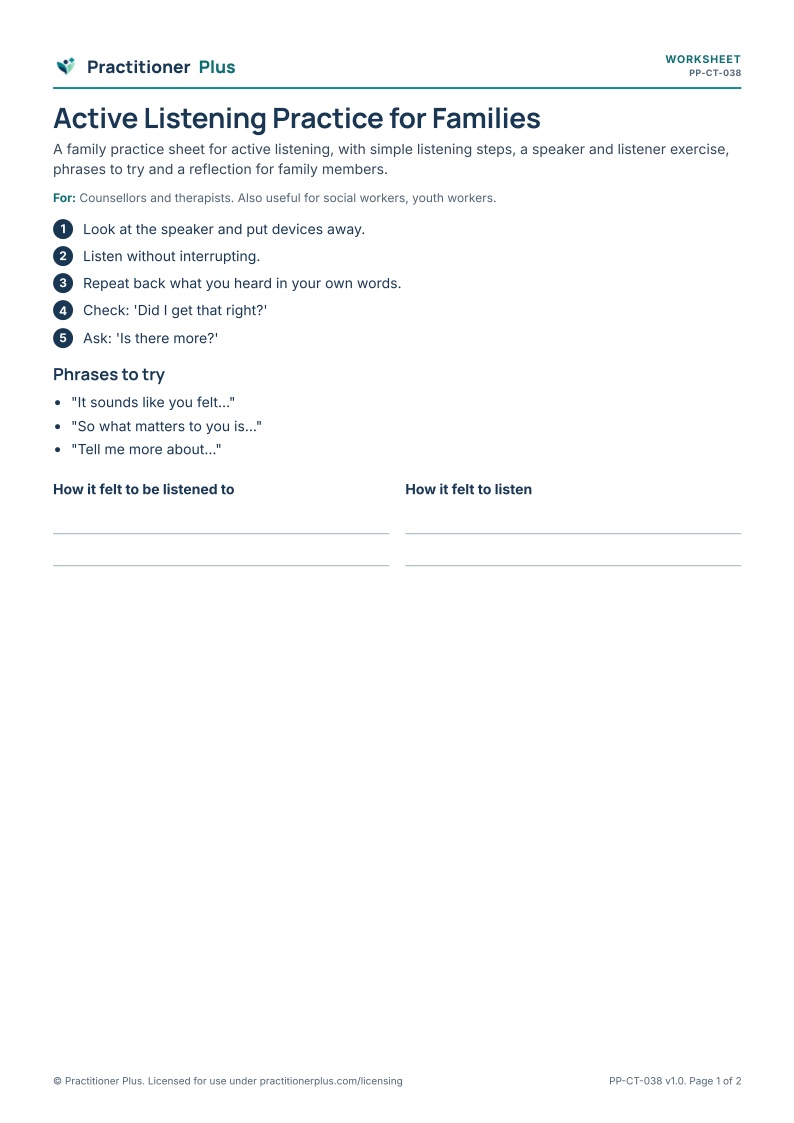
Feeling heard can change family conversations. This sheet teaches simple listening steps, a structured speaker and listener exercise with turns, phrases to try and a reflection on how it felt for each person.
Purpose
To help family members practise listening to understand.
Who it is for
Primary profession: Counsellors and therapists. Also relevant for social workers, youth workers.
Client or participant group: Families, including parents and adolescents, working on communication.
Practice setting: Family counselling and parenting programs.
Suggested uses
- Family counselling
- Parent and adolescent conflict
- Couples work
- Parenting groups
Instructions for practitioners
- Model the exercise first.
- Start with low-conflict topics.
- Coach listeners to reflect, not respond.
- Debrief together.
Instructions for clients or participants
- Take turns as speaker and listener.
- The listener repeats back what they heard.
- Swap and reflect.
Accessibility considerations
Use a talking object to show whose turn it is.
Scope and limitations
A skills activity for use within family counselling. It is not suitable where there is family violence.
Research basis
School-based social and emotional learning programs improve students' social skills, behaviour and academic results. Parent support that builds positive interactions, consistent responses and emotional communication improves child behaviour and family wellbeing.
- Durlak, J. A., Weissberg, R. P., Dymnicki, A. B., Taylor, R. D., & Schellinger, K. B. (2011). The Impact of Enhancing Students’ Social and Emotional Learning: A Meta-Analysis of School-Based Universal Interventions. Child Development, 82(1), 405–432. https://doi.org/10.1111/j.1467-8624.2010.01564.x
- Kaminski, J. W., Valle, L. A., Filene, J. H., & Boyle, C. L. (2008). A meta-analytic review of components associated with parent training program effectiveness. Journal of Abnormal Child Psychology, 36(4), 567–589. https://doi.org/10.1007/s10802-007-9201-9
What is included
A 2-page printable A4 PDF, including a practitioner notes page with the research basis (version 1.0).
Originality
Original Practitioner Plus content: wording, activity structure, layout and icons were created for this resource. No third-party worksheets, illustrations or text were reproduced.


