
About this resource
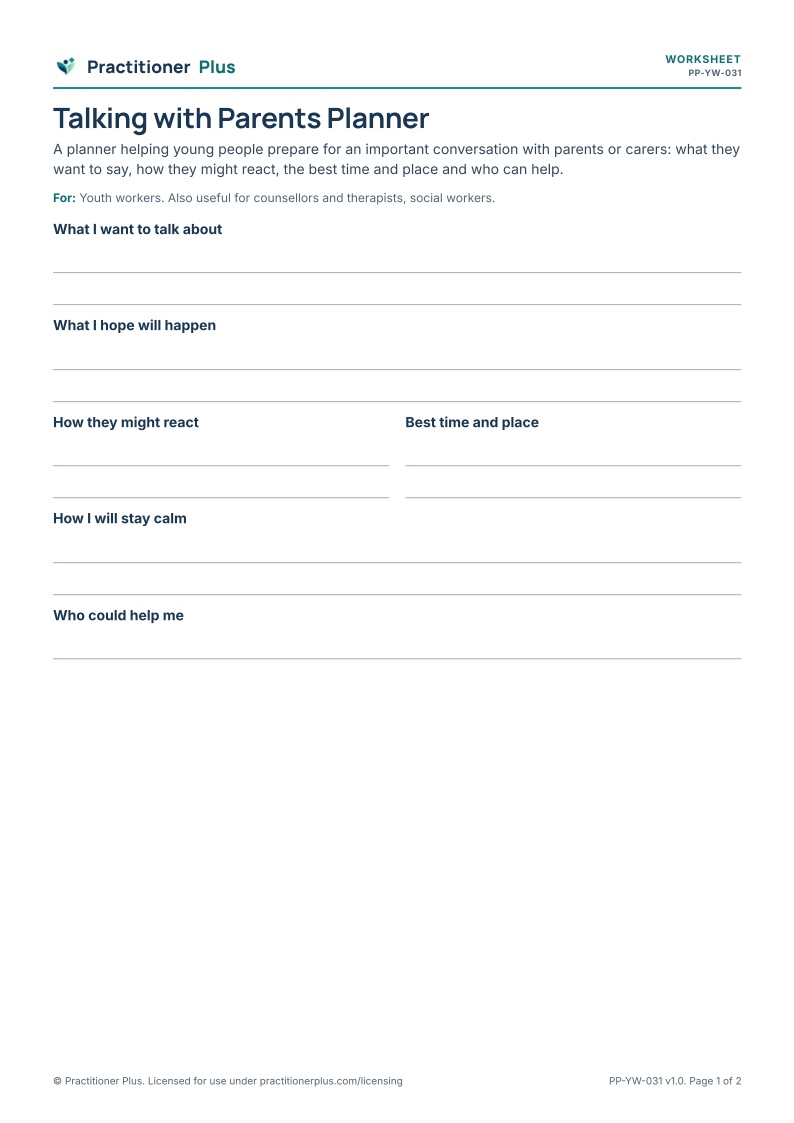
Some conversations with parents or carers feel hard to start. This planner helps young people think about what they want to say, what they hope will happen, how their parent might react, the best time and place, how to stay calm and who could help.
Purpose
To help young people plan conversations with parents or carers.
Who it is for
Primary profession: Youth workers. Also relevant for counsellors and therapists, social workers.
Client or participant group: Young people aged about 12 to 18.
Practice setting: Youth services, schools and counselling.
Suggested uses
- Preparing for difficult conversations
- Family conflict
- Sharing news or worries
- Asking for support
Instructions for practitioners
- Help the young person think through the conversation.
- Consider safety: if talking to a parent may not be safe, plan differently.
- Offer to support or attend if appropriate.
- Follow child safety procedures if harm is disclosed.
Instructions for clients or participants
- Write what you want to say.
- Think about the best time and place.
- Plan how you will stay calm.
Accessibility considerations
Can be discussed rather than written.
Scope and limitations
A planning tool. It is not for situations where talking to a parent may be unsafe.
Research basis
School-based social and emotional learning programs improve students' social skills, behaviour and academic results.
- Durlak, J. A., Weissberg, R. P., Dymnicki, A. B., Taylor, R. D., & Schellinger, K. B. (2011). The Impact of Enhancing Students’ Social and Emotional Learning: A Meta-Analysis of School-Based Universal Interventions. Child Development, 82(1), 405–432. https://doi.org/10.1111/j.1467-8624.2010.01564.x
What is included
A 2-page printable A4 PDF, including a practitioner notes page with the research basis (version 1.0).
Originality
Original Practitioner Plus content: wording, activity structure, layout and icons were created for this resource. No third-party worksheets, illustrations or text were reproduced.


