
About this resource
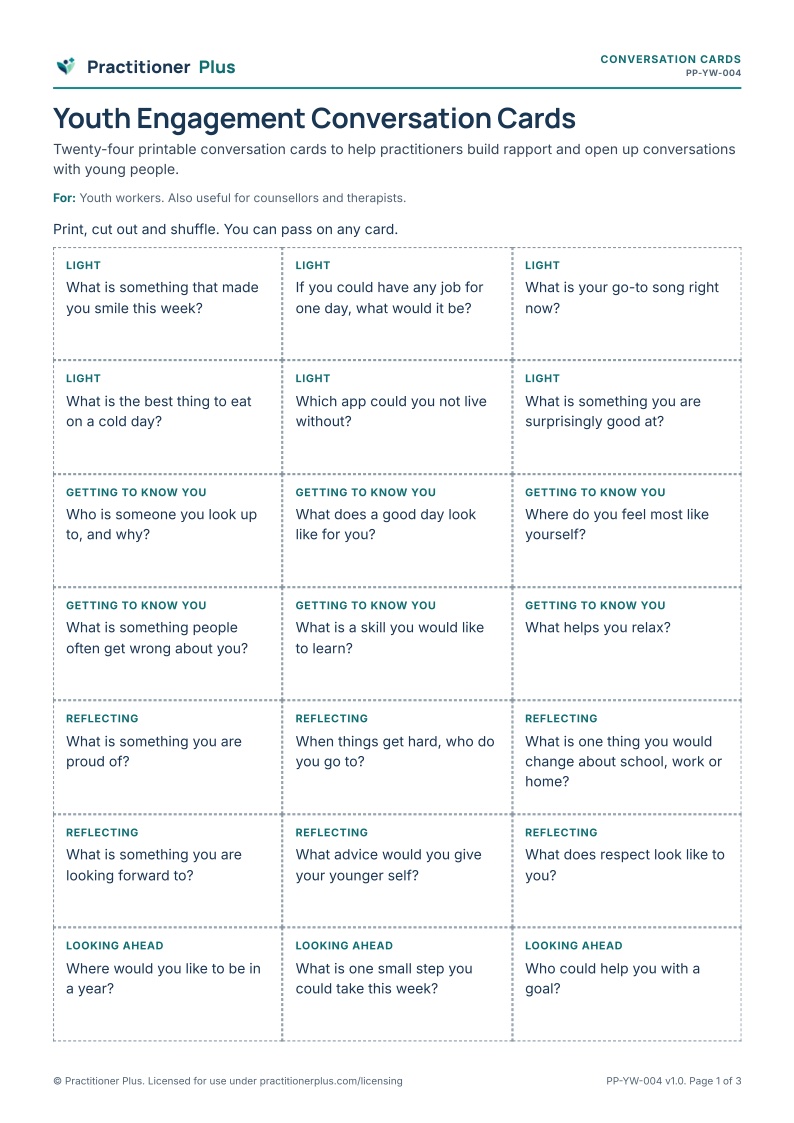
Conversation cards offer an easy, low-pressure way to start talking. These printable cards move from light questions to more reflective ones, and young people can choose which cards to answer or skip.
Purpose
To build rapport through low-pressure, choice-based conversation.
Who it is for
Primary profession: Youth workers. Also relevant for counsellors and therapists.
Client or participant group: Young people aged about 12 to 25, used with a youth worker, counsellor or educator.
Practice setting: Youth services, schools and outreach.
Suggested uses
- Building rapport in early sessions
- Warm-ups for group programmes
- Walk-and-talk or activity-based sessions
- Exploring interests, values and goals
Instructions for practitioners
- Print and cut out the cards.
- Let the young person shuffle and choose cards, or pick from a spread.
- Remind them they can pass on any card.
- Share your own light answers where appropriate, to model openness.
Instructions for clients or participants
- Pick a card.
- Answer it, or pass.
Accessibility considerations
Cards can be read aloud, and young people can pass on any card.
Scope and limitations
Some questions may bring up difficult experiences. Let the young person lead, respect a pass, and be ready to follow up safely if something concerning is shared.
Research basis
Young people are more likely to seek help when they know where to go, trust the person and feel less stigma. A strong working alliance and routine progress feedback are among the most consistent predictors of good outcomes in therapy.
- Flückiger, C., Del Re, A. C., Wampold, B. E., & Horvath, A. O. (2018). The alliance in adult psychotherapy: A meta-analytic synthesis. Psychotherapy, 55(4), 316–340. https://doi.org/10.1037/pst0000172
- Lambert, M. J., Whipple, J. L., & Kleinstäuber, M. (2018). Collecting and delivering progress feedback: A meta-analysis of routine outcome monitoring. Psychotherapy, 55(4), 520–537. https://doi.org/10.1037/pst0000167
- Rickwood, D., Deane, F. P., Wilson, C. J., & Ciarrochi, J. (2005). Young people’s help-seeking for mental health problems. Australian e-Journal for the Advancement of Mental Health, 4(3), 218–251. https://doi.org/10.5172/jamh.4.3.218
What is included
A 3-page printable A4 PDF, including a practitioner notes page with the research basis (version 1.0).
Originality
Original Practitioner Plus content: wording, activity structure and layout were created for this resource. No third-party worksheets, illustrations or text were reproduced.


