
About this resource
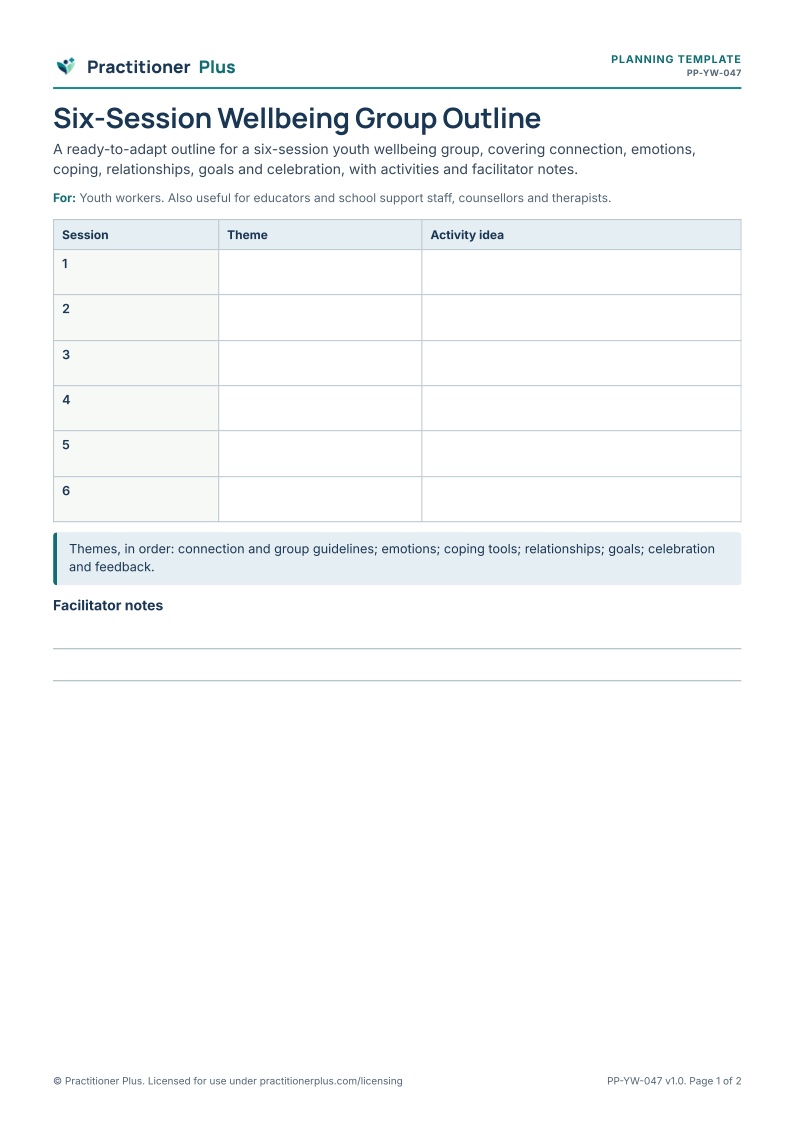
Groups can build connection and skills. This outline provides six sessions on connection, emotions, coping, relationships, goals and celebration, each with aims, activities, discussion prompts and facilitator notes.
Purpose
To provide a structured, flexible wellbeing group program.
Who it is for
Primary profession: Youth workers. Also relevant for educators and school support staff, counsellors and therapists.
Client or participant group: Youth workers running groups for young people aged about 12 to 18.
Practice setting: Youth services and schools.
Suggested uses
- Youth wellbeing groups
- School programs
- Holiday programs
- Peer support
Instructions for practitioners
- Adapt to the group's interests and culture.
- Agree group guidelines in session one.
- Plan for disclosures and referrals.
- Gather feedback at the end.
Accessibility considerations
Use varied activities: talking, drawing, movement.
Scope and limitations
A group outline. Adapt to your setting and follow child safety procedures.
Research basis
Group programs work through shared experience, belonging and practising skills with others. Young people are more likely to seek help when they know where to go, trust the person and feel less stigma.
- Rickwood, D., Deane, F. P., Wilson, C. J., & Ciarrochi, J. (2005). Young people’s help-seeking for mental health problems. Australian e-Journal for the Advancement of Mental Health, 4(3), 218–251. https://doi.org/10.5172/jamh.4.3.218
- Yalom, I. D., & Leszcz, M. (2005). The theory and practice of group psychotherapy (5th ed.). Basic Books.
What is included
A 2-page printable A4 PDF, including a practitioner notes page with the research basis (version 1.0).
Originality
Original Practitioner Plus content: wording, activity structure, layout and icons were created for this resource. No third-party worksheets, illustrations or text were reproduced.


