
About this resource
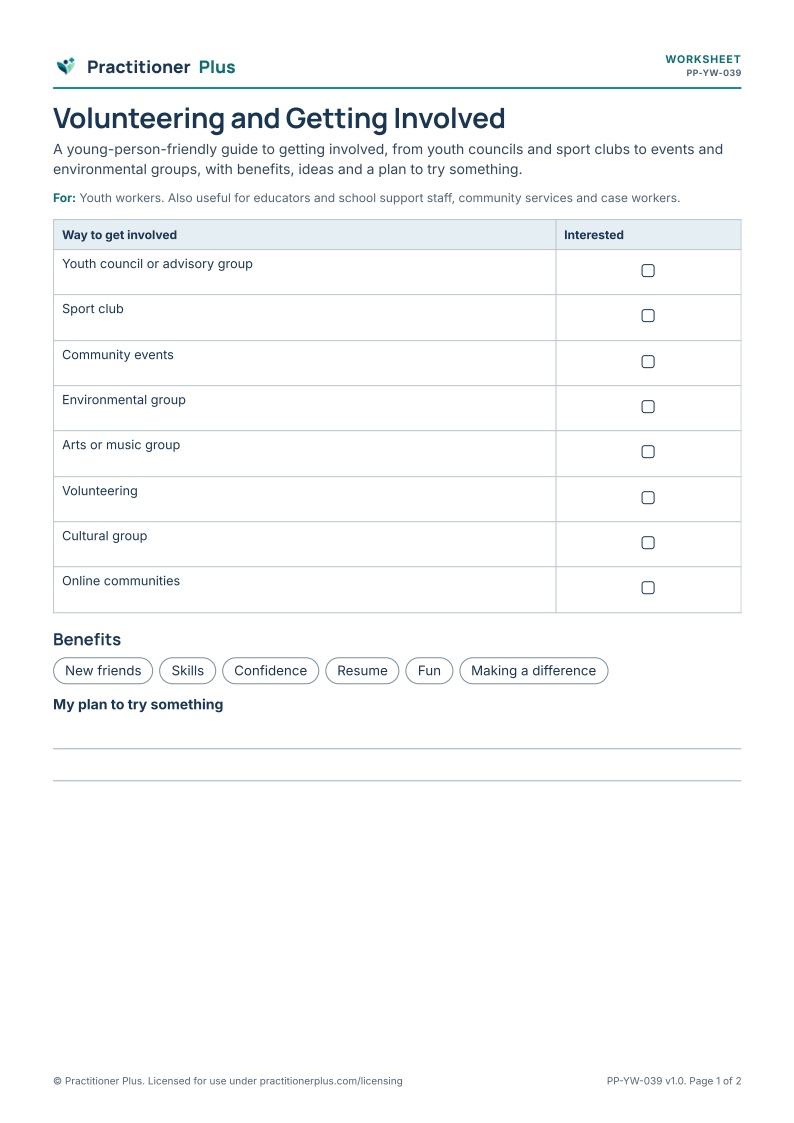
Getting involved builds skills, friendships and confidence. This guide shows ways young people can get involved, such as youth councils, sport clubs, events, environmental groups and volunteering, the benefits and a simple plan to try something.
Purpose
To help young people find ways to get involved in their community.
Who it is for
Primary profession: Youth workers. Also relevant for educators and school support staff, community services and case workers.
Client or participant group: Young people aged about 12 to 25.
Practice setting: Youth services, schools and community programs.
Suggested uses
- Youth engagement
- Building connection
- Resume building
- Group programs
Instructions for practitioners
- Explore the young person's interests.
- Share local opportunities.
- Address barriers such as cost and transport.
- Follow up.
Instructions for clients or participants
- Tick what interests you.
- Find out more.
- Try something.
Accessibility considerations
Can be completed on a phone.
Scope and limitations
An engagement resource.
Research basis
Occupational therapy models describe how the person, their environment and their activities interact, and how a balance of meaningful activity supports health and participation.
- Law, M., Cooper, B., Strong, S., Stewart, D., Rigby, P., & Letts, L. (1996). The Person-Environment-Occupation Model: A Transactive Approach to Occupational Performance. Canadian Journal of Occupational Therapy, 63(1), 9–23. https://doi.org/10.1177/000841749606300103
- Wagman, P., Håkansson, C., & Björklund, A. (2012). Occupational balance as used in occupational therapy: A concept analysis. Scandinavian Journal of Occupational Therapy, 19(4), 322–327. https://doi.org/10.3109/11038128.2011.596219
- World Health Organization. (2001). International classification of functioning, disability and health (ICF). WHO. https://www.who.int/standards/classifications/international-classification-of-functioning-disability-and-health
What is included
A 2-page printable A4 PDF, including a practitioner notes page with the research basis (version 1.0).
Originality
Original Practitioner Plus content: wording, activity structure, layout and icons were created for this resource. No third-party worksheets, illustrations or text were reproduced.


