
About this resource
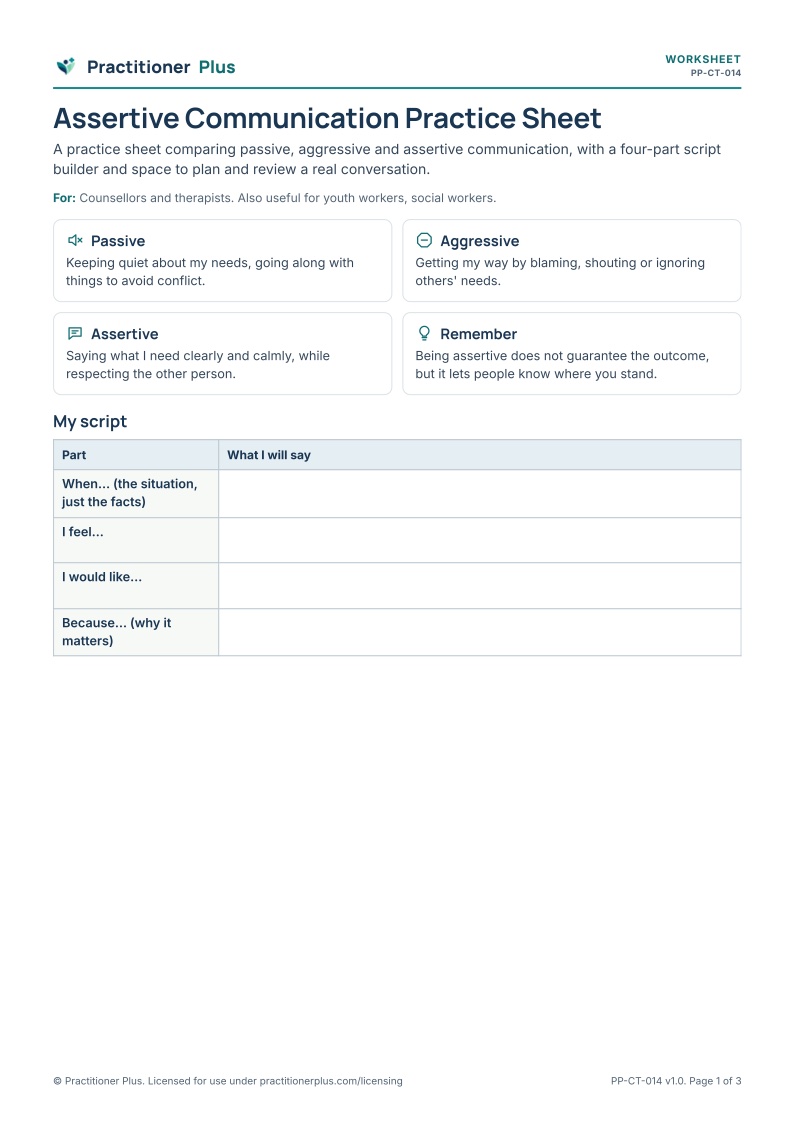
Assertive communication means stating your needs and limits clearly while respecting others. This sheet compares three styles, then helps clients build a script describing the situation, how they feel, what they would like and why it matters. They can plan a real conversation and review how it went.
Purpose
To help clients plan and practise clear, respectful communication of needs and limits.
Who it is for
Primary profession: Counsellors and therapists. Also relevant for youth workers, social workers.
Client or participant group: Adolescents and adults who want to express needs and limits more clearly.
Practice setting: Individual or group counselling.
Suggested uses
- Practising for a difficult conversation
- Role-play in sessions
- Group skills programs
- Building confidence with boundaries
Instructions for practitioners
- Explore what makes assertiveness hard for this client, including culture and past experiences.
- Practise the script through role-play.
- Start with lower-stakes conversations.
- Consider safety: assertiveness is not always safe, for example where there is family violence or coercive control.
Instructions for clients or participants
- Read the three styles.
- Build your script.
- Practise it, then try it in a real conversation.
Accessibility considerations
Can be practised verbally. Scripts can be written on cards.
Scope and limitations
A skills worksheet. It is not designed for conversations where there is a risk of violence or abuse; seek specialist support in those situations.
Research basis
Cognitive behavioural therapy (CBT) has a strong research base for anxiety, depression and many related problems; this resource uses CBT techniques to support, not replace, a structured treatment plan. Brief psychoeducation can reduce symptoms of depression and psychological distress.
- Beck, J. S. (2021). Cognitive behavior therapy: Basics and beyond (3rd ed.). Guilford Press.
- Donker, T., Griffiths, K. M., Cuijpers, P., & Christensen, H. (2009). Psychoeducation for depression, anxiety and psychological distress: a meta-analysis. BMC Medicine, 7(1), 79. https://doi.org/10.1186/1741-7015-7-79
- Hofmann, S. G., Asnaani, A., Vonk, I. J. J., Sawyer, A. T., & Fang, A. (2012). The Efficacy of Cognitive Behavioral Therapy: A Review of Meta-analyses. Cognitive Therapy and Research, 36(5), 427–440. https://doi.org/10.1007/s10608-012-9476-1
What is included
A 3-page printable A4 PDF, including a practitioner notes page with the research basis (version 1.0).
Originality
Original Practitioner Plus content: wording, activity structure, layout and icons were created for this resource. No third-party worksheets, illustrations or text were reproduced.


