
About this resource
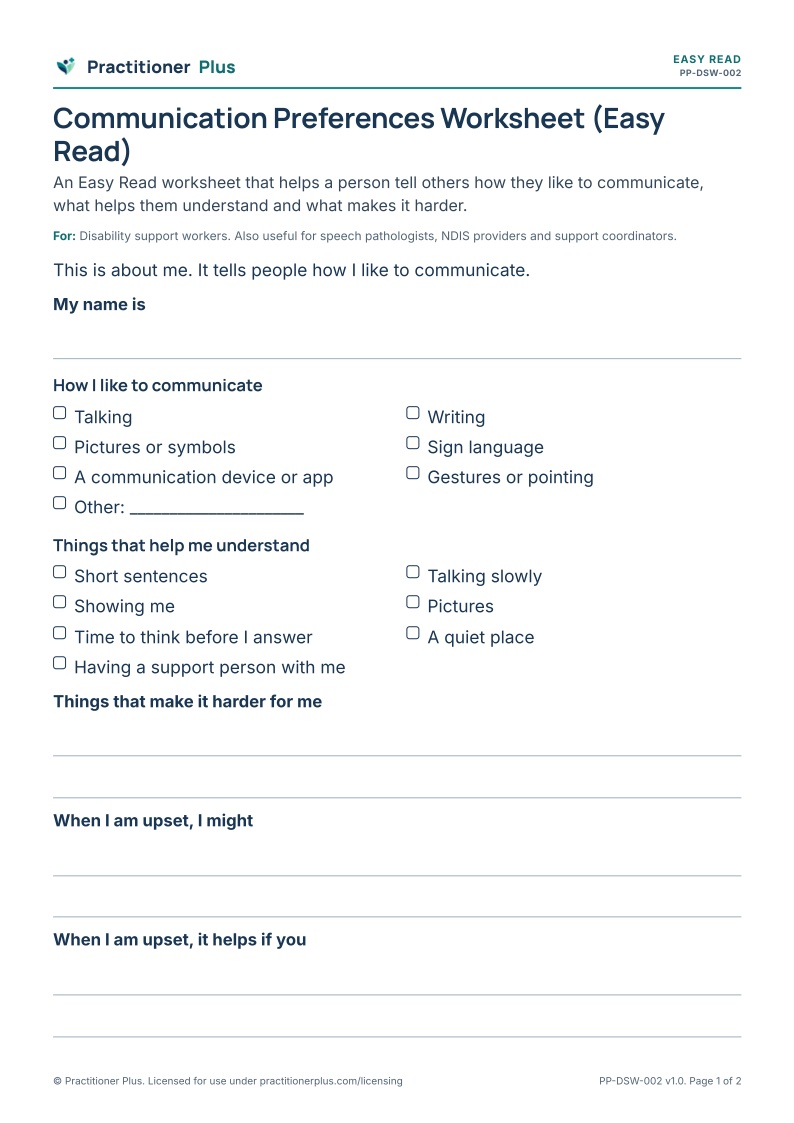
This Easy Read worksheet uses short sentences and simple choices to help people share how they like to communicate. It can be shared with support workers, services and new practitioners, so everyone knows what helps.
Purpose
To help the person tell others how they communicate and what helps them understand.
Who it is for
Primary profession: Disability support workers. Also relevant for speech pathologists, NDIS providers and support coordinators.
Client or participant group: Adults and young people, especially people with disability, completed with a support person.
Practice setting: Getting to know a person at the start of support, and team handovers.
Suggested uses
- Getting to know someone at the start of support
- Preparing for a new service, worker or appointment
- Including in a support plan, with the person's consent
- Reviewing communication supports over time
Instructions for practitioners
- Complete the worksheet with the person, at their pace.
- Read each question aloud if that helps, and offer choices.
- Use the person's own words wherever possible.
- Ask the person who they would like to share the worksheet with.
Instructions for clients or participants
- Tick how you like to communicate.
- Tick what helps you understand.
- Choose who can see this page.
Accessibility considerations
Easy Read style. Needs testing with Easy Read users and supporting images before publication.
Scope and limitations
This draft has not been tested with Easy Read users. Before publishing, test it with people who use Easy Read, and add supporting images. Some people will prefer other formats, such as symbols, photos or video.
Research basis
Easy Read standards and disability rights frameworks support people's right to accessible information; test Easy Read materials with the people who will use them. Training communication partners improves communication for people who use AAC and people with aphasia.
- Inclusion Europe. (2009). Information for all: European standards for making information easy to read and understand. https://www.inclusion-europe.eu/easy-to-read-standards-guidelines/
- Kent-Walsh, J., Murza, K. A., Malani, M. D., & Binger, C. (2015). Effects of Communication Partner Instruction on the Communication of Individuals using AAC: A Meta-Analysis. Augmentative and Alternative Communication, 31(4), 271–284. https://doi.org/10.3109/07434618.2015.1052153
- Simmons-Mackie, N., Raymer, A., & Cherney, L. R. (2016). Communication Partner Training in Aphasia: An Updated Systematic Review. Archives of Physical Medicine and Rehabilitation, 97(12), 2202–2221.e8. https://doi.org/10.1016/j.apmr.2016.03.023
- United Nations. (2006). Convention on the Rights of Persons with Disabilities. https://www.ohchr.org/en/instruments-mechanisms/instruments/convention-rights-persons-disabilities
What is included
A 2-page printable A4 PDF, including a practitioner notes page with the research basis (version 1.0).
Originality
Original Practitioner Plus content: wording, activity structure and layout were created for this resource. No third-party worksheets, illustrations or text were reproduced.


