
About this resource
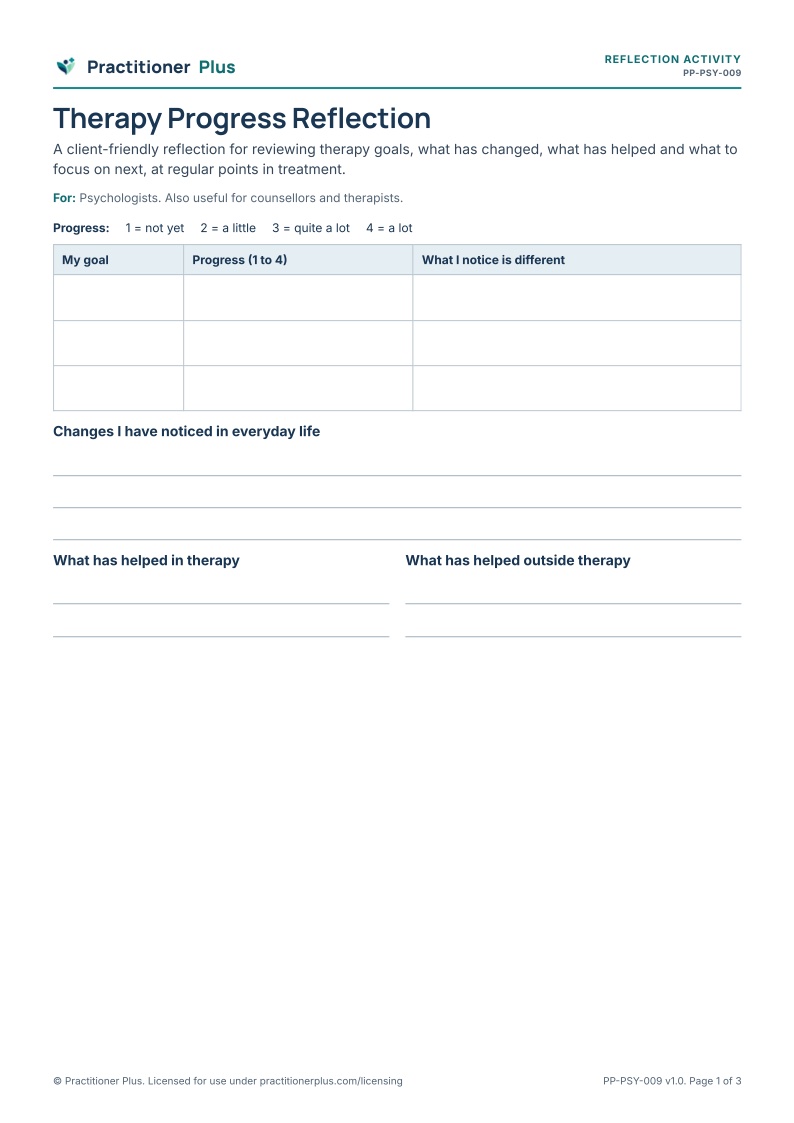
Pausing to review progress helps clients and practitioners stay on track. This reflection invites clients to rate progress on their own goals, notice what has changed in daily life, identify what has helped in and outside therapy, and decide what to focus on next.
Purpose
To make progress reviews collaborative and to keep treatment focused on what matters to the client.
Who it is for
Primary profession: Psychologists. Also relevant for counsellors and therapists.
Client or participant group: Adolescents and adults in psychological therapy.
Practice setting: Review points in individual therapy, such as every six sessions or before planning further sessions.
Suggested uses
- Regular review points in therapy
- Planning further sessions or a change in approach
- Preparing for the end of therapy
- Celebrating progress with the client
Instructions for practitioners
- Invite the client to complete the reflection before or during a review session.
- Discuss differences between the client's view and your own observations.
- Use the reflection to agree next steps, including adjusting or ending treatment.
- Use validated outcome measures separately where your practice requires them.
Instructions for clients or participants
- Rate how each goal is going.
- Think about what has changed in your everyday life.
- Note what has helped, and what you want to focus on next.
Accessibility considerations
Ratings use a simple four-point visual scale. Can be completed verbally in session.
Scope and limitations
A reflective review tool. It is not a validated outcome measure and does not replace standardised measures where they are required.
Research basis
A strong working alliance and routine progress feedback are among the most consistent predictors of good outcomes in therapy. Specific goals, if-then plans and regular progress monitoring all improve the chances of reaching goals.
- Flückiger, C., Del Re, A. C., Wampold, B. E., & Horvath, A. O. (2018). The alliance in adult psychotherapy: A meta-analytic synthesis. Psychotherapy, 55(4), 316–340. https://doi.org/10.1037/pst0000172
- Gollwitzer, P. M., & Sheeran, P. (2006). Implementation Intentions and Goal Achievement: A Meta‐analysis of Effects and Processes. Advances in Experimental Social Psychology, 69–119. https://doi.org/10.1016/s0065-2601(06)38002-1
- Harkin, B., Webb, T. L., Chang, B. P. I., Prestwich, A., Conner, M., Kellar, I., Benn, Y., & Sheeran, P. (2016). Does monitoring goal progress promote goal attainment? A meta-analysis of the experimental evidence. Psychological Bulletin, 142(2), 198–229. https://doi.org/10.1037/bul0000025
- Lambert, M. J., Whipple, J. L., & Kleinstäuber, M. (2018). Collecting and delivering progress feedback: A meta-analysis of routine outcome monitoring. Psychotherapy, 55(4), 520–537. https://doi.org/10.1037/pst0000167
- Locke, E. A., & Latham, G. P. (2002). Building a practically useful theory of goal setting and task motivation: A 35-year odyssey. American Psychologist, 57(9), 705–717. https://doi.org/10.1037/0003-066x.57.9.705
What is included
A 3-page printable A4 PDF, including a practitioner notes page with the research basis (version 1.0).
Originality
Original Practitioner Plus content: wording, activity structure, layout and icons were created for this resource. No third-party worksheets, illustrations or text were reproduced.


