
About this resource
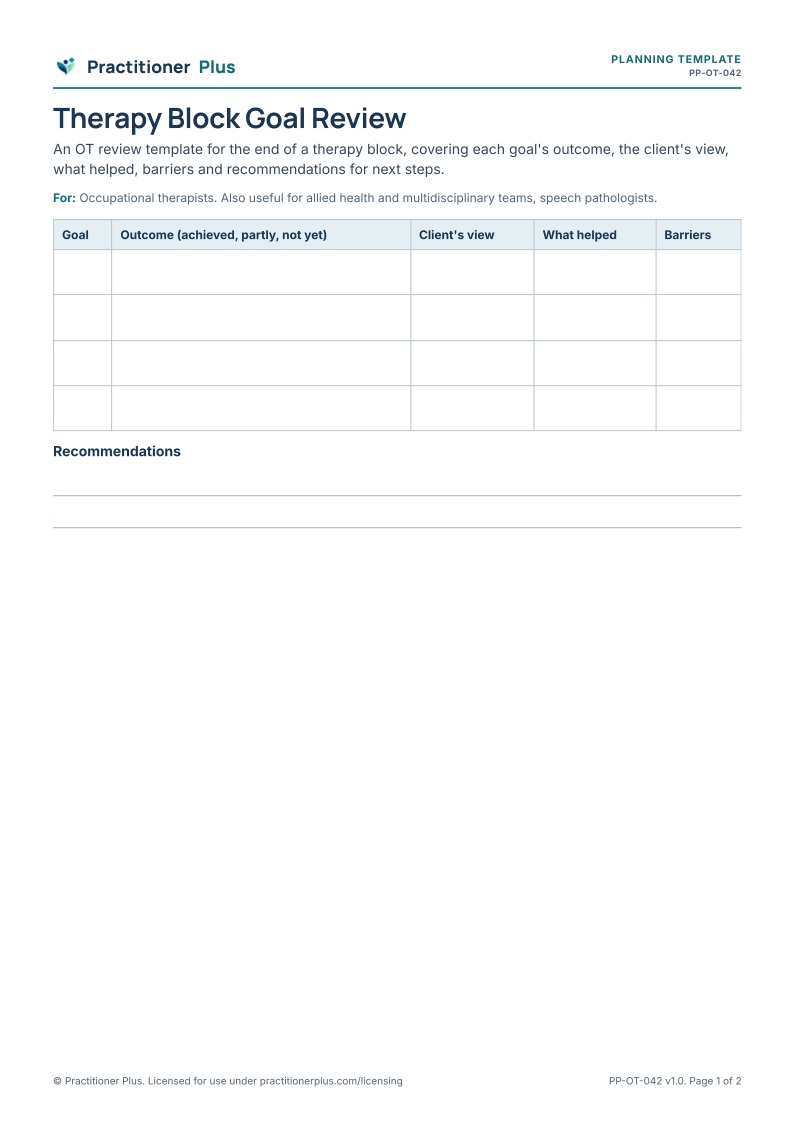
Reviewing goals together shows progress and guides next steps. This template records each goal, its outcome, the client's view, what helped, barriers and recommendations, such as continuing, changing focus or finishing therapy.
Purpose
To review goals collaboratively and plan next steps.
Who it is for
Primary profession: Occupational therapists. Also relevant for allied health and multidisciplinary teams, speech pathologists.
Client or participant group: Occupational therapists and clients.
Practice setting: End of therapy blocks.
Suggested uses
- End of therapy blocks
- Reports
- Funding reviews
- Supervision
Instructions for practitioners
- Review with the client, not just about them.
- Use measures agreed at the start.
- Record barriers honestly.
- Agree next steps together.
Accessibility considerations
Plain-language version for clients.
Scope and limitations
A review template.
Research basis
A strong working alliance and routine progress feedback are among the most consistent predictors of good outcomes in therapy. Specific goals, if-then plans and regular progress monitoring all improve the chances of reaching goals.
- Flückiger, C., Del Re, A. C., Wampold, B. E., & Horvath, A. O. (2018). The alliance in adult psychotherapy: A meta-analytic synthesis. Psychotherapy, 55(4), 316–340. https://doi.org/10.1037/pst0000172
- Gollwitzer, P. M., & Sheeran, P. (2006). Implementation Intentions and Goal Achievement: A Meta‐analysis of Effects and Processes. Advances in Experimental Social Psychology, 69–119. https://doi.org/10.1016/s0065-2601(06)38002-1
- Harkin, B., Webb, T. L., Chang, B. P. I., Prestwich, A., Conner, M., Kellar, I., Benn, Y., & Sheeran, P. (2016). Does monitoring goal progress promote goal attainment? A meta-analysis of the experimental evidence. Psychological Bulletin, 142(2), 198–229. https://doi.org/10.1037/bul0000025
- Lambert, M. J., Whipple, J. L., & Kleinstäuber, M. (2018). Collecting and delivering progress feedback: A meta-analysis of routine outcome monitoring. Psychotherapy, 55(4), 520–537. https://doi.org/10.1037/pst0000167
- Locke, E. A., & Latham, G. P. (2002). Building a practically useful theory of goal setting and task motivation: A 35-year odyssey. American Psychologist, 57(9), 705–717. https://doi.org/10.1037/0003-066x.57.9.705
What is included
A 2-page printable A4 PDF, including a practitioner notes page with the research basis (version 1.0).
Originality
Original Practitioner Plus content: wording, activity structure, layout and icons were created for this resource. No third-party worksheets, illustrations or text were reproduced.


