
About this resource
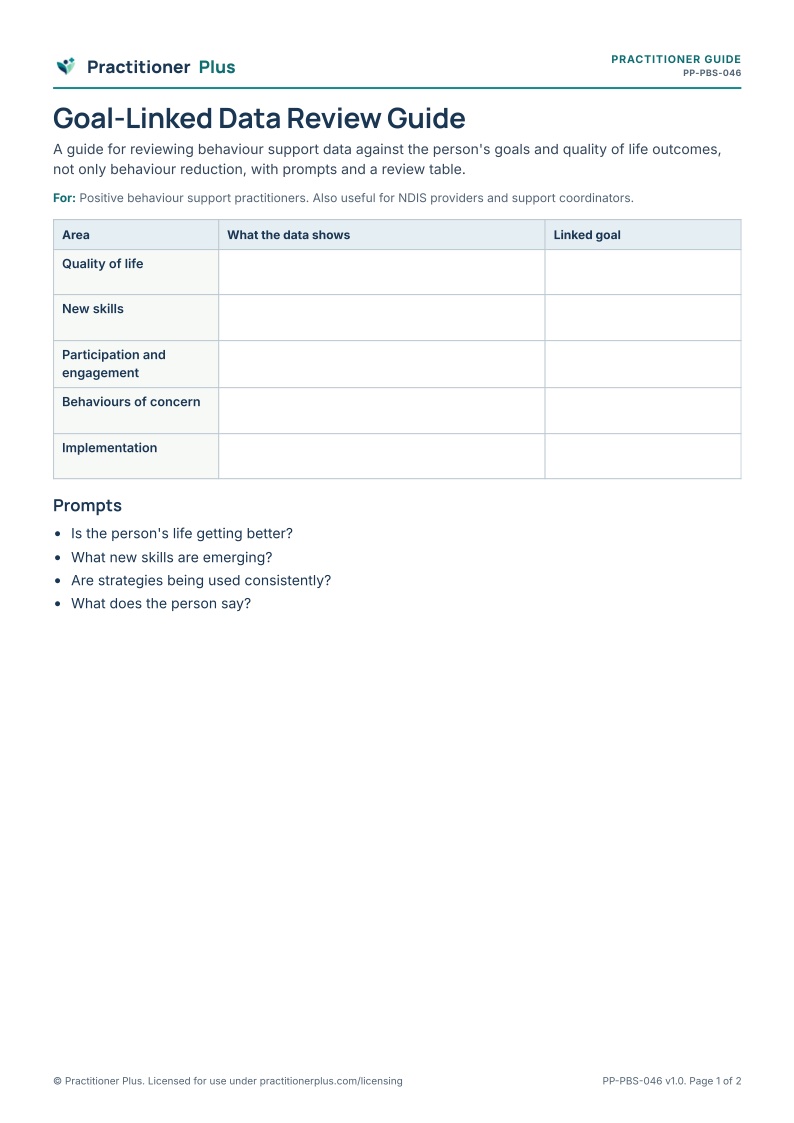
Success in behaviour support is a better life, not just fewer incidents. This guide prompts practitioners to review data against the person's goals, quality of life outcomes, skill development and implementation, as well as behaviours of concern.
Purpose
To keep data review focused on what matters to the person.
Who it is for
Primary profession: Positive behaviour support practitioners. Also relevant for NDIS providers and support coordinators.
Client or participant group: Behaviour support practitioners.
Practice setting: Plan reviews and progress reports.
Suggested uses
- Plan reviews
- Progress reports
- Team meetings
- Supervision
Instructions for practitioners
- Start with the person's goals.
- Look at quality of life and skills as well as behaviour.
- Consider implementation before judging strategies.
- Share findings in accessible ways.
Accessibility considerations
Use accessible graphs and summaries for the person and family.
Scope and limitations
A practice guide.
Research basis
Understanding what happens before and after behaviour is the basis of functional assessment, which guides support. Person-centred planning shows positive but limited evidence of improving community participation and everyday choice for people with intellectual disability. Specific goals, if-then plans and regular progress monitoring all improve the chances of reaching goals.
- Gollwitzer, P. M., & Sheeran, P. (2006). Implementation Intentions and Goal Achievement: A Meta‐analysis of Effects and Processes. Advances in Experimental Social Psychology, 69–119. https://doi.org/10.1016/s0065-2601(06)38002-1
- Hanley, G. P., Iwata, B. A., & McCord, B. E. (2003). FUNCTIONAL ANALYSIS OF PROBLEM BEHAVIOR: A REVIEW. Journal of Applied Behavior Analysis, 36(2), 147–185. https://doi.org/10.1901/jaba.2003.36-147
- Harkin, B., Webb, T. L., Chang, B. P. I., Prestwich, A., Conner, M., Kellar, I., Benn, Y., & Sheeran, P. (2016). Does monitoring goal progress promote goal attainment? A meta-analysis of the experimental evidence. Psychological Bulletin, 142(2), 198–229. https://doi.org/10.1037/bul0000025
- Locke, E. A., & Latham, G. P. (2002). Building a practically useful theory of goal setting and task motivation: A 35-year odyssey. American Psychologist, 57(9), 705–717. https://doi.org/10.1037/0003-066x.57.9.705
- Ratti, V., Hassiotis, A., Crabtree, J., Deb, S., Gallagher, P., & Unwin, G. (2016). The effectiveness of person-centred planning for people with intellectual disabilities: A systematic review. Research in Developmental Disabilities, 57, 63–84. https://doi.org/10.1016/j.ridd.2016.06.015
What is included
A 2-page printable A4 PDF, including a practitioner notes page with the research basis (version 1.0).
Originality
Original Practitioner Plus content: wording, activity structure, layout and icons were created for this resource. No third-party worksheets, illustrations or text were reproduced.


