
About this resource
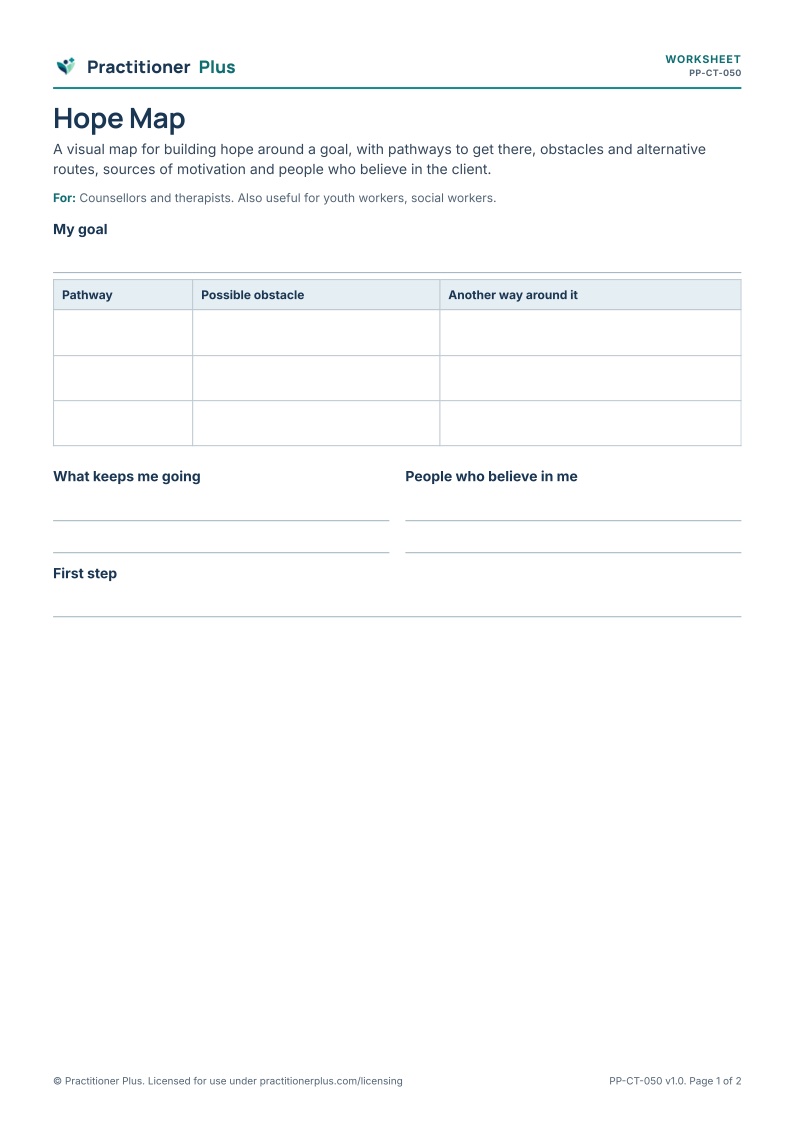
Hope involves having a goal, seeing ways to get there and believing you can. This map helps clients name a goal, map several pathways, anticipate obstacles and alternative routes, identify what keeps them going and the people who believe in them.
Purpose
To strengthen hope by mapping goals, pathways and motivation.
Who it is for
Primary profession: Counsellors and therapists. Also relevant for youth workers, social workers.
Client or participant group: Adolescents and adults who feel stuck or hopeless about the future.
Practice setting: Individual counselling.
Suggested uses
- Low mood and hopelessness
- Goal setting
- Recovery
- Youth work
Instructions for practitioners
- Start with a goal that matters to the client.
- Generate several pathways, not just one.
- Plan for obstacles.
- If hopelessness includes thoughts of suicide, follow risk assessment procedures.
Instructions for clients or participants
- Write your goal.
- Map different paths.
- Write who believes in you.
Accessibility considerations
Can be drawn as a map.
Scope and limitations
A reflective tool for use within counselling. It does not replace risk assessment where hopelessness is present.
Research basis
Gratitude and savouring practices have small but real effects on wellbeing, and are best used alongside support for any difficulties. Specific goals, if-then plans and regular progress monitoring all improve the chances of reaching goals. The strengths model, a recovery-oriented approach, builds on people's own abilities, interests and resources.
- Bryant, F. B., & Veroff, J. (2007). Savoring: A New Model of Positive Experience. Lawrence Erlbaum Associates.
- Davis, D. E., Choe, E., Meyers, J., Wade, N., Varjas, K., Gifford, A., Quinn, A., Hook, J. N., Van Tongeren, D. R., Griffin, B. J., & Worthington, E. L. (2016). Thankful for the little things: A meta-analysis of gratitude interventions. Journal of Counseling Psychology, 63(1), 20–31. https://doi.org/10.1037/cou0000107
- Gollwitzer, P. M., & Sheeran, P. (2006). Implementation Intentions and Goal Achievement: A Meta‐analysis of Effects and Processes. Advances in Experimental Social Psychology, 69–119. https://doi.org/10.1016/s0065-2601(06)38002-1
- Harkin, B., Webb, T. L., Chang, B. P. I., Prestwich, A., Conner, M., Kellar, I., Benn, Y., & Sheeran, P. (2016). Does monitoring goal progress promote goal attainment? A meta-analysis of the experimental evidence. Psychological Bulletin, 142(2), 198–229. https://doi.org/10.1037/bul0000025
- Locke, E. A., & Latham, G. P. (2002). Building a practically useful theory of goal setting and task motivation: A 35-year odyssey. American Psychologist, 57(9), 705–717. https://doi.org/10.1037/0003-066x.57.9.705
- Rapp, C. A., & Goscha, R. J. (2012). The strengths model: A recovery-oriented approach to mental health services (3rd ed.). Oxford University Press.
What is included
A 2-page printable A4 PDF, including a practitioner notes page with the research basis (version 1.0).
Originality
Original Practitioner Plus content: wording, activity structure, layout and icons were created for this resource. No third-party worksheets, illustrations or text were reproduced. Reflects widely described models of hope involving goals, pathways and agency.


