
About this resource
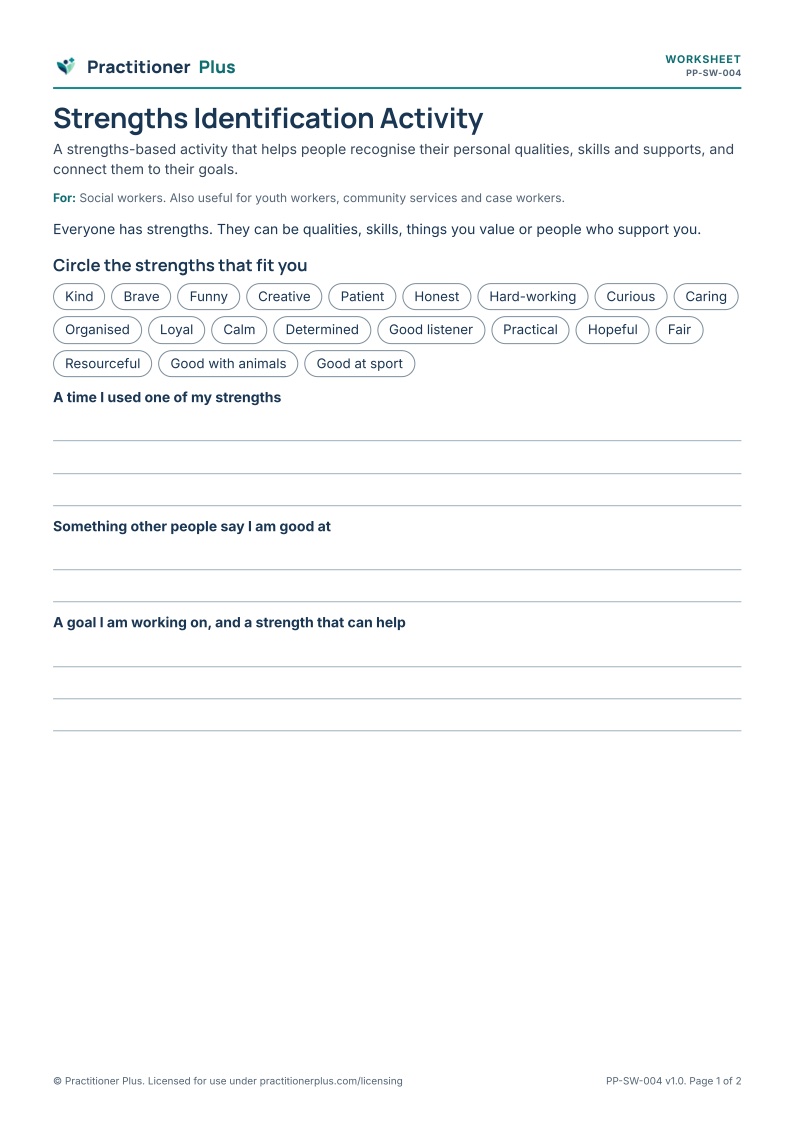
Focusing on strengths can help people feel more capable and hopeful. This activity offers a strengths word bank and prompts to identify strengths in different areas of life, notice them in action and connect them to a current goal.
Purpose
To identify personal strengths and connect them to goals.
Who it is for
Primary profession: Social workers. Also relevant for youth workers, community services and case workers.
Client or participant group: Adolescents and adults, individually or in groups.
Practice setting: Early engagement and strengths-based case planning, individually or in groups.
Suggested uses
- Building rapport and confidence early in support
- Strengths-based case planning
- Group activities in schools or community programmes
- Linking personal strengths to goals
Instructions for practitioners
- Explain that strengths include qualities, skills, values and supports.
- Ask the person to circle strengths that fit, adding their own.
- Explore examples of each strength in action.
- Connect one or two strengths to a current goal.
Instructions for clients or participants
- Circle the strengths that fit you.
- Think of a time you used one.
- Link a strength to a goal.
Accessibility considerations
Offer examples and accept spoken answers.
Scope and limitations
Some people find it hard to name strengths, especially when they are struggling. Offer examples and gently reflect strengths you have noticed, without pushing.
Research basis
The strengths model, a recovery-oriented approach, builds on people's own abilities, interests and resources.
- Rapp, C. A., & Goscha, R. J. (2012). The strengths model: A recovery-oriented approach to mental health services (3rd ed.). Oxford University Press.
What is included
A 2-page printable A4 PDF, including a practitioner notes page with the research basis (version 1.0).
Originality
Original Practitioner Plus content: wording, activity structure and layout were created for this resource. No third-party worksheets, illustrations or text were reproduced.


