
About this resource
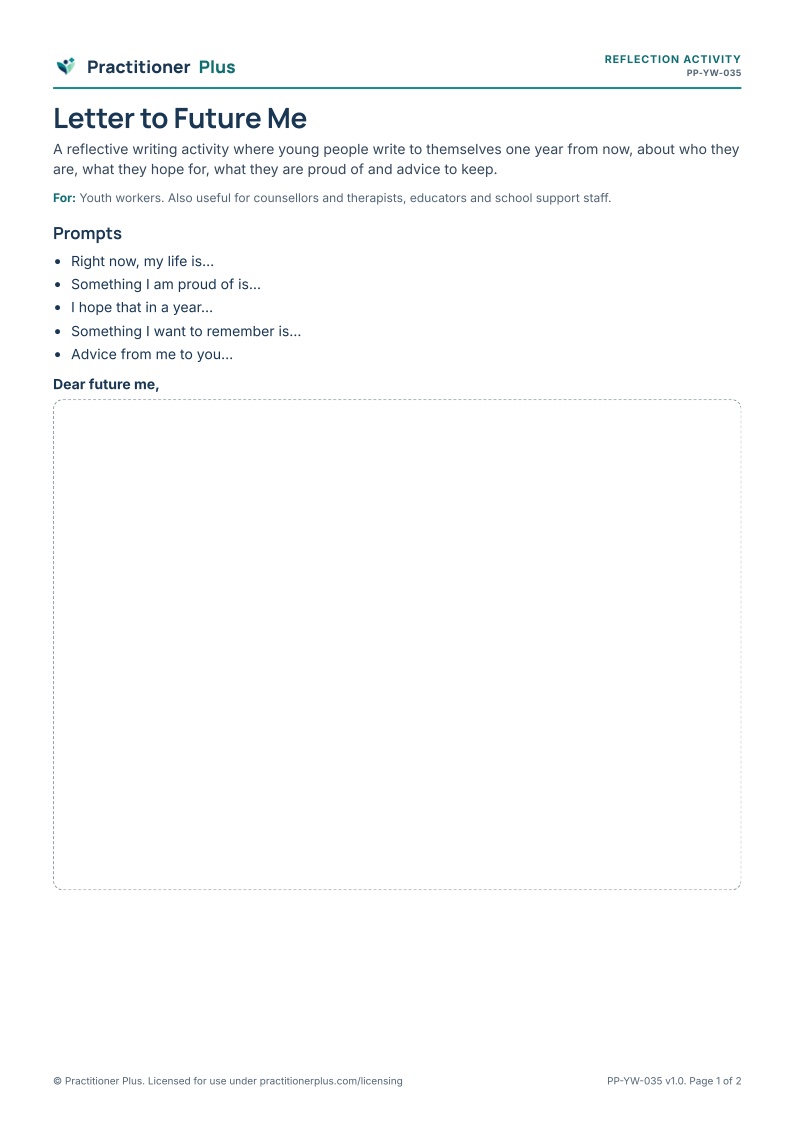
Writing to your future self can help clarify hopes and values. This activity guides young people to write to themselves a year from now about who they are today, what they hope for, what they are proud of and advice they want to remember.
Purpose
To build hope, identity and a sense of direction.
Who it is for
Primary profession: Youth workers. Also relevant for counsellors and therapists, educators and school support staff.
Client or participant group: Young people aged about 12 to 25.
Practice setting: Youth services, schools, mentoring and group programs.
Suggested uses
- Start or end of programs
- Mentoring
- Transitions
- Group sessions
Instructions for practitioners
- Offer as an optional, private activity.
- Agree who keeps the letter and when it is opened.
- Use prompts to support writing.
- Follow up any concerns that come up.
Instructions for clients or participants
- Read the prompts.
- Write your letter.
- Seal it and choose when to open it.
Accessibility considerations
Can be drawn, recorded or typed.
Scope and limitations
A reflective activity.
Research basis
Solution-focused approaches, which build on strengths and preferred futures, show promising results across settings. Specific goals, if-then plans and regular progress monitoring all improve the chances of reaching goals.
- Gingerich, W. J., & Peterson, L. T. (2013). Effectiveness of Solution-Focused Brief Therapy: A Systematic Qualitative Review of Controlled Outcome Studies. Research on Social Work Practice, 23(3), 266–283. https://doi.org/10.1177/1049731512470859
- Gollwitzer, P. M., & Sheeran, P. (2006). Implementation Intentions and Goal Achievement: A Meta‐analysis of Effects and Processes. Advances in Experimental Social Psychology, 69–119. https://doi.org/10.1016/s0065-2601(06)38002-1
- Harkin, B., Webb, T. L., Chang, B. P. I., Prestwich, A., Conner, M., Kellar, I., Benn, Y., & Sheeran, P. (2016). Does monitoring goal progress promote goal attainment? A meta-analysis of the experimental evidence. Psychological Bulletin, 142(2), 198–229. https://doi.org/10.1037/bul0000025
- Locke, E. A., & Latham, G. P. (2002). Building a practically useful theory of goal setting and task motivation: A 35-year odyssey. American Psychologist, 57(9), 705–717. https://doi.org/10.1037/0003-066x.57.9.705
What is included
A 2-page printable A4 PDF, including a practitioner notes page with the research basis (version 1.0).
Originality
Original Practitioner Plus content: wording, activity structure, layout and icons were created for this resource. No third-party worksheets, illustrations or text were reproduced.


