
About this resource
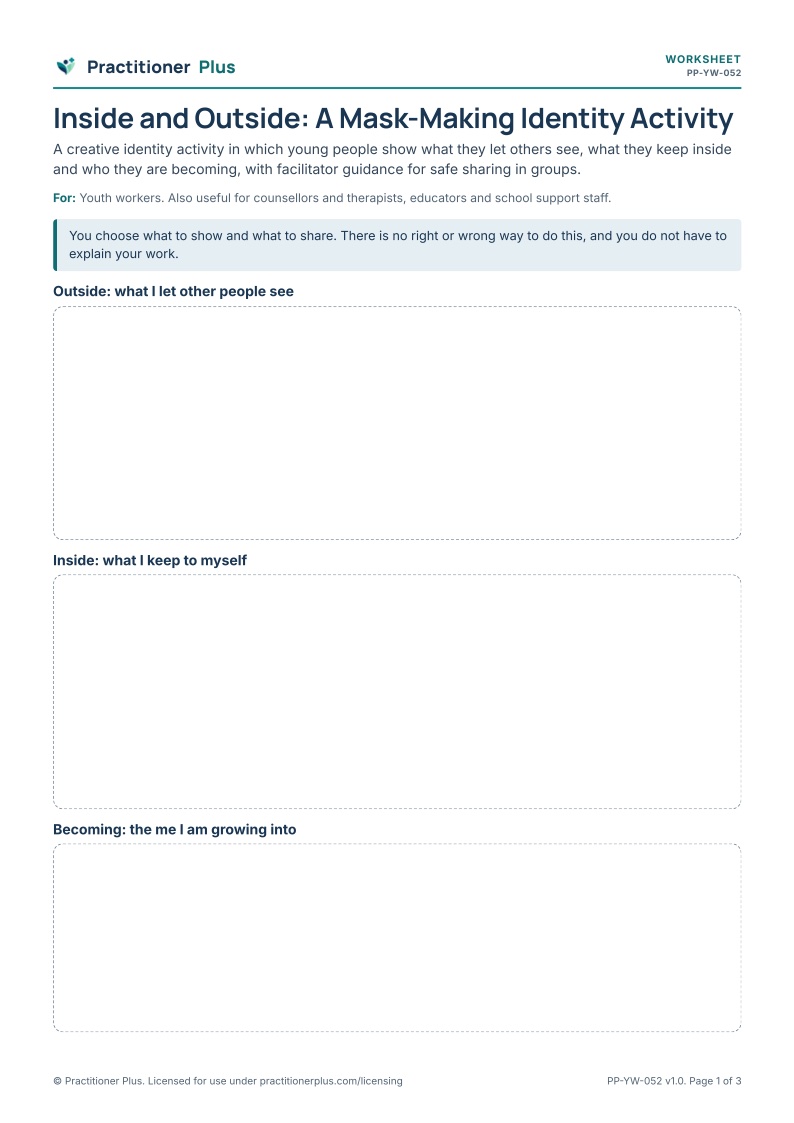
Many young people show one side of themselves to the world and keep another side private. In this activity, participants use colours, words and symbols to show what others see, what they keep inside and who they are becoming. Facilitator guidance covers choice, privacy and safe group sharing.
Purpose
To support self-reflection and identity exploration through a creative, low-pressure activity.
Who it is for
Primary profession: Youth workers. Also relevant for counsellors and therapists, educators and school support staff.
Client or participant group: Young people aged about 12 to 25, in groups or one to one.
Practice setting: Youth programs, groups, counselling and school wellbeing programs.
Suggested uses
- Identity and self-esteem groups
- Early relationship building
- Transition programs
- Creative wellbeing sessions
Instructions for practitioners
- Agree group guidelines on respect and privacy first.
- Explain that participants choose what to show and share, and can pass.
- Provide a range of materials and allow words, symbols or colours only.
- Invite sharing in pairs or the group, never requiring it.
- Watch for distress or disclosures and follow your procedures.
Instructions for clients or participants
- Fill each part with colours, words, pictures or symbols.
- Choose what, if anything, you want to share.
- Reflect on the questions at the end.
Accessibility considerations
Any materials can be used. Participants can describe their ideas instead of drawing.
Scope and limitations
A creative reflection activity, not art therapy or a clinical assessment. Disclosures of harm must be responded to under your organisation's procedures.
Research basis
Group art therapy shows some benefits for mental health, although the evidence is limited; creative activities like this support self-expression and reflection rather than acting as a treatment. School-based social and emotional learning programs improve students' social skills, behaviour and academic results.
- Durlak, J. A., Weissberg, R. P., Dymnicki, A. B., Taylor, R. D., & Schellinger, K. B. (2011). The Impact of Enhancing Students’ Social and Emotional Learning: A Meta-Analysis of School-Based Universal Interventions. Child Development, 82(1), 405–432. https://doi.org/10.1111/j.1467-8624.2010.01564.x
- Uttley, L., Stevenson, M., Scope, A., Rawdin, A., & Sutton, A. (2015). The clinical and cost effectiveness of group art therapy for people with non-psychotic mental health disorders: a systematic review and cost-effectiveness analysis. BMC Psychiatry, 15(1), 151. https://doi.org/10.1186/s12888-015-0528-4
What is included
A 3-page printable A4 PDF, including a practitioner notes page with the research basis (version 1.0).
Originality
Original Practitioner Plus content: wording, activity structure, layout and icons were created for this resource. No third-party worksheets, illustrations or text were reproduced. Written for Practitioner Plus from the research and guidance listed in the research basis; no third-party worksheet was used as a template.


