
About this resource
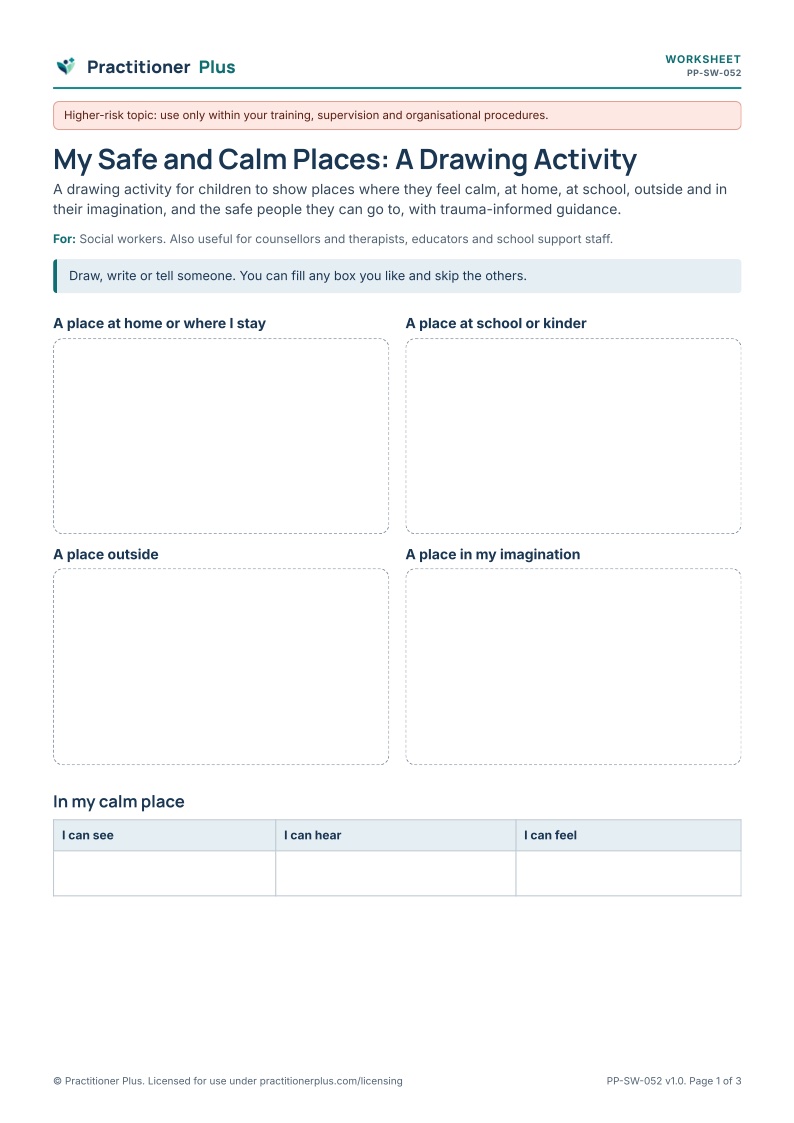
Knowing where they feel calm and who they can go to helps children settle when feelings are big. Children draw or describe calm places in different parts of their lives, including their imagination, notice what they can see, hear and feel there, and name safe people. Practitioner guidance is trauma-informed and does not assume any place is safe.
Purpose
To help children identify places, people and sensations that help them feel calm, and to build a shared calming plan.
Who it is for
Primary profession: Social workers. Also relevant for counsellors and therapists, educators and school support staff.
Client or participant group: Children aged about 5 to 12.
Practice setting: Social work, counselling, school wellbeing and family support settings.
Suggested uses
- Early sessions with children
- Building a calming plan
- School wellbeing support
- Work with families after change or stress
Instructions for practitioners
- Let the child choose which boxes to fill; do not assume home or any other place feels safe.
- Accept drawing, words, stickers or telling you.
- Use the child's answers to build a simple calming plan with them.
- Notice any worries about safety and follow child safety and reporting procedures.
- Share the plan with caregivers or teachers only with the child's agreement, unless safety requires otherwise.
Instructions for clients or participants
- Draw or write in any box you like.
- Think about what you can see, hear and feel in your calm place.
- Name people you can go to when you need help.
Accessibility considerations
Children can draw, write, use stickers or tell an adult. Boxes can be skipped.
Scope and limitations
A therapeutic activity, not an assessment of safety. Concerns about a child's safety must be responded to under child safety procedures and mandatory reporting obligations.
Higher-risk topic: use only within your training, supervision and organisational procedures.
Research basis
Children learn to self-regulate through warm, responsive co-regulation from adults and predictable environments. Trauma-informed practice prioritises safety, trust, choice, collaboration and empowerment, and avoids re-traumatising people. Group art therapy shows some benefits for mental health, although the evidence is limited; creative activities like this support self-expression and reflection rather than acting as a treatment.
- Kezelman, C., & Stavropoulos, P. (2012). Practice guidelines for treatment of complex trauma and trauma informed care and service delivery. Adults Surviving Child Abuse (now Blue Knot Foundation). https://professionals.blueknot.org.au/resources/publications/practice-guidelines/
- Murray, D. W., Rosanbalm, K., Christopoulos, C., & Hamoudi, A. (2015). Self-regulation and toxic stress: Foundations for understanding self-regulation from an applied developmental perspective (OPRE Report 2015-21). Office of Planning, Research and Evaluation, US Department of Health and Human Services. https://acf.gov/opre/report/self-regulation-and-toxic-stress-foundations-understanding-self-regulation-applied
- Substance Abuse and Mental Health Services Administration. (2014). SAMHSA's concept of trauma and guidance for a trauma-informed approach (HHS Publication No. SMA 14-4884). SAMHSA. https://store.samhsa.gov/product/samhsas-concept-trauma-and-guidance-trauma-informed-approach/sma14-4884
- Uttley, L., Stevenson, M., Scope, A., Rawdin, A., & Sutton, A. (2015). The clinical and cost effectiveness of group art therapy for people with non-psychotic mental health disorders: a systematic review and cost-effectiveness analysis. BMC Psychiatry, 15(1), 151. https://doi.org/10.1186/s12888-015-0528-4
What is included
A 3-page printable A4 PDF, including a practitioner notes page with the research basis (version 1.0).
Originality
Original Practitioner Plus content: wording, activity structure, layout and icons were created for this resource. No third-party worksheets, illustrations or text were reproduced. Written for Practitioner Plus from the research and guidance listed in the research basis; no third-party worksheet was used as a template.


