
About this resource
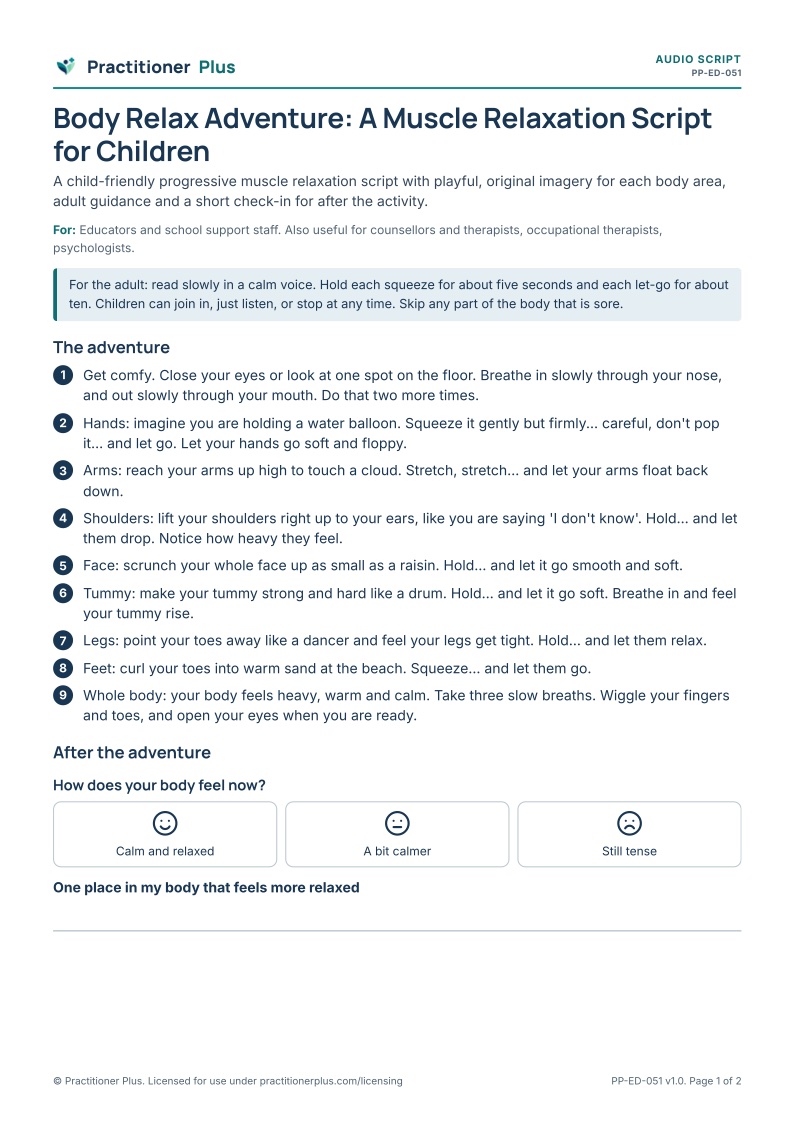
Tensing and then relaxing muscles helps children notice what calm feels like in their bodies. This script takes children on a short adventure, tensing and letting go of their hands, arms, shoulders, face, tummy, legs and feet, with gentle breathing at the start and end. Adult guidance covers pacing, choice and safety.
Purpose
To teach children to notice the difference between tense and relaxed muscles and to calm their bodies.
Who it is for
Primary profession: Educators and school support staff. Also relevant for counsellors and therapists, occupational therapists, psychologists.
Client or participant group: Children aged about 5 to 12, individually or in groups.
Practice setting: Classrooms, counselling sessions, therapy sessions and home.
Suggested uses
- Calm-down time after breaks
- Before bed or rest time
- Counselling and therapy sessions
- Teaching a coping skill
Instructions for practitioners
- Practise reading the script aloud first.
- Explain that children can join in, just listen or stop at any time.
- Read slowly, pausing about five seconds for each squeeze and ten seconds for each let-go.
- Skip any body area that is sore or injured.
- Ask children afterwards what they noticed.
Instructions for clients or participants
- Get comfy sitting or lying down.
- Squeeze when the story says squeeze, and let go when it says let go.
- Notice how your body feels at the end.
Accessibility considerations
Can be read aloud or recorded. Demonstrate each movement for children who learn by watching.
Scope and limitations
A relaxation activity. It is not a treatment for anxiety on its own. Some children find body-focused activities uncomfortable, so offer choice and alternatives.
Research basis
Relaxation training, including breathing and muscle relaxation, reduces anxiety across a range of groups. Children learn to self-regulate through warm, responsive co-regulation from adults and predictable environments.
- Manzoni, G. M., Pagnini, F., Castelnuovo, G., & Molinari, E. (2008). Relaxation training for anxiety: a ten-years systematic review with meta-analysis. BMC Psychiatry, 8(1), 41. https://doi.org/10.1186/1471-244x-8-41
- Murray, D. W., Rosanbalm, K., Christopoulos, C., & Hamoudi, A. (2015). Self-regulation and toxic stress: Foundations for understanding self-regulation from an applied developmental perspective (OPRE Report 2015-21). Office of Planning, Research and Evaluation, US Department of Health and Human Services. https://acf.gov/opre/report/self-regulation-and-toxic-stress-foundations-understanding-self-regulation-applied
What is included
A 2-page printable A4 PDF, including a practitioner notes page with the research basis (version 1.0).
Originality
Original Practitioner Plus content: wording, activity structure, layout and icons were created for this resource. No third-party worksheets, illustrations or text were reproduced. Written for Practitioner Plus from the research and guidance listed in the research basis; no third-party worksheet was used as a template.


