
About this resource
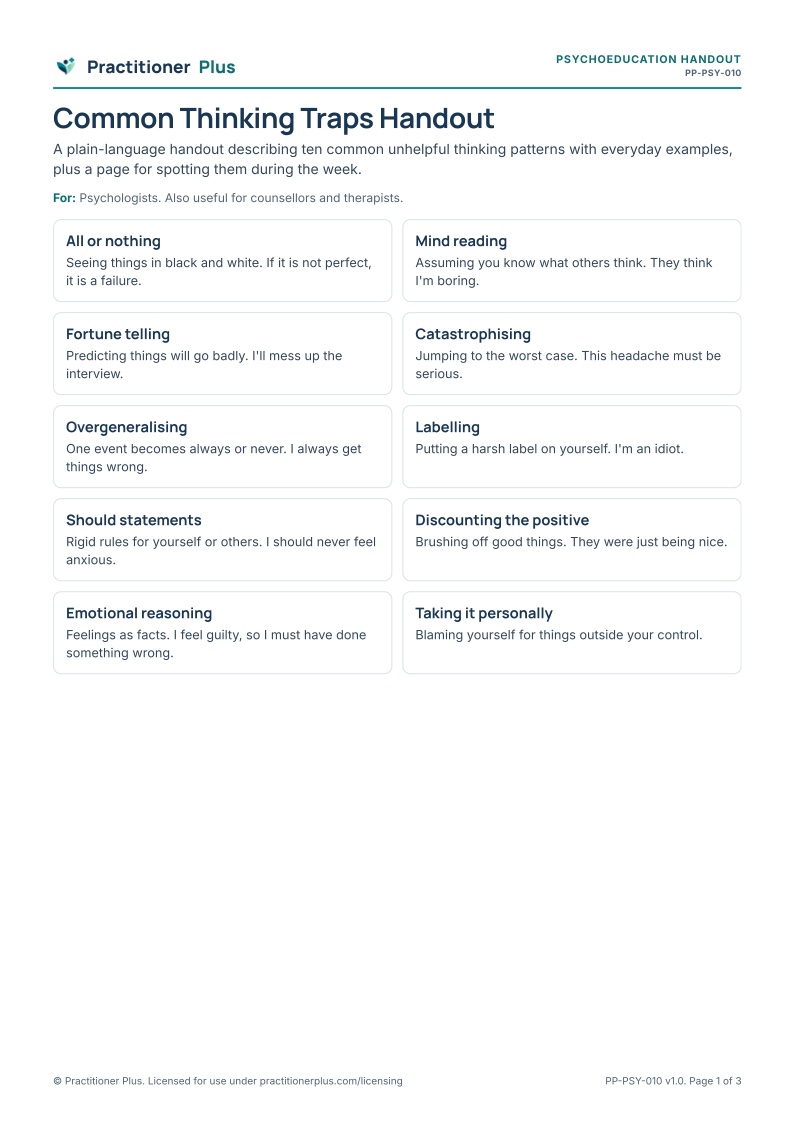
Everyone falls into thinking traps sometimes. This handout describes ten common patterns in everyday language, each with a short example, and includes a page for noticing which traps show up during the week and what a more balanced thought might be.
Purpose
To help clients recognise unhelpful thinking patterns as a first step towards more balanced thinking.
Who it is for
Primary profession: Psychologists. Also relevant for counsellors and therapists.
Client or participant group: Adolescents and adults learning cognitive behavioural skills.
Practice setting: Psychoeducation in CBT-informed treatment, with between-session practice.
Suggested uses
- Introducing cognitive patterns in early CBT sessions
- Between-session spotting practice
- Supporting thought records
- Group psychoeducation
Instructions for practitioners
- Introduce one or two traps at a time, using the client's examples.
- Emphasise that these are common patterns, not flaws.
- Use the spotting page for practice between sessions.
- Link to thought records or behavioural experiments.
Instructions for clients or participants
- Read about the thinking traps.
- Notice which ones show up for you this week.
- Try writing a more balanced thought.
Accessibility considerations
Read together and use the client's own examples. Introduce traps gradually.
Scope and limitations
An educational handout. It is not a diagnostic tool and does not replace treatment.
Research basis
Cognitive behavioural therapy (CBT) has a strong research base for anxiety, depression and many related problems; this resource uses CBT techniques to support, not replace, a structured treatment plan. Brief psychoeducation can reduce symptoms of depression and psychological distress.
- Beck, J. S. (2021). Cognitive behavior therapy: Basics and beyond (3rd ed.). Guilford Press.
- Donker, T., Griffiths, K. M., Cuijpers, P., & Christensen, H. (2009). Psychoeducation for depression, anxiety and psychological distress: a meta-analysis. BMC Medicine, 7(1), 79. https://doi.org/10.1186/1741-7015-7-79
- Hofmann, S. G., Asnaani, A., Vonk, I. J. J., Sawyer, A. T., & Fang, A. (2012). The Efficacy of Cognitive Behavioral Therapy: A Review of Meta-analyses. Cognitive Therapy and Research, 36(5), 427–440. https://doi.org/10.1007/s10608-012-9476-1
What is included
A 3-page printable A4 PDF, including a practitioner notes page with the research basis (version 1.0).
Originality
Original Practitioner Plus content: wording, activity structure, layout and icons were created for this resource. No third-party worksheets, illustrations or text were reproduced. Based on the well-established concept of cognitive distortions from cognitive therapy; names, descriptions and examples are original.


