
About this resource
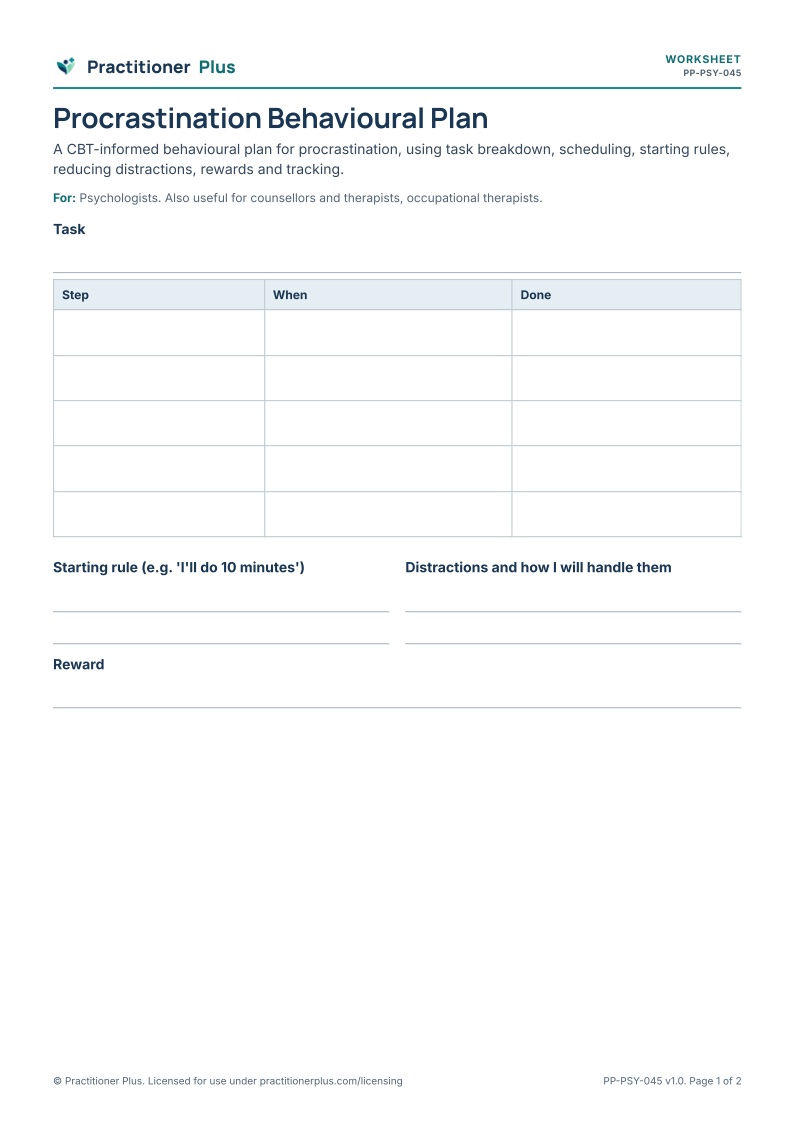
Understanding procrastination helps; changing behaviour needs a plan. This worksheet breaks a task into steps, schedules them, sets a starting rule, plans for distractions and rewards, and tracks follow-through.
Purpose
To translate understanding of procrastination into concrete behavioural steps.
Who it is for
Primary profession: Psychologists. Also relevant for counsellors and therapists, occupational therapists.
Client or participant group: Adolescents and adults with procrastination in treatment.
Practice setting: Psychology sessions and between-session practice.
Suggested uses
- Procrastination treatment
- Study and work tasks
- Perfectionism
- Between-session practice
Instructions for practitioners
- Choose one task.
- Make the first step tiny.
- Plan for likely distractions.
- Review follow-through without judgement.
Instructions for clients or participants
- Break your task into steps.
- Schedule them.
- Track what you did.
Accessibility considerations
Can be completed on a phone.
Scope and limitations
An educational CBT-informed worksheet for use within treatment.
Research basis
Perfectionism and procrastination are well-studied patterns that keep distress going; cognitive behavioural approaches to perfectionism have growing evidence. Cognitive behavioural therapy (CBT) has a strong research base for anxiety, depression and many related problems; this resource uses CBT techniques to support, not replace, a structured treatment plan. Executive functions such as planning, working memory and self-control develop over time and can be supported with external structure and practice.
- Beck, J. S. (2021). Cognitive behavior therapy: Basics and beyond (3rd ed.). Guilford Press.
- Diamond, A. (2013). Executive Functions. Annual Review of Psychology, 64(1), 135–168. https://doi.org/10.1146/annurev-psych-113011-143750
- Egan, S. J., Wade, T. D., & Shafran, R. (2011). Perfectionism as a transdiagnostic process: A clinical review. Clinical Psychology Review, 31(2), 203–212. https://doi.org/10.1016/j.cpr.2010.04.009
- Hofmann, S. G., Asnaani, A., Vonk, I. J. J., Sawyer, A. T., & Fang, A. (2012). The Efficacy of Cognitive Behavioral Therapy: A Review of Meta-analyses. Cognitive Therapy and Research, 36(5), 427–440. https://doi.org/10.1007/s10608-012-9476-1
- Steel, P. (2007). The nature of procrastination: A meta-analytic and theoretical review of quintessential self-regulatory failure. Psychological Bulletin, 133(1), 65–94. https://doi.org/10.1037/0033-2909.133.1.65
What is included
A 2-page printable A4 PDF, including a practitioner notes page with the research basis (version 1.0).
Originality
Original Practitioner Plus content: wording, activity structure, layout and icons were created for this resource. No third-party worksheets, illustrations or text were reproduced.


