
About this resource
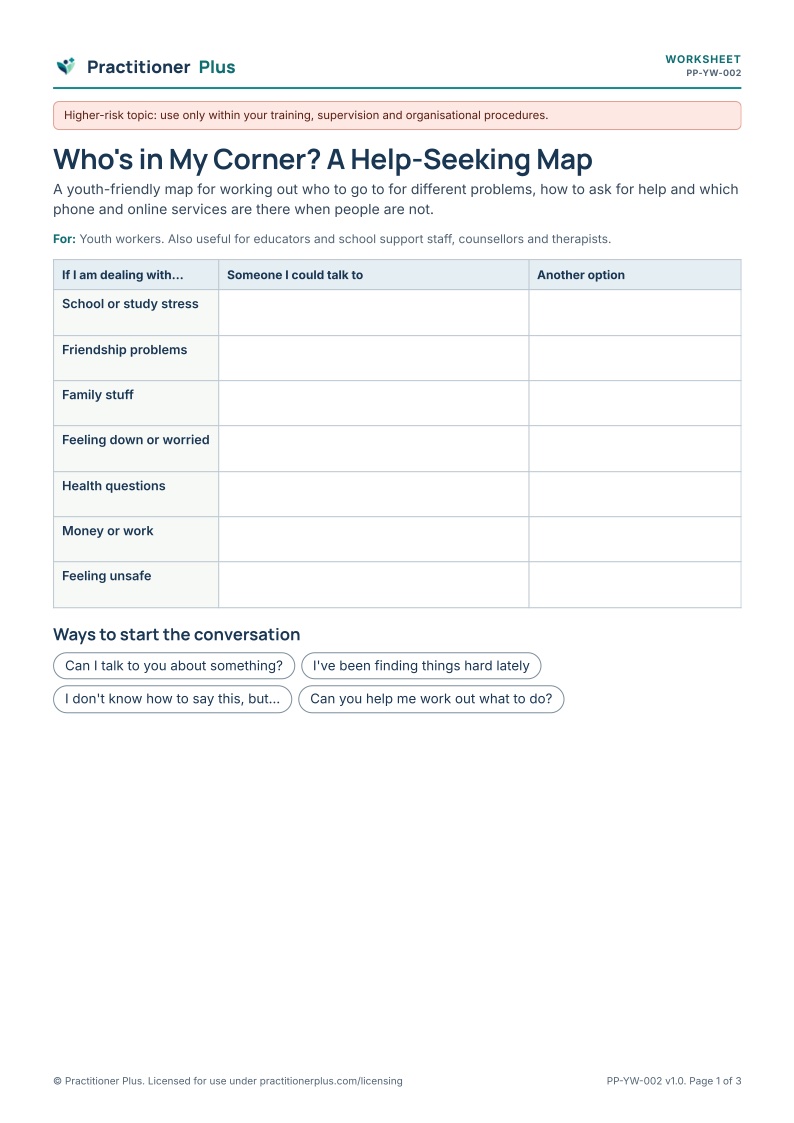
Knowing who to go to makes asking for help easier. This map helps young people match everyday problems with people and services they trust, practise ways to start the conversation and keep key Australian support services in one place.
Purpose
To make help-seeking concrete by identifying trusted people and services for different kinds of problems before they are needed.
Who it is for
Primary profession: Youth workers. Also relevant for educators and school support staff, counsellors and therapists.
Client or participant group: Young people aged about 12 to 25.
Practice setting: Youth services, schools, outreach and one-to-one sessions.
Suggested uses
- Group sessions on wellbeing and help-seeking
- One-to-one planning with a young person
- Transition points such as leaving school or a service
- Following up after a young person has struggled to ask for help
Instructions for practitioners
- Normalise asking for help, using everyday examples.
- Let the young person choose which problems to map.
- Practise conversation starters together.
- Check service details are current for your area before handing out.
- If a young person discloses risk, follow your organisation's procedures immediately.
Instructions for clients or participants
- Pick a problem type and think of who you could go to.
- Choose a way to start the conversation.
- Keep the service list somewhere you can find it.
Accessibility considerations
Can be completed verbally, on a phone or in pairs. Use local services and language that fits the young person.
Scope and limitations
A help-seeking resource. It is not a safety plan or crisis intervention, and it does not replace risk assessment or safety planning by a qualified practitioner.
Higher-risk topic: use only within your training, supervision and organisational procedures.
Research basis
Young people are more likely to seek help when they know where to go, trust the person and feel less stigma.
- Rickwood, D., Deane, F. P., Wilson, C. J., & Ciarrochi, J. (2005). Young people’s help-seeking for mental health problems. Australian e-Journal for the Advancement of Mental Health, 4(3), 218–251. https://doi.org/10.5172/jamh.4.3.218
What is included
A 3-page printable A4 PDF, including a practitioner notes page with the research basis (version 1.0).
Originality
Original Practitioner Plus content: wording, activity structure, layout and icons were created for this resource. No third-party worksheets, illustrations or text were reproduced. Service names and numbers should be checked against each service's official website before publication.


