
About this resource
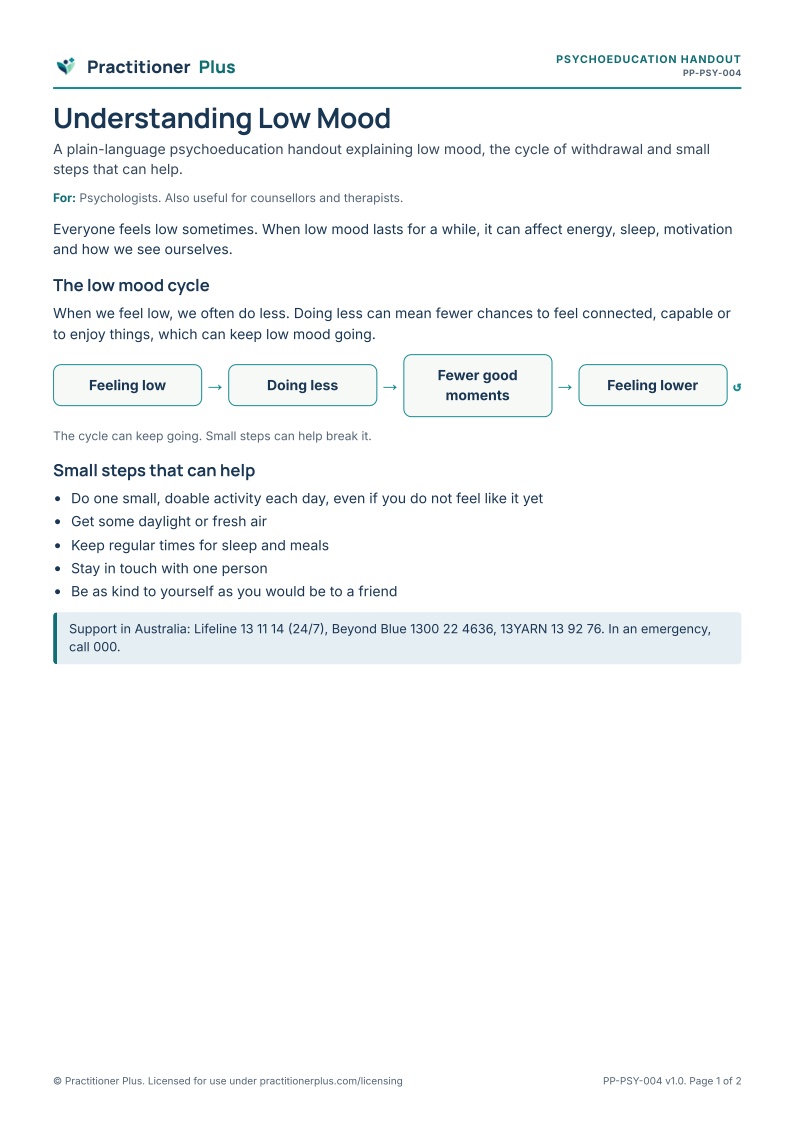
This handout explains low mood in everyday language, describes how withdrawal and low mood can feed each other, and suggests small, practical steps. It also lists where to find support in Australia.
Purpose
To explain low mood and the withdrawal cycle in plain language and introduce small steps.
Who it is for
Primary profession: Psychologists. Also relevant for counsellors and therapists.
Client or participant group: Adults experiencing low mood, shared by a practitioner as part of a conversation.
Practice setting: Psychoeducation in early sessions; can be shared with supporters with consent.
Suggested uses
- Psychoeducation in early sessions
- Normalising and explaining low mood
- Introducing small, achievable activity steps
- Sharing with family or supporters, with consent
Instructions for practitioners
- Read through the handout together.
- Ask which parts fit the person's experience.
- Choose one small step to try before the next session.
- Check where the person can get support between sessions.
Instructions for clients or participants
- Read the handout, or read it together.
- Choose one small step to try.
Accessibility considerations
Read together, use the cycle diagram and consider translated versions.
Scope and limitations
This handout is general information. It does not assess or diagnose depression. If low mood is persistent or severe, or there are concerns about safety, follow your organisation's procedures and consider referral.
Research basis
Behavioural activation, which builds routine and rewarding activity, is an effective treatment for depression. Brief psychoeducation can reduce symptoms of depression and psychological distress.
- Donker, T., Griffiths, K. M., Cuijpers, P., & Christensen, H. (2009). Psychoeducation for depression, anxiety and psychological distress: a meta-analysis. BMC Medicine, 7(1), 79. https://doi.org/10.1186/1741-7015-7-79
- Ekers, D., Webster, L., Van Straten, A., Cuijpers, P., Richards, D., & Gilbody, S. (2014). Behavioural Activation for Depression; An Update of Meta-Analysis of Effectiveness and Sub Group Analysis. PLoS ONE, 9(6), e100100. https://doi.org/10.1371/journal.pone.0100100
What is included
A 2-page printable A4 PDF, including a practitioner notes page with the research basis (version 1.0).
Originality
Original Practitioner Plus content: wording, activity structure and layout were created for this resource. No third-party worksheets, illustrations or text were reproduced.


