
About this resource
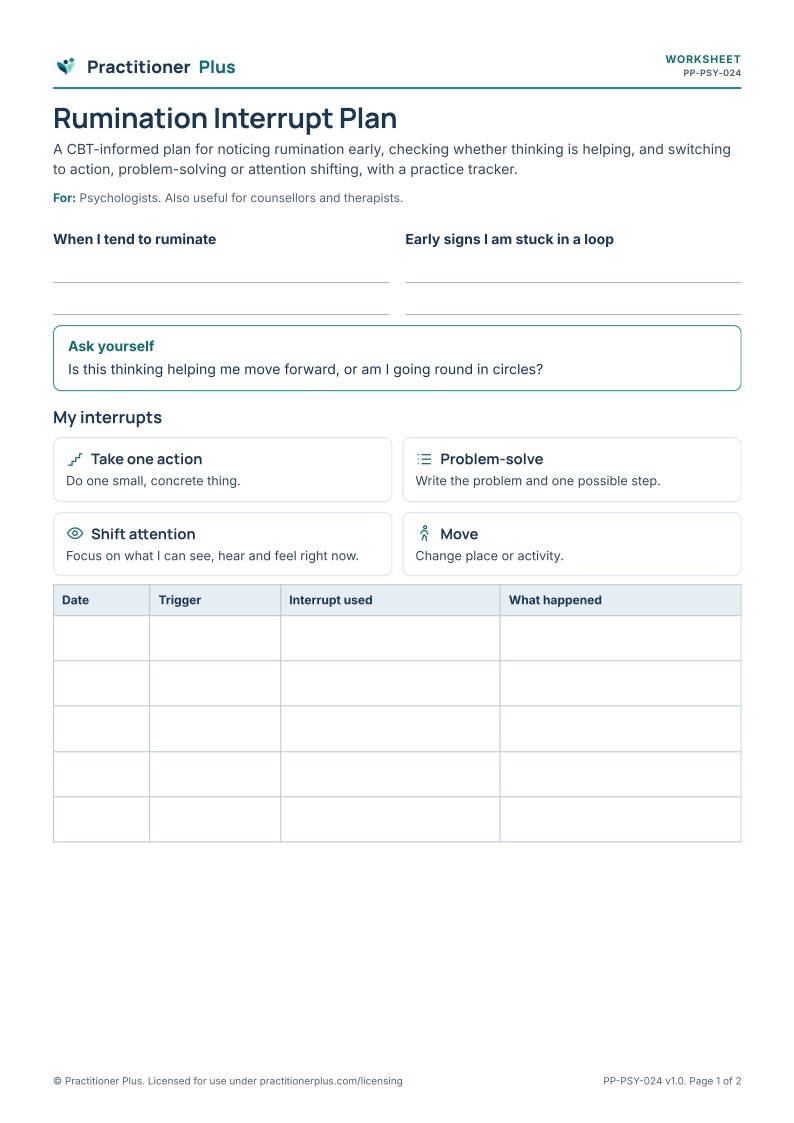
Going over and over problems can feel like problem-solving but often deepens low mood. This plan helps clients notice triggers and early signs, ask whether their thinking is helping them move forward, then choose an interrupt: a concrete action, structured problem-solving or shifting attention to the present.
Purpose
To help clients recognise rumination and practise stepping out of it.
Who it is for
Primary profession: Psychologists. Also relevant for counsellors and therapists.
Client or participant group: Adolescents and adults who get caught in repetitive negative thinking.
Practice setting: Psychology sessions and between-session practice.
Suggested uses
- Depression and low mood
- Worry and rumination
- Relapse prevention
- Between-session practice
Instructions for practitioners
- Explore the client's beliefs about rumination, such as that it helps.
- Identify personal triggers and early signs.
- Practise interrupts in session.
- Review the tracker together.
Instructions for clients or participants
- Write your triggers and signs.
- Choose your interrupts.
- Track when you use them.
Accessibility considerations
Can be completed verbally. The key question can be put on a phone reminder.
Scope and limitations
An educational CBT-informed worksheet for use within treatment.
Research basis
Scheduling worry and shifting from abstract to concrete thinking are supported strategies for reducing unhelpful worry and rumination. Cognitive behavioural therapy (CBT) has a strong research base for anxiety, depression and many related problems; this resource uses CBT techniques to support, not replace, a structured treatment plan. Behavioural activation, which builds routine and rewarding activity, is an effective treatment for depression.
- Beck, J. S. (2021). Cognitive behavior therapy: Basics and beyond (3rd ed.). Guilford Press.
- Borkovec, T., Wilkinson, L., Folensbee, R., & Lerman, C. (1983). Stimulus control applications to the treatment of worry. Behaviour Research and Therapy, 21(3), 247–251. https://doi.org/10.1016/0005-7967(83)90206-1
- Ekers, D., Webster, L., Van Straten, A., Cuijpers, P., Richards, D., & Gilbody, S. (2014). Behavioural Activation for Depression; An Update of Meta-Analysis of Effectiveness and Sub Group Analysis. PLoS ONE, 9(6), e100100. https://doi.org/10.1371/journal.pone.0100100
- Hofmann, S. G., Asnaani, A., Vonk, I. J. J., Sawyer, A. T., & Fang, A. (2012). The Efficacy of Cognitive Behavioral Therapy: A Review of Meta-analyses. Cognitive Therapy and Research, 36(5), 427–440. https://doi.org/10.1007/s10608-012-9476-1
- Watkins, E. R. (2008). Constructive and unconstructive repetitive thought. Psychological Bulletin, 134(2), 163–206. https://doi.org/10.1037/0033-2909.134.2.163
What is included
A 2-page printable A4 PDF, including a practitioner notes page with the research basis (version 1.0).
Originality
Original Practitioner Plus content: wording, activity structure, layout and icons were created for this resource. No third-party worksheets, illustrations or text were reproduced. Reflects widely described cognitive behavioural approaches to rumination.


