
About this resource
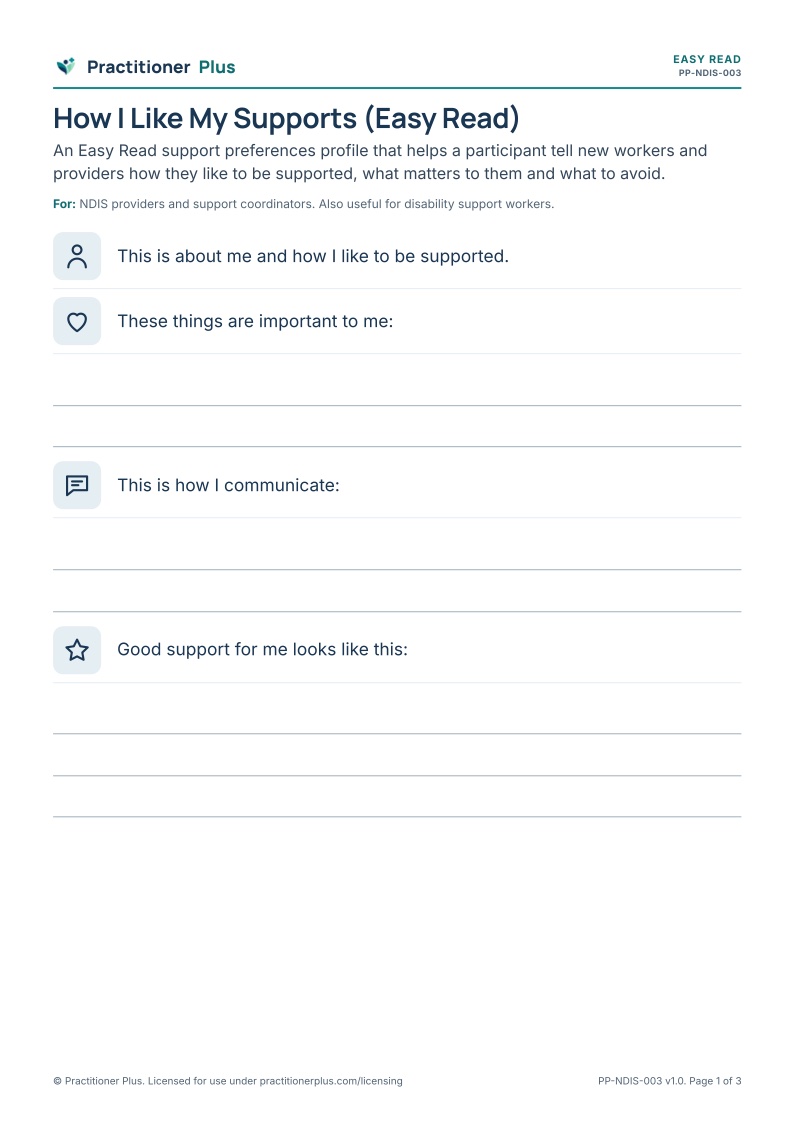
Every person has their own way of being supported well. This Easy Read profile uses short sentences and icons to capture what is important to the participant, how they communicate, how they like support to happen, the qualities they value in workers and the things that do not work for them.
Purpose
To give every new worker a clear, respectful picture of how the participant wants to be supported, in the participant's own words.
Who it is for
Primary profession: NDIS providers and support coordinators. Also relevant for disability support workers.
Client or participant group: Adult NDIS participants, completed with the participant and people they trust.
Practice setting: Provider onboarding, support coordination and team handovers.
Suggested uses
- Onboarding a new provider or support worker
- Updating a team when preferences change
- Preparing for a change of provider
- Supporting choice and control in service agreements
Instructions for practitioners
- Complete the profile with the participant, not about them. Use their words.
- Offer choices and examples where open questions are hard.
- Ask the participant who can see the profile and how it will be shared.
- Review it at least yearly, or when the participant asks.
Instructions for clients or participants
- Read or listen to each part.
- Say or show what is true for you.
- Choose who can see your profile.
Accessibility considerations
Large text, short sentences and icons. Test with Easy Read users and add the participant's own photos or symbols where possible.
Scope and limitations
A person-centred profile. It is not a support plan, risk assessment or behaviour support plan, and it is not an official NDIS form.
Research basis
Human rights frameworks and research on the dignity of risk support people's right to make their own choices, including choices that involve some risk. Case management practice standards describe assessment, planning, coordination, review and planned exits with the person at the centre.
- Case Management Society of Australia and New Zealand. (2013). National standards of practice for case management (3rd ed.). https://www.cmsa.org.au/
- Ibrahim, J. E., & Davis, M. (2013). Impediments to applying the ‘dignity of risk’ principle in residential aged care services. Australasian Journal on Ageing, 32(3), 188–193. https://doi.org/10.1111/ajag.12014
- United Nations. (2006). Convention on the Rights of Persons with Disabilities. https://www.ohchr.org/en/instruments-mechanisms/instruments/convention-rights-persons-disabilities
What is included
A 3-page printable A4 PDF, including a practitioner notes page with the research basis (version 1.0).
Originality
Original Practitioner Plus content: wording, activity structure, layout and icons were created for this resource. No third-party worksheets, illustrations or text were reproduced.


