
About this resource
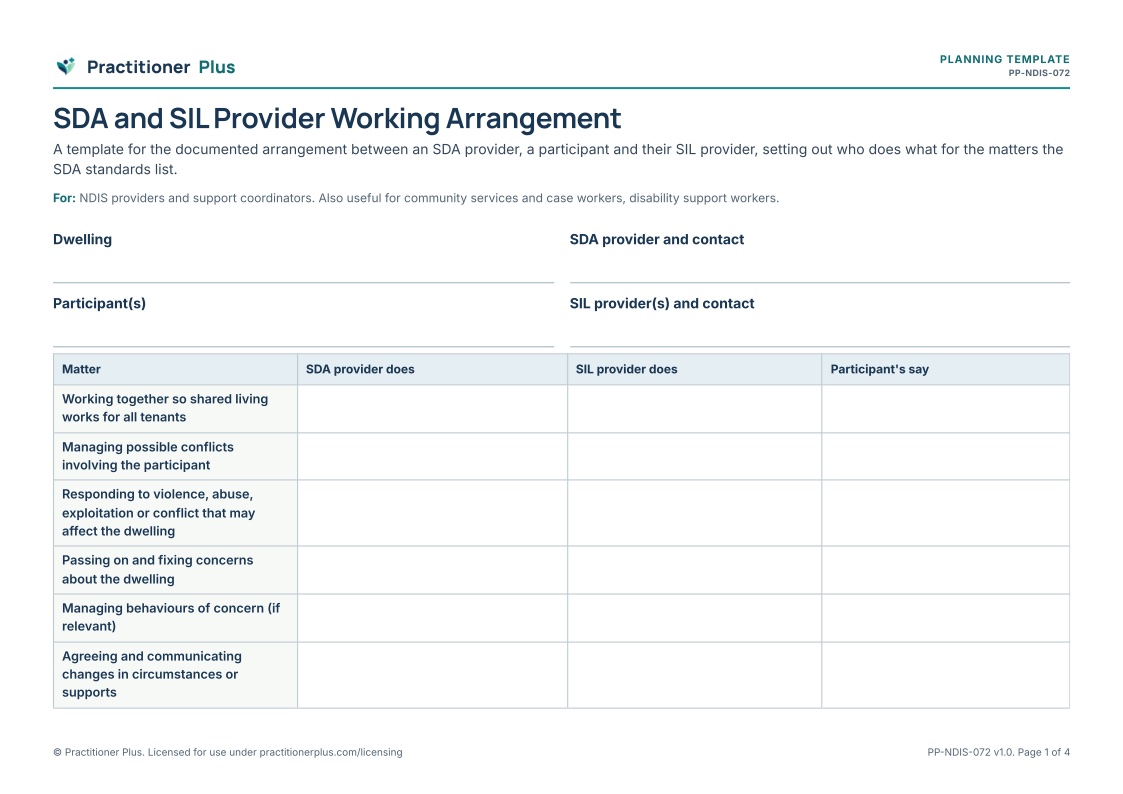
The SDA tenancy management standard requires documented arrangements with each participant and their SIL provider, covering how the providers work together so shared living works for all tenants, how conflicts and violence, abuse or exploitation that may affect the dwelling are handled, how concerns about the dwelling are passed on and addressed, how behaviours of concern are managed, how changes are agreed, continuity in an emergency or natural disaster, and how vacancies are filled. This template sets out each matter with space for each party's role.
Purpose
To agree and record roles between the SDA provider and SIL providers, with the participant's input.
Who it is for
Primary profession: NDIS providers and support coordinators. Also relevant for community services and case workers, disability support workers.
Client or participant group: SDA providers, SIL providers and participants who live in SDA with SIL supports.
Practice setting: SDA dwellings where one or more residents receive supported independent living.
Suggested uses
- Setting up a new SDA and SIL arrangement
- Reviewing arrangements each year or after changes
- Audit evidence for the SDA tenancy management standard
- Resolving confusion about who fixes what
Instructions for practitioners
- Complete it with the participant, the SDA provider and each SIL provider in the dwelling.
- Be specific about who does what and how quickly.
- Give the participant an accessible copy and record their agreement, or record that they did not consent.
- Review it yearly and whenever providers, residents or needs change.
Accessibility considerations
Clear table; prepare an Easy Read summary for each participant.
Scope and limitations
A practical record-keeping tool. It is not legal advice and does not by itself show that a provider meets the NDIS Practice Standards. Check it against the current Practice Standards, NDIS rules and your registration groups, and adapt it to your own policies.
Research basis
Specialist disability accommodation providers must meet the SDA Conditions Rule and the SDA module of the Practice Standards, including agreements that follow tenancy law, managed conflicts of interest, vacancy processes, well-maintained dwellings and documented arrangements with SIL providers. From 1 July 2026, providers of supported independent living must be registered (class of support 0138) and meet the Core Module and the NDIS Commission's SIL Practice Standards: supported decision-making, safeguarding, practice governance, and agreements about tenancy, housing and support. This resource is organised around those standards; using it does not by itself demonstrate compliance.
- National Disability Insurance Scheme (Specialist Disability Accommodation Conditions) Rule 2018 (Cth). https://www.legislation.gov.au/F2018L00627/latest/text
- NDIS Quality and Safeguards Commission. (2026). Mandatory registration and transition pathways for supported independent living (SIL). https://www.ndiscommission.gov.au/about-us/ndis-commission-reform-hub/mandatory-registration/mandatory-registration-SIL
- NDIS Quality and Safeguards Commission. (2026). Supplementary module: Supported independent living (SIL) Practice Standards and Quality Indicators. https://www.ndiscommission.gov.au/rules-and-standards/ndis-practice-standards/sil
- NDIS Quality and Safeguards Commission. NDIS Practice Standards: Supplementary module: Specialist disability accommodation. https://www.ndiscommission.gov.au/rules-and-standards/ndis-practice-standards/supplementary-module-specialist-disability
What is included
A 4-page printable A4 PDF, including a practitioner notes page with the research basis (version 1.0).
Originality
Original Practitioner Plus content: wording, activity structure, layout and icons were created for this resource. No third-party worksheets, illustrations or text were reproduced. Written for Practitioner Plus from the NDIS Practice Standards and NDIS rules listed in the research basis; no third-party template was used. It is not an NDIS Commission form.


