
About this resource
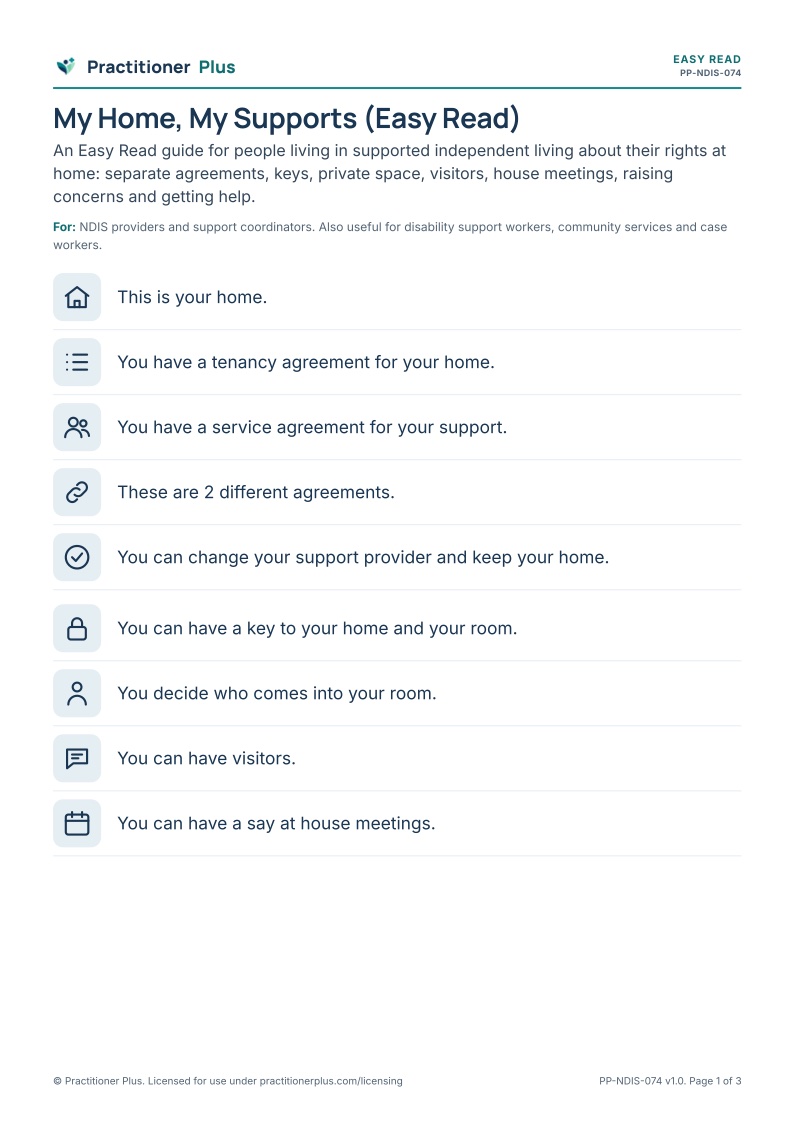
The SIL and SDA Practice Standards require providers to explain agreements and rights in the way each person understands best, including that tenancy and support agreements are separate, that people can change their support provider and keep their home, and that they can have keys, private space and visitors and raise concerns without fear. This Easy Read guide explains these rights in short sentences with pictures and gives space to write down who can help.
Purpose
To help people understand their rights at home and that their home and their supports are separate.
Who it is for
Primary profession: NDIS providers and support coordinators. Also relevant for disability support workers, community services and case workers.
Client or participant group: Adults living in supported independent living or SDA, and their families and supporters.
Practice setting: Supported independent living and SDA homes, at move-in and when agreements are reviewed.
Suggested uses
- When a person moves into a SIL or SDA home
- When agreements are reviewed
- House meetings about rights
- Supporting a person to raise a concern
Instructions for practitioners
- Go through the guide with the person at their pace.
- Check understanding by asking the person to tell you in their own way.
- Fill in the 'Who can help me' table with real names and numbers.
- Offer an independent advocate if the person wants one.
Instructions for clients or participants
- Read this with someone you trust.
- Ask questions.
- Keep it somewhere you can find it.
Accessibility considerations
Easy Read format with icons and short sentences. Test it with the people who will use it.
Scope and limitations
General information about rights in SIL and SDA homes. It is not legal advice; tenancy law differs between states and territories.
Research basis
Easy Read standards and disability rights frameworks support people's right to accessible information; test Easy Read materials with the people who will use them. From 1 July 2026, providers of supported independent living must be registered (class of support 0138) and meet the Core Module and the NDIS Commission's SIL Practice Standards: supported decision-making, safeguarding, practice governance, and agreements about tenancy, housing and support. This resource is organised around those standards; using it does not by itself demonstrate compliance.
- Inclusion Europe. (2009). Information for all: European standards for making information easy to read and understand. https://www.inclusion-europe.eu/easy-to-read-standards-guidelines/
- NDIS Quality and Safeguards Commission. (2026). Mandatory registration and transition pathways for supported independent living (SIL). https://www.ndiscommission.gov.au/about-us/ndis-commission-reform-hub/mandatory-registration/mandatory-registration-SIL
- NDIS Quality and Safeguards Commission. (2026). Supplementary module: Supported independent living (SIL) Practice Standards and Quality Indicators. https://www.ndiscommission.gov.au/rules-and-standards/ndis-practice-standards/sil
- United Nations. (2006). Convention on the Rights of Persons with Disabilities. https://www.ohchr.org/en/instruments-mechanisms/instruments/convention-rights-persons-disabilities
What is included
A 3-page printable A4 PDF, including a practitioner notes page with the research basis (version 1.0).
Originality
Original Practitioner Plus content: wording, activity structure, layout and icons were created for this resource. No third-party worksheets, illustrations or text were reproduced. Written for Practitioner Plus from the NDIS Practice Standards and NDIS rules listed in the research basis; no third-party template was used. It is not an NDIS Commission form.


