
About this resource
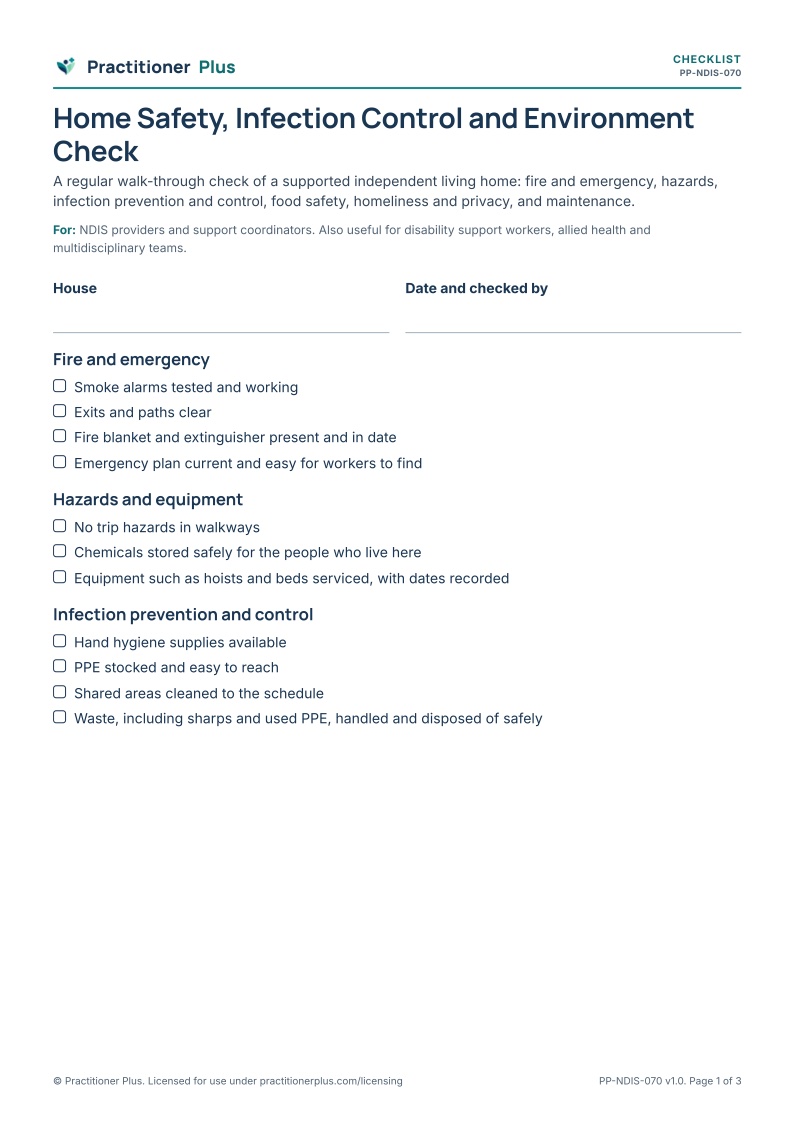
The Practice Standards require a safe support environment, standard infection prevention and control precautions, PPE where needed, safe waste handling and safe storage of meals for people with mealtime management needs. The SIL standards remind providers that the workplace is first a participant's home. This check covers safety and infection control while also asking whether the house feels like a home.
Purpose
To keep the home safe, clean and homely, and to follow up issues with the SDA provider or landlord.
Who it is for
Primary profession: NDIS providers and support coordinators. Also relevant for disability support workers, allied health and multidisciplinary teams.
Client or participant group: House leaders and teams in supported independent living homes.
Practice setting: Supported independent living homes, including SDA dwellings.
Suggested uses
- Monthly house checks
- After maintenance work or changes in residents' needs
- Preparing for audits and SDA inspections
- Team leader handover
Instructions for practitioners
- Walk through the whole home with residents' permission for private spaces.
- Tick each item and note anything that needs action.
- Report repairs to the SDA provider or landlord and record the date.
- Follow up actions and record when they are done.
Accessibility considerations
Tick-box checklist with a follow-up table.
Scope and limitations
A practical record-keeping tool. It is not legal advice and does not by itself show that a provider meets the NDIS Practice Standards. Check it against the current Practice Standards, NDIS rules and your registration groups, and adapt it to your own policies. Follow your state or territory's fire safety, food safety and work health and safety requirements.
Research basis
Standard precautions, including hand hygiene, routine cleaning, correct use of personal protective equipment and safe waste handling, are the foundation of infection prevention and control. From 1 July 2026, providers of supported independent living must be registered (class of support 0138) and meet the Core Module and the NDIS Commission's SIL Practice Standards: supported decision-making, safeguarding, practice governance, and agreements about tenancy, housing and support. This resource is organised around those standards; using it does not by itself demonstrate compliance.
- National Health and Medical Research Council. (2019). Australian guidelines for the prevention and control of infection in healthcare. https://www.nhmrc.gov.au/about-us/publications/australian-guidelines-prevention-and-control-infection-healthcare-2019
- NDIS Quality and Safeguards Commission. (2026). Mandatory registration and transition pathways for supported independent living (SIL). https://www.ndiscommission.gov.au/about-us/ndis-commission-reform-hub/mandatory-registration/mandatory-registration-SIL
- NDIS Quality and Safeguards Commission. (2026). Supplementary module: Supported independent living (SIL) Practice Standards and Quality Indicators. https://www.ndiscommission.gov.au/rules-and-standards/ndis-practice-standards/sil
- NDIS Quality and Safeguards Commission. NDIS Practice Standards and Quality Indicators. https://www.ndiscommission.gov.au/rules-and-standards/ndis-practice-standards
What is included
A 3-page printable A4 PDF, including a practitioner notes page with the research basis (version 1.0).
Originality
Original Practitioner Plus content: wording, activity structure, layout and icons were created for this resource. No third-party worksheets, illustrations or text were reproduced. Written for Practitioner Plus from the NDIS Practice Standards and NDIS rules listed in the research basis; no third-party template was used. It is not an NDIS Commission form.


