
About this resource
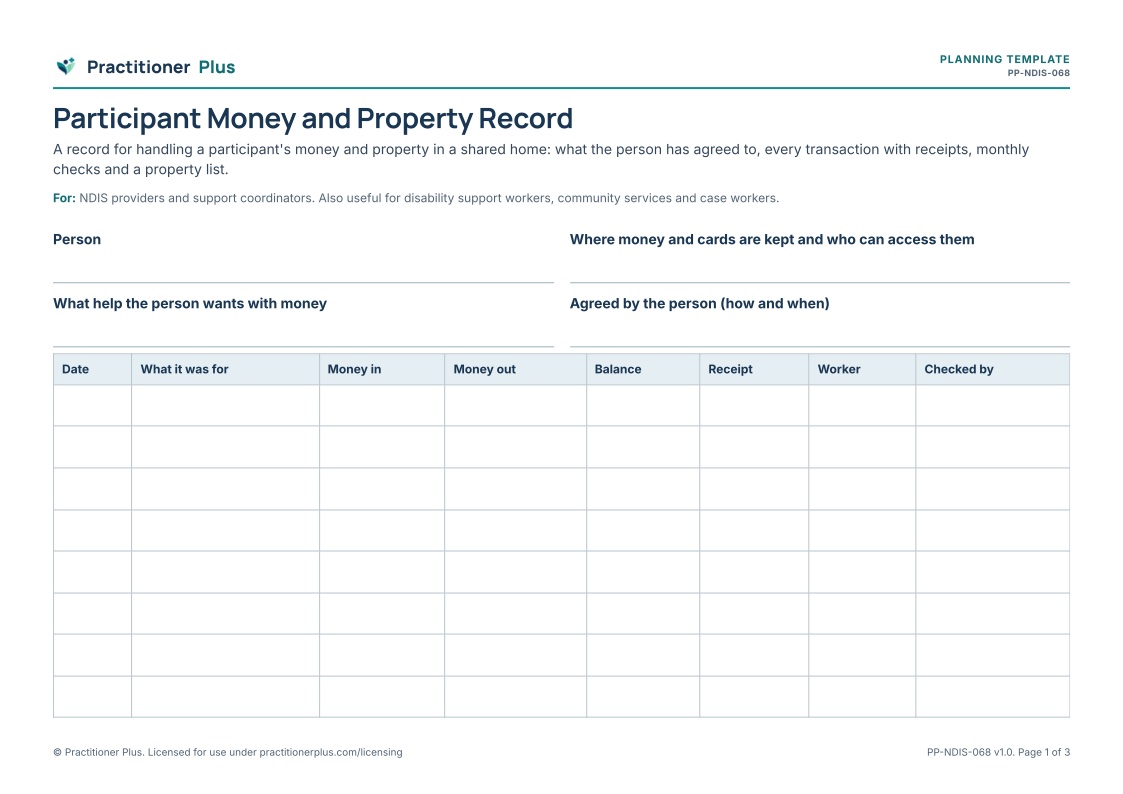
The Participant Money and Property standard requires processes so that, where a provider has access to a participant's money or property, it is managed, protected and accounted for, used only with the person's consent and for the purposes they intend, and the person is supported to spend their own money as they choose. Providers must not give financial advice beyond what the plan requires. This record covers the agreement with the person, every transaction and a monthly check.
Purpose
To keep participants' money and property secure, used only with consent and accounted for.
Who it is for
Primary profession: NDIS providers and support coordinators. Also relevant for disability support workers, community services and case workers.
Client or participant group: Adults in supported independent living whose workers help with money, and their house teams.
Practice setting: Supported independent living homes.
Suggested uses
- Cash and card spending supported by workers
- Monthly reconciliation by the house leader
- Showing the person their own spending
- Audit evidence for money and property
Instructions for practitioners
- Agree with the person what help they want and record it.
- Record every transaction straight away and keep receipts.
- Check and reconcile monthly with the person if they wish.
- Report any missing money or property as an incident.
Instructions for clients or participants
- Tell us what you want to buy.
- Keep your receipts with ours.
- Ask to see your record any time.
Accessibility considerations
Clear tables; show the person their balance using the way they understand best.
Scope and limitations
A record-keeping tool. It is not financial advice and does not replace financial administration or guardianship arrangements where these apply. A practical record-keeping tool. It is not legal advice and does not by itself show that a provider meets the NDIS Practice Standards. Check it against the current Practice Standards, NDIS rules and your registration groups, and adapt it to your own policies.
Research basis
This resource is designed to align with the NDIS Practice Standards and Code of Conduct; using it does not by itself demonstrate compliance. Human rights frameworks and research on the dignity of risk support people's right to make their own choices, including choices that involve some risk.
- Ibrahim, J. E., & Davis, M. (2013). Impediments to applying the ‘dignity of risk’ principle in residential aged care services. Australasian Journal on Ageing, 32(3), 188–193. https://doi.org/10.1111/ajag.12014
- NDIS Quality and Safeguards Commission. NDIS Code of Conduct. https://www.ndiscommission.gov.au/rules-and-standards/ndis-code-conduct
- NDIS Quality and Safeguards Commission. NDIS Practice Standards and Quality Indicators. https://www.ndiscommission.gov.au/rules-and-standards/ndis-practice-standards
- United Nations. (2006). Convention on the Rights of Persons with Disabilities. https://www.ohchr.org/en/instruments-mechanisms/instruments/convention-rights-persons-disabilities
What is included
A 3-page printable A4 PDF, including a practitioner notes page with the research basis (version 1.0).
Originality
Original Practitioner Plus content: wording, activity structure, layout and icons were created for this resource. No third-party worksheets, illustrations or text were reproduced. Written for Practitioner Plus from the NDIS Practice Standards and NDIS rules listed in the research basis; no third-party template was used. It is not an NDIS Commission form.


