
About this resource
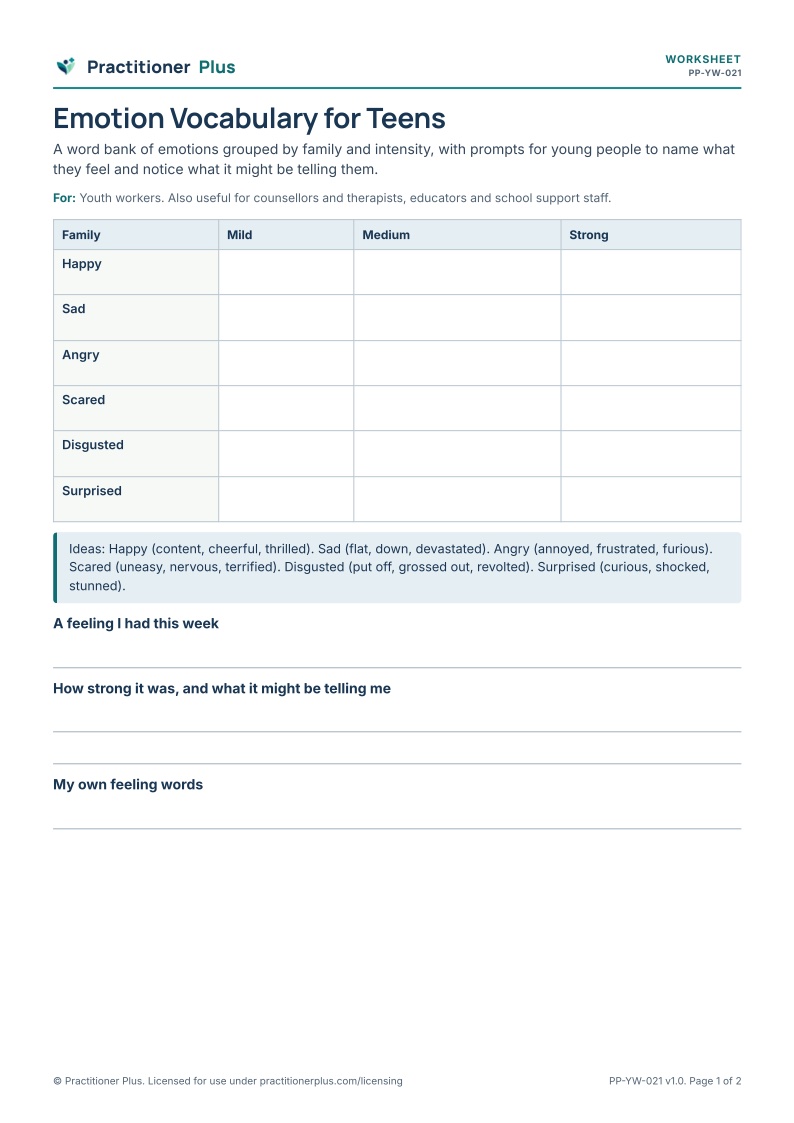
Naming feelings precisely can make them easier to manage. This word bank groups emotions into families, from mild to intense, then asks young people to name a recent feeling, how strong it was and what it might be telling them.
Purpose
To help young people find more precise words for their feelings.
Who it is for
Primary profession: Youth workers. Also relevant for counsellors and therapists, educators and school support staff.
Client or participant group: Young people aged about 12 to 18.
Practice setting: Youth services, schools and counselling.
Suggested uses
- Wellbeing conversations
- Group programs
- Building emotional literacy
- Before problem-solving or coping skills work
Instructions for practitioners
- Use alongside conversation, not as a test.
- Invite young people to add their own words, including slang.
- Notice mixed feelings.
- Follow up any safety concerns.
Instructions for clients or participants
- Look at the word bank.
- Circle words that fit.
- Write about a recent feeling.
Accessibility considerations
Read aloud. Young people can point or use their own words.
Scope and limitations
An emotional literacy activity.
Research basis
Understanding, naming and choosing strategies for emotions are central to emotion regulation; putting feelings into words and finer emotion distinctions are linked to better regulation.
- Gross, J. J. (2015). Emotion Regulation: Current Status and Future Prospects. Psychological Inquiry, 26(1), 1–26. https://doi.org/10.1080/1047840x.2014.940781
- Kashdan, T. B., Barrett, L. F., & McKnight, P. E. (2015). Unpacking Emotion Differentiation: Transforming Unpleasant Experience by Perceiving Distinctions in Negativity. Current Directions in Psychological Science, 24(1), 10–16. https://doi.org/10.1177/0963721414550708
- Kircanski, K., Lieberman, M. D., & Craske, M. G. (2012). Feelings Into Words: Contributions of Language to Exposure Therapy. Psychological Science, 23(10), 1086–1091. https://doi.org/10.1177/0956797612443830
What is included
A 2-page printable A4 PDF, including a practitioner notes page with the research basis (version 1.0).
Originality
Original Practitioner Plus content: wording, activity structure, layout and icons were created for this resource. No third-party worksheets, illustrations or text were reproduced.


