
About this resource
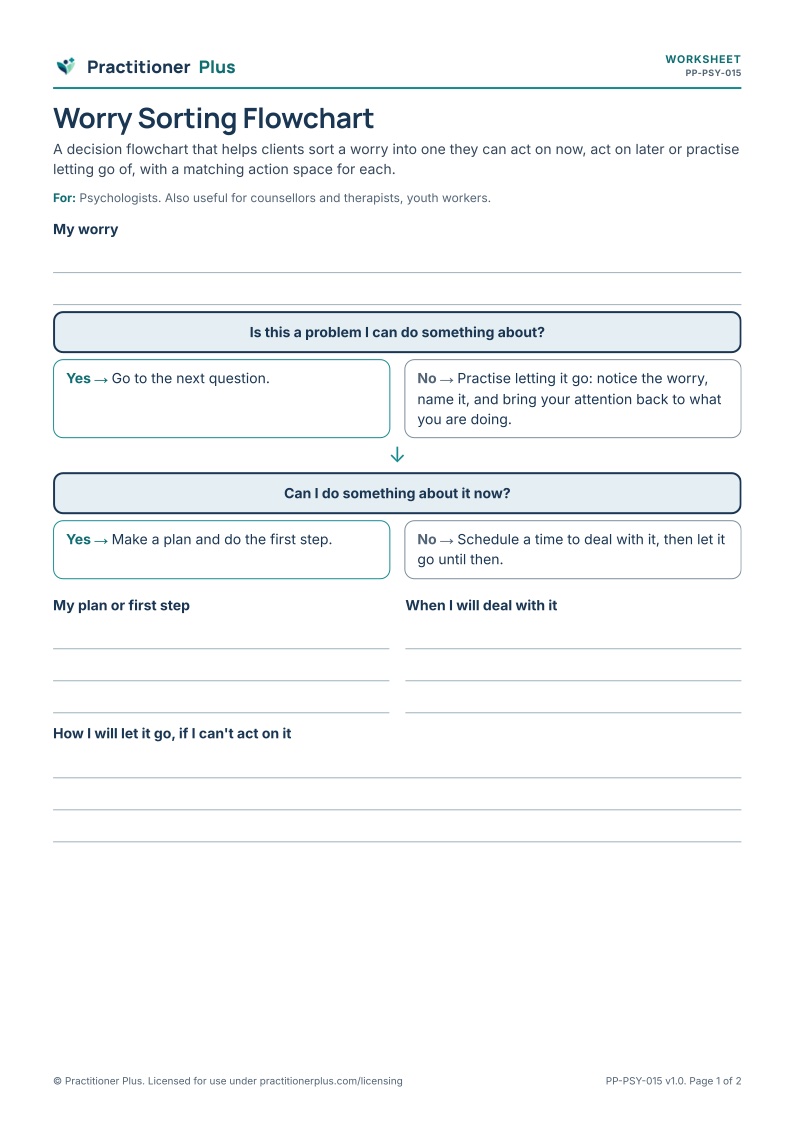
Some worries point to a problem we can solve; others are about things we cannot control. This flowchart guides clients through two questions to decide whether to make a plan now, schedule it for later or practise letting the worry go, with space to record what they will do.
Purpose
To help clients separate practical problems from hypothetical worries and respond to each differently.
Who it is for
Primary profession: Psychologists. Also relevant for counsellors and therapists, youth workers.
Client or participant group: Adolescents and adults who spend a lot of time worrying.
Practice setting: Psychology sessions and between-session practice.
Suggested uses
- Generalised worry
- Problem-solving practice
- Between-session homework
- Combining with scheduled worry time
Instructions for practitioners
- Practise the flowchart with a current worry in session.
- Link practical problems to problem-solving skills.
- Teach strategies for letting go, such as refocusing attention or mindful noticing.
- Review patterns over several weeks.
Instructions for clients or participants
- Write your worry.
- Follow the questions.
- Write what you will do.
Accessibility considerations
Can be completed verbally. The flowchart can be printed as a pocket card.
Scope and limitations
An educational CBT-informed worksheet for use within treatment.
Research basis
Scheduling worry and shifting from abstract to concrete thinking are supported strategies for reducing unhelpful worry and rumination. Cognitive behavioural therapy (CBT) has a strong research base for anxiety, depression and many related problems; this resource uses CBT techniques to support, not replace, a structured treatment plan.
- Beck, J. S. (2021). Cognitive behavior therapy: Basics and beyond (3rd ed.). Guilford Press.
- Borkovec, T., Wilkinson, L., Folensbee, R., & Lerman, C. (1983). Stimulus control applications to the treatment of worry. Behaviour Research and Therapy, 21(3), 247–251. https://doi.org/10.1016/0005-7967(83)90206-1
- Hofmann, S. G., Asnaani, A., Vonk, I. J. J., Sawyer, A. T., & Fang, A. (2012). The Efficacy of Cognitive Behavioral Therapy: A Review of Meta-analyses. Cognitive Therapy and Research, 36(5), 427–440. https://doi.org/10.1007/s10608-012-9476-1
- Watkins, E. R. (2008). Constructive and unconstructive repetitive thought. Psychological Bulletin, 134(2), 163–206. https://doi.org/10.1037/0033-2909.134.2.163
What is included
A 2-page printable A4 PDF, including a practitioner notes page with the research basis (version 1.0).
Originality
Original Practitioner Plus content: wording, activity structure, layout and icons were created for this resource. No third-party worksheets, illustrations or text were reproduced. Reflects the widely used distinction between practical and hypothetical worries in cognitive behavioural approaches.


