
About this resource
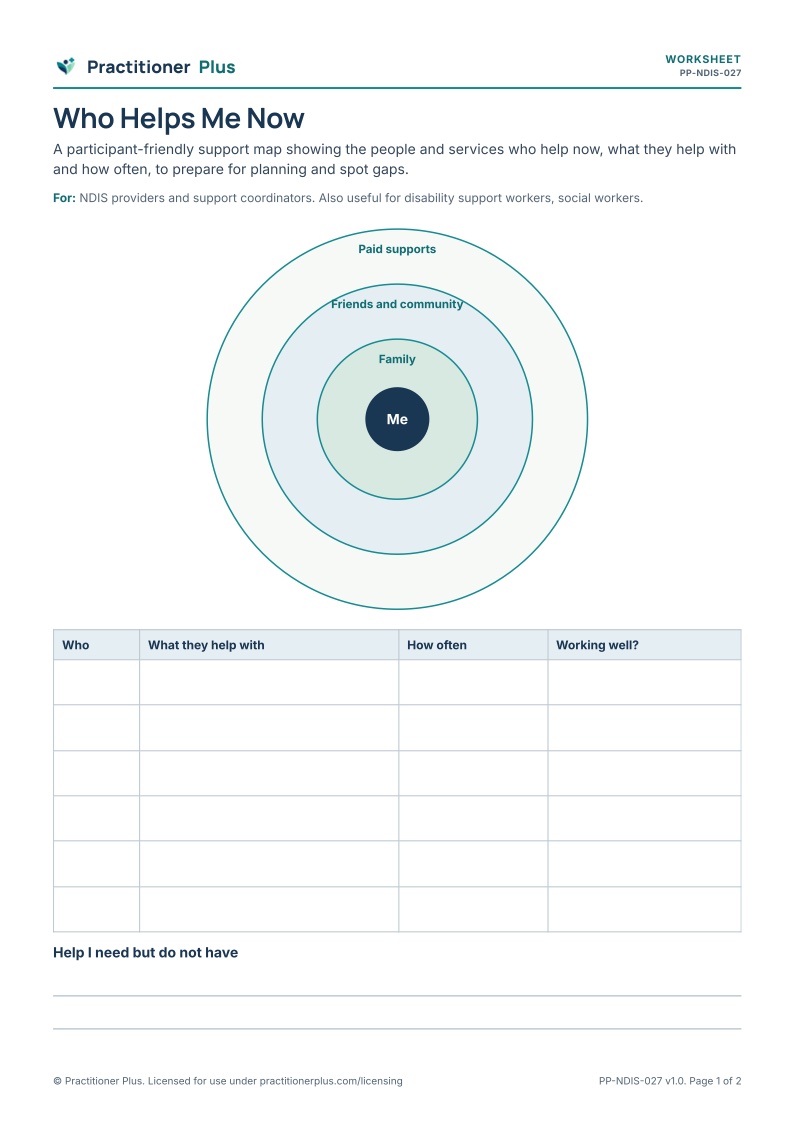
Planning starts with knowing who helps now. This map records family, friends, community and paid supports, what each helps with and how often, and what is working, missing or changing, so participants can prepare for planning conversations.
Purpose
To show the full picture of current supports, formal and informal.
Who it is for
Primary profession: NDIS providers and support coordinators. Also relevant for disability support workers, social workers.
Client or participant group: Participants, families and support coordinators.
Practice setting: Pre-planning, plan reviews and support coordination.
Suggested uses
- Preparing for planning meetings
- Plan reviews
- Identifying informal supports
- Carer sustainability conversations
Instructions for practitioners
- Complete with the participant and people they choose.
- Include informal and community supports.
- Ask whether supports are sustainable.
- Use findings in planning conversations.
Instructions for clients or participants
- Write the people who help you.
- Write what they help with.
- Tick what is missing.
Accessibility considerations
Use photos of people. Offer verbal completion.
Scope and limitations
A preparation tool. It is not an official NDIS document.
Research basis
Biopsychosocial and ecological models describe how health, relationships and wider systems interact in a person's life. Case management practice standards describe assessment, planning, coordination, review and planned exits with the person at the centre.
- Bronfenbrenner, U. (1979). The Ecology of Human Development: Experiments by Nature and Design. Harvard University Press. https://doi.org/10.4159/9780674028845
- Case Management Society of Australia and New Zealand. (2013). National standards of practice for case management (3rd ed.). https://www.cmsa.org.au/
- Engel, G. L. (1977). The Need for a New Medical Model: A Challenge for Biomedicine. Science, 196(4286), 129–136. https://doi.org/10.1126/science.847460
What is included
A 2-page printable A4 PDF, including a practitioner notes page with the research basis (version 1.0).
Originality
Original Practitioner Plus content: wording, activity structure, layout and icons were created for this resource. No third-party worksheets, illustrations or text were reproduced.


