
About this resource
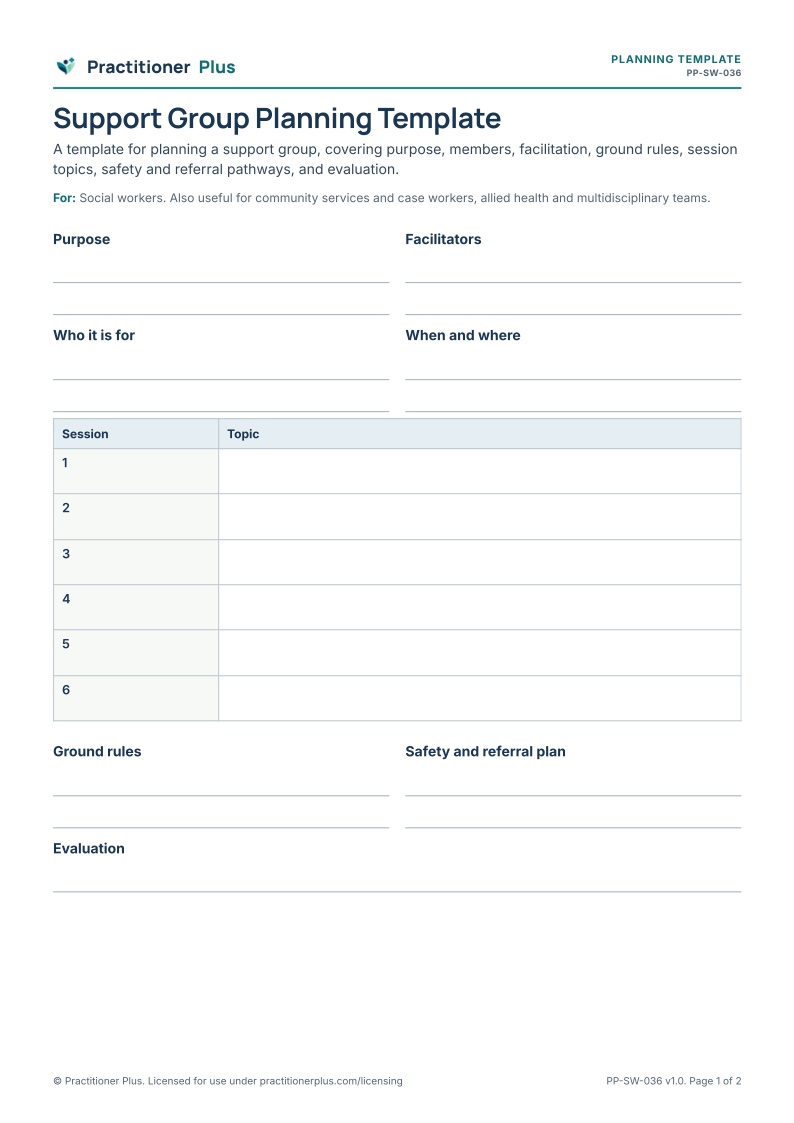
Support groups can reduce isolation and build hope. This template covers purpose, who the group is for, facilitation and co-facilitation, ground rules, session topics, safety and referral pathways for members who need more support, and evaluation.
Purpose
To plan safe, purposeful support groups.
Who it is for
Primary profession: Social workers. Also relevant for community services and case workers, allied health and multidisciplinary teams.
Client or participant group: Social workers planning support groups.
Practice setting: Hospital, community and specialist services.
Suggested uses
- Carer groups
- Grief and loss groups
- Health condition groups
- Peer support
Instructions for practitioners
- Involve people with lived experience in planning.
- Agree ground rules with the group.
- Plan how to respond to distress and refer on.
- Evaluate with members.
Accessibility considerations
Plan venue access, interpreters and online options.
Scope and limitations
A planning template.
Research basis
Interventions that address social connection and unhelpful social thinking can reduce loneliness. Group programs work through shared experience, belonging and practising skills with others.
- Masi, C. M., Chen, H. Y., Hawkley, L. C., & Cacioppo, J. T. (2011). A Meta-Analysis of Interventions to Reduce Loneliness. Personality and Social Psychology Review, 15(3), 219–266. https://doi.org/10.1177/1088868310377394
- Yalom, I. D., & Leszcz, M. (2005). The theory and practice of group psychotherapy (5th ed.). Basic Books.
What is included
A 2-page printable A4 PDF, including a practitioner notes page with the research basis (version 1.0).
Originality
Original Practitioner Plus content: wording, activity structure, layout and icons were created for this resource. No third-party worksheets, illustrations or text were reproduced.


