
About this resource
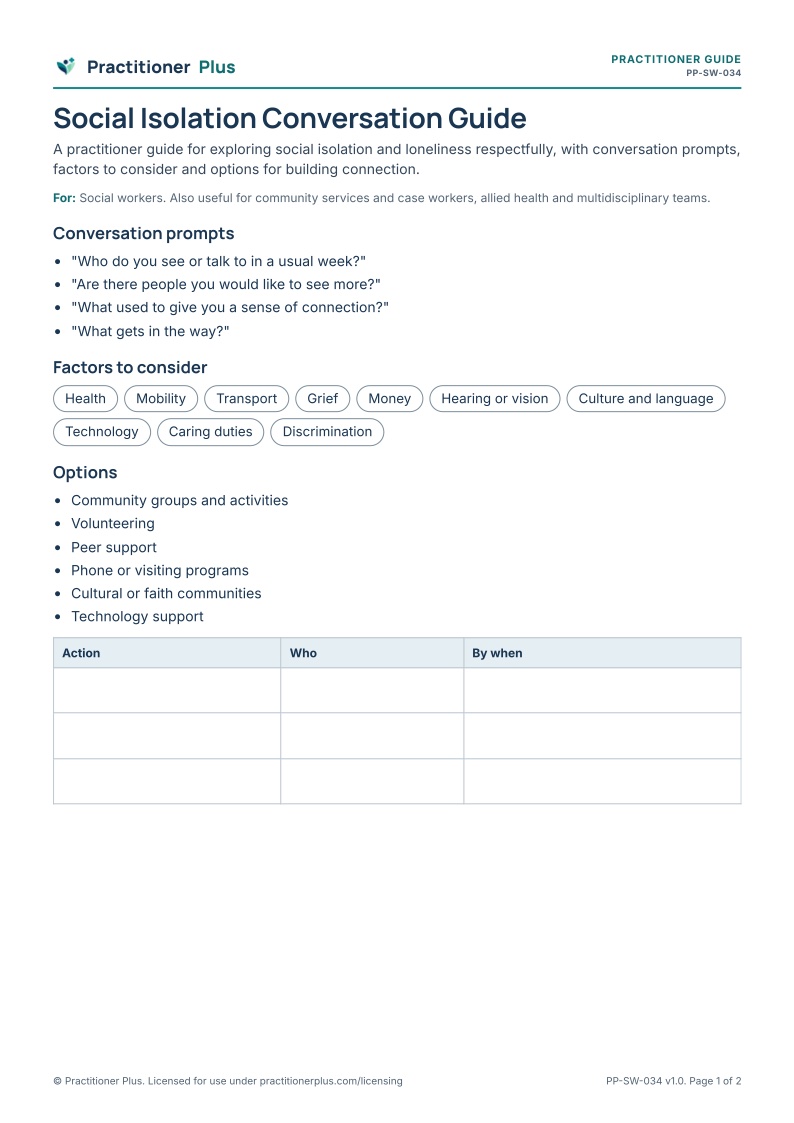
Social isolation affects health and wellbeing, but it can be hard to raise. This guide offers respectful conversation prompts, factors to consider such as health, mobility, transport, grief, money, culture and technology, and options for building connection based on what the person wants.
Purpose
To help practitioners identify isolation and support meaningful connection.
Who it is for
Primary profession: Social workers. Also relevant for community services and case workers, allied health and multidisciplinary teams.
Client or participant group: Social workers and practitioners working with people who may be isolated.
Practice setting: Hospital, aged care, community and disability services.
Suggested uses
- Psychosocial assessment
- Discharge planning
- Aged care and disability services
- Community programs
Instructions for practitioners
- Ask gently and without assumptions.
- Explore what kind of connection the person wants.
- Address practical barriers.
- Follow up to see whether connections have helped.
Accessibility considerations
Use interpreters. Consider hearing and vision needs.
Scope and limitations
A practice guide.
Research basis
Interventions that address social connection and unhelpful social thinking can reduce loneliness.
- Masi, C. M., Chen, H. Y., Hawkley, L. C., & Cacioppo, J. T. (2011). A Meta-Analysis of Interventions to Reduce Loneliness. Personality and Social Psychology Review, 15(3), 219–266. https://doi.org/10.1177/1088868310377394
What is included
A 2-page printable A4 PDF, including a practitioner notes page with the research basis (version 1.0).
Originality
Original Practitioner Plus content: wording, activity structure, layout and icons were created for this resource. No third-party worksheets, illustrations or text were reproduced.


