
About this resource
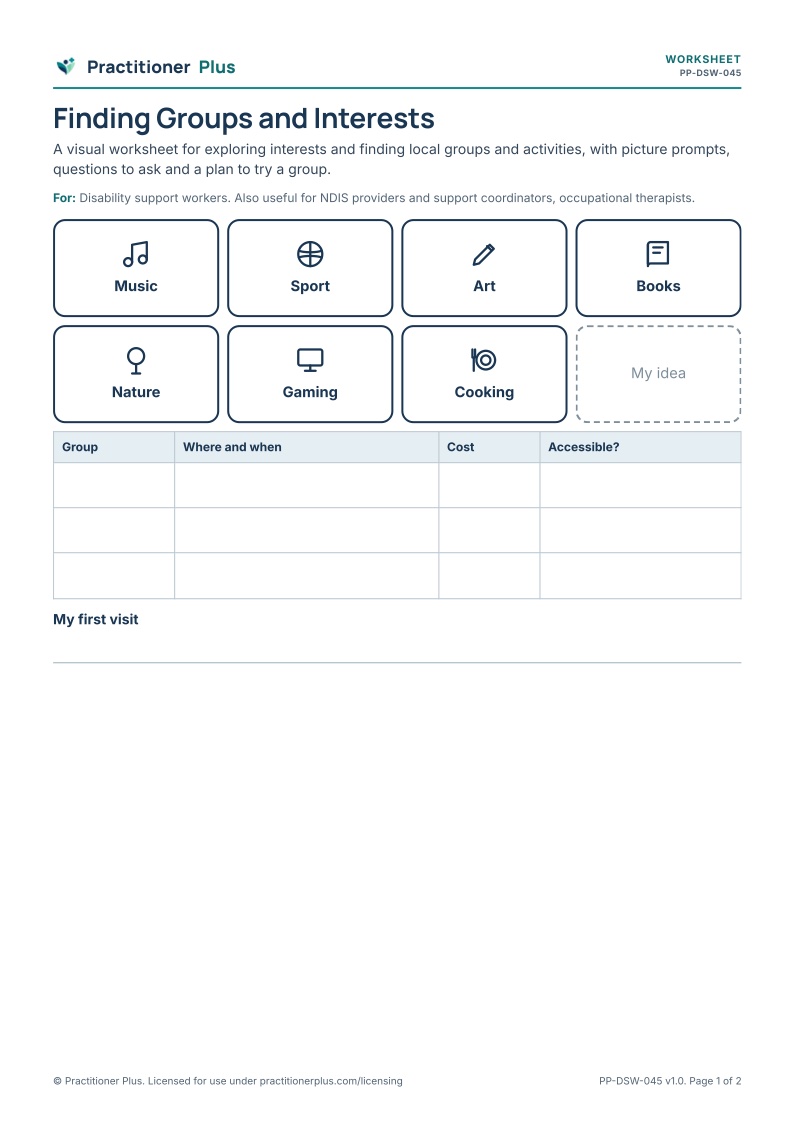
Groups can bring friendship and fun. This worksheet uses picture prompts to explore interests, then helps find local groups, questions to ask, such as cost and accessibility, and plans a first visit.
Purpose
To support community participation based on the person's interests.
Who it is for
Primary profession: Disability support workers. Also relevant for NDIS providers and support coordinators, occupational therapists.
Client or participant group: Adults and young people wanting to join groups or activities.
Practice setting: Home, day programs and community access.
Suggested uses
- Community access goals
- Social connection
- Leisure planning
- After a move
Instructions for practitioners
- Start with the person's interests.
- Search together for inclusive local groups.
- Check accessibility and costs.
- Offer support for the first visit.
Instructions for clients or participants
- Circle what you like.
- Find a group.
- Plan your first visit.
Accessibility considerations
Use photos and symbols.
Scope and limitations
A planning worksheet.
Research basis
Interventions that address social connection and unhelpful social thinking can reduce loneliness. Active support, which gives people real opportunities and just-enough help to take part in everyday activities, increases engagement for people with intellectual disability. Occupational therapy models describe how the person, their environment and their activities interact, and how a balance of meaningful activity supports health and participation.
- Law, M., Cooper, B., Strong, S., Stewart, D., Rigby, P., & Letts, L. (1996). The Person-Environment-Occupation Model: A Transactive Approach to Occupational Performance. Canadian Journal of Occupational Therapy, 63(1), 9–23. https://doi.org/10.1177/000841749606300103
- Mansell, J., & Beadle-Brown, J. (2012). Active support: Enabling and empowering people with intellectual disabilities. Jessica Kingsley Publishers.
- Masi, C. M., Chen, H. Y., Hawkley, L. C., & Cacioppo, J. T. (2011). A Meta-Analysis of Interventions to Reduce Loneliness. Personality and Social Psychology Review, 15(3), 219–266. https://doi.org/10.1177/1088868310377394
- Wagman, P., Håkansson, C., & Björklund, A. (2012). Occupational balance as used in occupational therapy: A concept analysis. Scandinavian Journal of Occupational Therapy, 19(4), 322–327. https://doi.org/10.3109/11038128.2011.596219
- World Health Organization. (2001). International classification of functioning, disability and health (ICF). WHO. https://www.who.int/standards/classifications/international-classification-of-functioning-disability-and-health
What is included
A 2-page printable A4 PDF, including a practitioner notes page with the research basis (version 1.0).
Originality
Original Practitioner Plus content: wording, activity structure, layout and icons were created for this resource. No third-party worksheets, illustrations or text were reproduced. Symbols are original line drawings created for Practitioner Plus.


