
About this resource
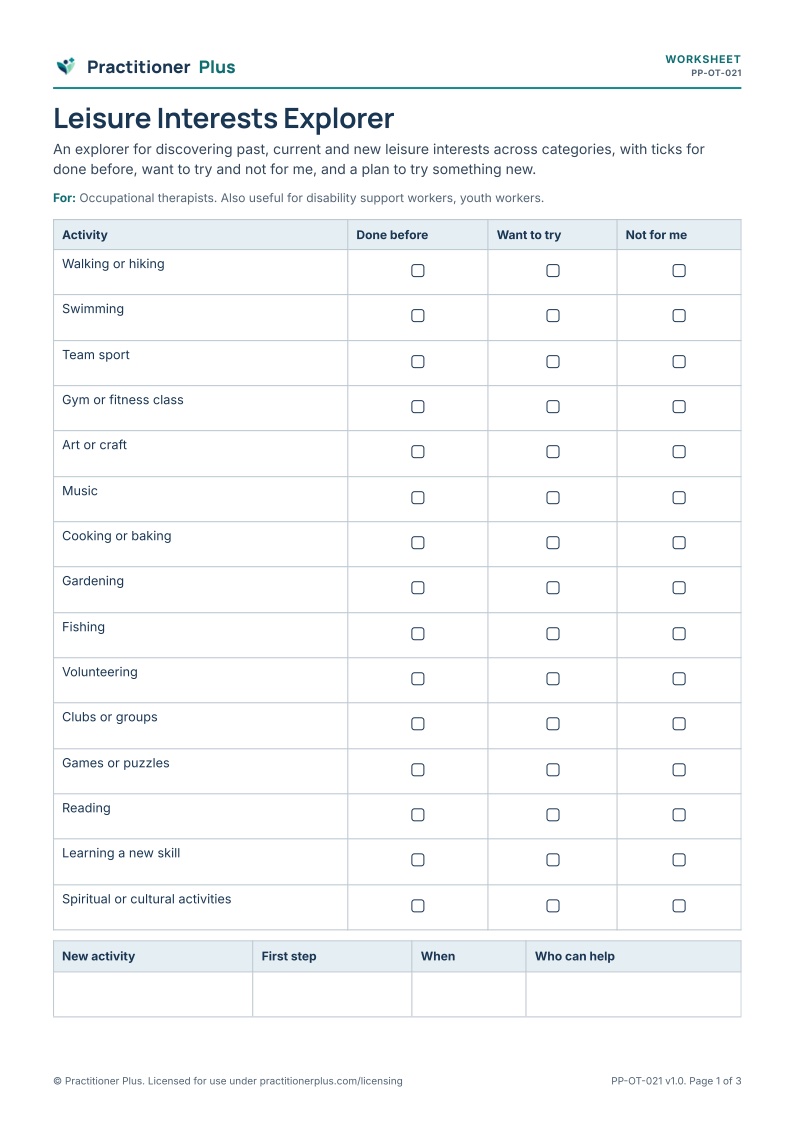
Leisure supports wellbeing, identity and connection. This explorer lists activities across physical, creative, social, outdoor, learning and quiet categories. People tick what they have done before, want to try or is not for them, then plan one new activity.
Purpose
To identify meaningful leisure interests and plan participation.
Who it is for
Primary profession: Occupational therapists. Also relevant for disability support workers, youth workers.
Client or participant group: Adolescents and adults rebuilding or exploring leisure, including after illness, injury or life change.
Practice setting: Occupational therapy, rehabilitation and community programs.
Suggested uses
- Occupational therapy goal setting
- Rehabilitation
- Community participation planning
- Mental health recovery
Instructions for practitioners
- Explore what made past activities meaningful.
- Consider barriers such as cost, transport and energy.
- Plan a first step with the person.
- Review how it went.
Instructions for clients or participants
- Tick each activity.
- Add your own.
- Plan one to try.
Accessibility considerations
Use pictures. Can be completed verbally.
Scope and limitations
An interest exploration tool. It is not a standardised assessment.
Research basis
Occupational therapy models describe how the person, their environment and their activities interact, and how a balance of meaningful activity supports health and participation.
- Law, M., Cooper, B., Strong, S., Stewart, D., Rigby, P., & Letts, L. (1996). The Person-Environment-Occupation Model: A Transactive Approach to Occupational Performance. Canadian Journal of Occupational Therapy, 63(1), 9–23. https://doi.org/10.1177/000841749606300103
- Wagman, P., Håkansson, C., & Björklund, A. (2012). Occupational balance as used in occupational therapy: A concept analysis. Scandinavian Journal of Occupational Therapy, 19(4), 322–327. https://doi.org/10.3109/11038128.2011.596219
- World Health Organization. (2001). International classification of functioning, disability and health (ICF). WHO. https://www.who.int/standards/classifications/international-classification-of-functioning-disability-and-health
What is included
A 3-page printable A4 PDF, including a practitioner notes page with the research basis (version 1.0).
Originality
Original Practitioner Plus content: wording, activity structure, layout and icons were created for this resource. No third-party worksheets, illustrations or text were reproduced.


