
About this resource
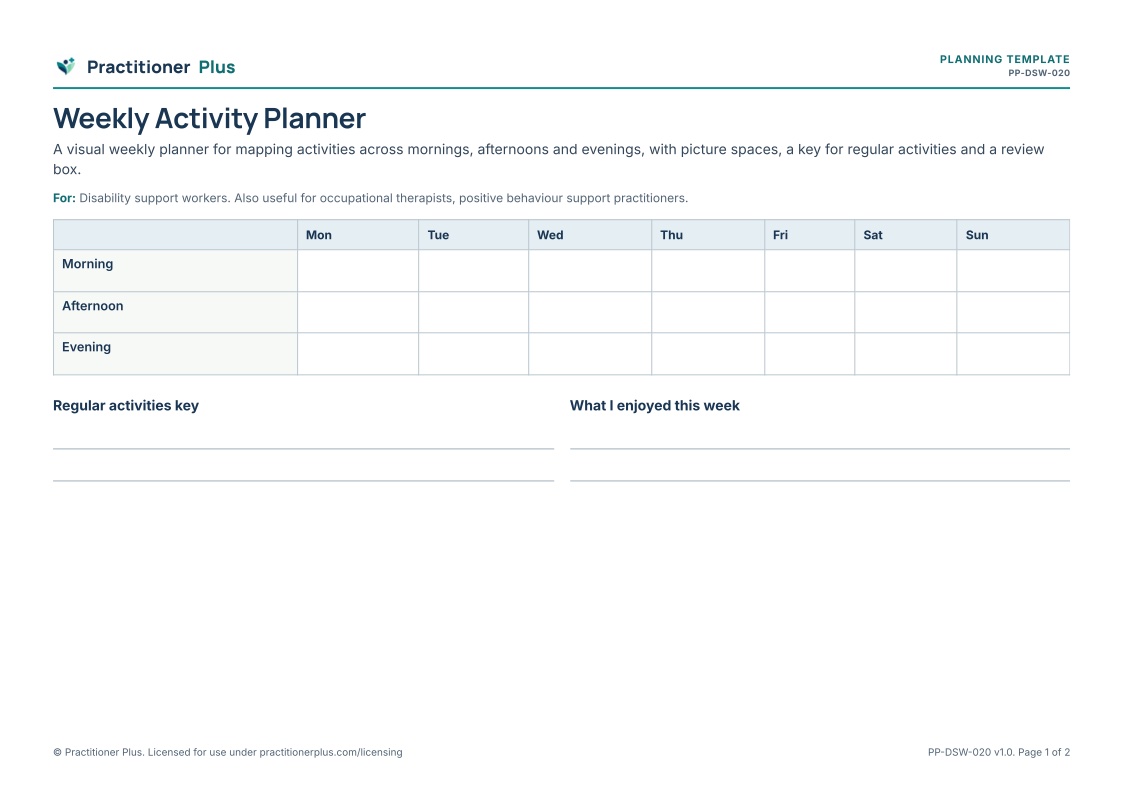
Knowing what the week holds can reduce worry and support choice. This planner maps activities across each day, with space for pictures or symbols, a key for regular activities and a review box to note what the person enjoyed.
Purpose
To help the person know what is happening each week and plan activities they enjoy.
Who it is for
Primary profession: Disability support workers. Also relevant for occupational therapists, positive behaviour support practitioners.
Client or participant group: Adults and young people who benefit from a visual week plan.
Practice setting: Home, supported living and day programs.
Suggested uses
- Weekly planning with the person
- Supporting predictability
- Community access planning
- Reviewing activities
Instructions for practitioners
- Plan the week with the person.
- Use photos or symbols the person understands.
- Tell the person early about any changes.
- Review what the person enjoyed.
Instructions for clients or participants
- Choose your activities.
- Look at your planner each day.
- Tell us what you enjoyed.
Accessibility considerations
Use photos, symbols or colour coding. Print large.
Scope and limitations
A planning tool.
Research basis
Visual schedules and other visual supports are established evidence-based practices for autistic children and young people, and are widely used with others who benefit from visual information. Occupational therapy models describe how the person, their environment and their activities interact, and how a balance of meaningful activity supports health and participation.
- Knight, V., Sartini, E., & Spriggs, A. D. (2015). Evaluating Visual Activity Schedules as Evidence-Based Practice for Individuals with Autism Spectrum Disorders. Journal of Autism and Developmental Disorders, 45(1), 157–178. https://doi.org/10.1007/s10803-014-2201-z
- Law, M., Cooper, B., Strong, S., Stewart, D., Rigby, P., & Letts, L. (1996). The Person-Environment-Occupation Model: A Transactive Approach to Occupational Performance. Canadian Journal of Occupational Therapy, 63(1), 9–23. https://doi.org/10.1177/000841749606300103
- Steinbrenner, J. R., Hume, K., Odom, S. L., Morin, K. L., Nowell, S. W., Tomaszewski, B., Szendrey, S., McIntyre, N. S., Yücesoy-Özkan, S., & Savage, M. N. (2020). Evidence-based practices for children, youth, and young adults with autism. FPG Child Development Institute, University of North Carolina. https://ncaep.fpg.unc.edu/wp-content/uploads/EBP-Report-2020.pdf
- Wagman, P., Håkansson, C., & Björklund, A. (2012). Occupational balance as used in occupational therapy: A concept analysis. Scandinavian Journal of Occupational Therapy, 19(4), 322–327. https://doi.org/10.3109/11038128.2011.596219
- World Health Organization. (2001). International classification of functioning, disability and health (ICF). WHO. https://www.who.int/standards/classifications/international-classification-of-functioning-disability-and-health
What is included
A 3-page printable A4 PDF, including a practitioner notes page with the research basis (version 1.0).
Originality
Original Practitioner Plus content: wording, activity structure, layout and icons were created for this resource. No third-party worksheets, illustrations or text were reproduced.


