
About this resource
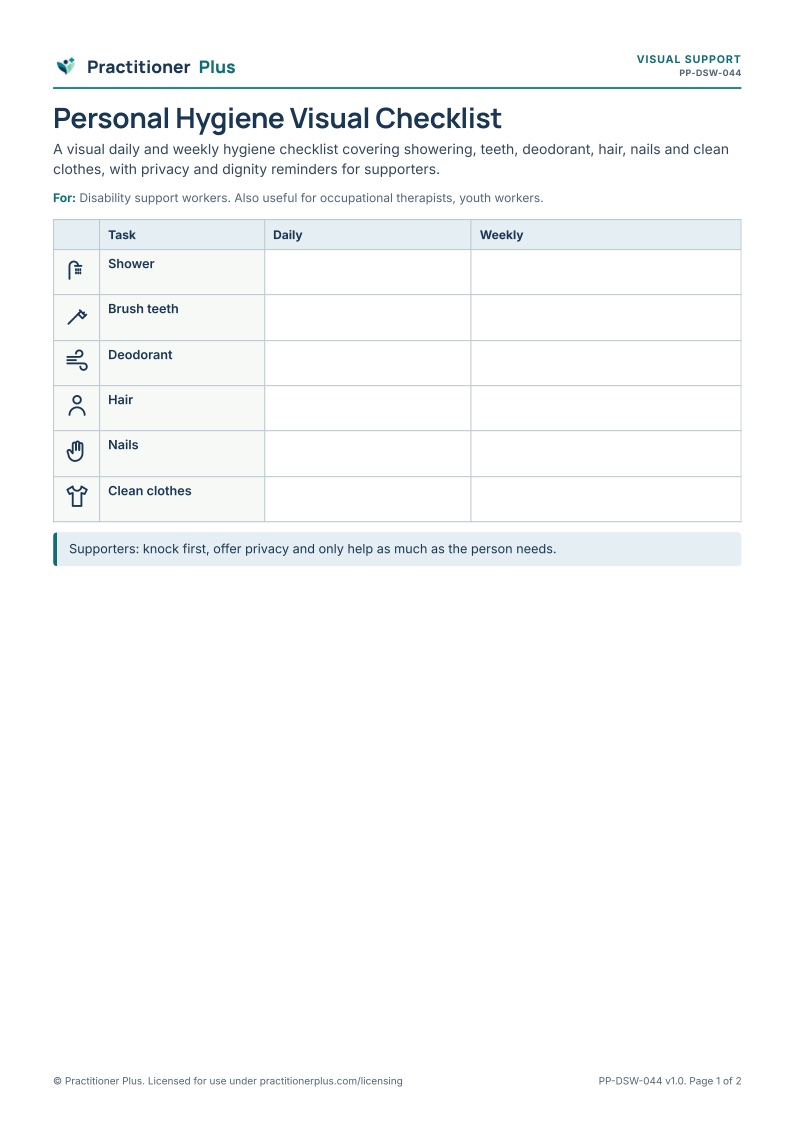
A visual checklist can make hygiene routines easier to remember. This checklist covers showering, brushing teeth, deodorant, hair, nails and clean clothes, with daily and weekly tick boxes and reminders for supporters about privacy and dignity.
Purpose
To support independence and dignity in personal hygiene.
Who it is for
Primary profession: Disability support workers. Also relevant for occupational therapists, youth workers.
Client or participant group: Adolescents and adults building independence with personal hygiene.
Practice setting: Home and supported living.
Suggested uses
- Building independence
- Morning and evening routines
- Puberty and young adults
- Supported living
Instructions for practitioners
- Agree the checklist with the person.
- Protect privacy and dignity.
- Teach steps as needed.
- Praise independence.
Instructions for clients or participants
- Look at the pictures.
- Tick each one.
- Ask for help if you need it.
Accessibility considerations
Use photos of the person's own products.
Scope and limitations
A visual support.
Research basis
Active support, which gives people real opportunities and just-enough help to take part in everyday activities, increases engagement for people with intellectual disability. Visual schedules and other visual supports are established evidence-based practices for autistic children and young people, and are widely used with others who benefit from visual information.
- Knight, V., Sartini, E., & Spriggs, A. D. (2015). Evaluating Visual Activity Schedules as Evidence-Based Practice for Individuals with Autism Spectrum Disorders. Journal of Autism and Developmental Disorders, 45(1), 157–178. https://doi.org/10.1007/s10803-014-2201-z
- Mansell, J., & Beadle-Brown, J. (2012). Active support: Enabling and empowering people with intellectual disabilities. Jessica Kingsley Publishers.
- Steinbrenner, J. R., Hume, K., Odom, S. L., Morin, K. L., Nowell, S. W., Tomaszewski, B., Szendrey, S., McIntyre, N. S., Yücesoy-Özkan, S., & Savage, M. N. (2020). Evidence-based practices for children, youth, and young adults with autism. FPG Child Development Institute, University of North Carolina. https://ncaep.fpg.unc.edu/wp-content/uploads/EBP-Report-2020.pdf
What is included
A 2-page printable A4 PDF, including a practitioner notes page with the research basis (version 1.0).
Originality
Original Practitioner Plus content: wording, activity structure, layout and icons were created for this resource. No third-party worksheets, illustrations or text were reproduced. Symbols are original line drawings created for Practitioner Plus.


