
About this resource
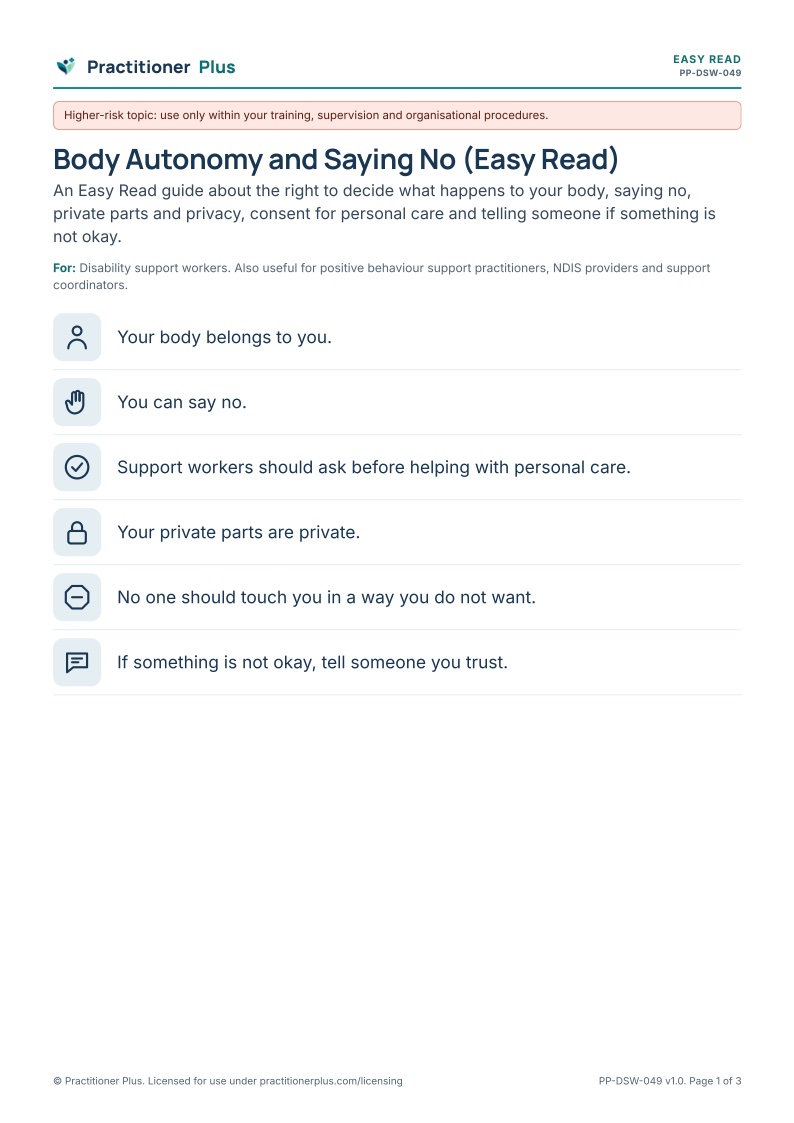
Everyone has the right to decide what happens to their body. This Easy Read guide explains saying no, privacy, being asked before personal care, that no one should touch you in ways you do not want and telling someone you trust if something is not okay.
Purpose
To support people to understand body autonomy and speak up.
Who it is for
Primary profession: Disability support workers. Also relevant for positive behaviour support practitioners, NDIS providers and support coordinators.
Client or participant group: Adults and young people with intellectual disability or low literacy.
Practice setting: Home, day programs and protective education, with a trusted worker.
Suggested uses
- Protective education
- Personal care conversations
- Rights education
- Safeguarding programs
Instructions for practitioners
- Use in a calm, private setting with a trusted worker.
- Respect the person's answers in daily practice, including in personal care.
- Follow safeguarding and reporting procedures if abuse is disclosed.
- Refer to specialist relationships and sexuality educators where needed.
Instructions for clients or participants
- Read with someone you trust.
- Practise saying no.
- Write who you can tell.
Accessibility considerations
Easy Read layout with one idea per line and symbols. Should be user tested with people with intellectual disability.
Scope and limitations
General Easy Read information. Disclosures of abuse need specialist responses and reporting.
Higher-risk topic: use only within your training, supervision and organisational procedures.
Research basis
Human rights frameworks and research on the dignity of risk support people's right to make their own choices, including choices that involve some risk. Primary prevention of violence focuses on respectful relationships, consent and challenging harmful attitudes. Easy Read standards and disability rights frameworks support people's right to accessible information; test Easy Read materials with the people who will use them.
- Ibrahim, J. E., & Davis, M. (2013). Impediments to applying the ‘dignity of risk’ principle in residential aged care services. Australasian Journal on Ageing, 32(3), 188–193. https://doi.org/10.1111/ajag.12014
- Inclusion Europe. (2009). Information for all: European standards for making information easy to read and understand. https://www.inclusion-europe.eu/easy-to-read-standards-guidelines/
- Our Watch. (2021). Change the story: A shared framework for the primary prevention of violence against women in Australia (2nd ed.). https://www.ourwatch.org.au/change-the-story
- United Nations. (2006). Convention on the Rights of Persons with Disabilities. https://www.ohchr.org/en/instruments-mechanisms/instruments/convention-rights-persons-disabilities
What is included
A 3-page printable A4 PDF, including a practitioner notes page with the research basis (version 1.0).
Originality
Original Practitioner Plus content: wording, activity structure, layout and icons were created for this resource. No third-party worksheets, illustrations or text were reproduced. Symbols are original line drawings created for Practitioner Plus.


