
About this resource
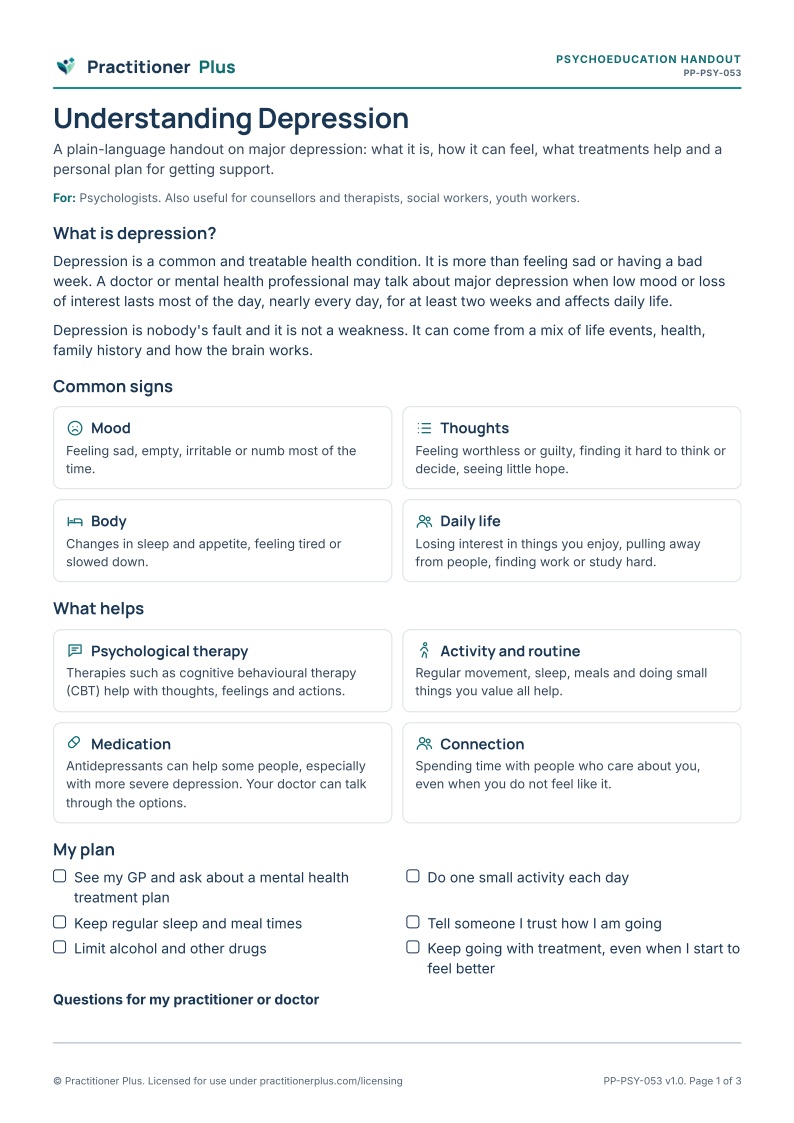
Depression is a common and treatable health condition. It is more than feeling sad or having a bad week. A doctor or mental health professional may talk about major depression when low mood or loss of interest lasts most of the day, nearly every day, for at least two weeks and affects daily life. This handout explains common signs, what helps and gives space for a personal plan.
Purpose
To give clear, accurate information about depression and what helps.
Who it is for
Primary profession: Psychologists. Also relevant for counsellors and therapists, social workers, youth workers.
Client or participant group: People living with depression, and their families and supporters.
Practice setting: Counselling, psychology and mental health services, as part of psychoeducation.
Suggested uses
- Psychoeducation after diagnosis
- Helping someone decide to seek assessment
- Sessions with family or supporters
- Goal setting and treatment planning
Instructions for practitioners
- Check what the person already knows and has been told.
- Go through the handout together, linking it to their own experience.
- Choose one or two things to try first.
- Talk with the person's GP or treating team about assessment, diagnosis and medication.
- Complete a risk assessment conversation where needed.
Instructions for clients or participants
- Read this with your practitioner or someone you trust.
- Tick the things that sound like you.
- Write down questions for your practitioner or doctor.
Accessibility considerations
Plain language. Can be read aloud or worked through with an interpreter or supporter.
Scope and limitations
General psychoeducation. It is not a diagnostic tool and does not replace assessment or treatment by a doctor, psychiatrist or other qualified clinician. Questions about medication should go to the prescribing doctor.
Research basis
Australian guidelines for mood disorders recommend lifestyle changes and psychological therapy for depression, with antidepressant medication as an option depending on severity. Brief psychoeducation can reduce symptoms of depression and psychological distress.
- Donker, T., Griffiths, K. M., Cuijpers, P., & Christensen, H. (2009). Psychoeducation for depression, anxiety and psychological distress: a meta-analysis. BMC Medicine, 7(1), 79. https://doi.org/10.1186/1741-7015-7-79
- Malhi, G. S., Bell, E., Bassett, D., Boyce, P., Bryant, R., Hazell, P., Hopwood, M., Lyndon, B., Mulder, R., Porter, R., Singh, A. B., & Murray, G. (2021). The 2020 Royal Australian and New Zealand College of Psychiatrists clinical practice guidelines for mood disorders. Australian & New Zealand Journal of Psychiatry, 55(1), 7–117. https://doi.org/10.1177/0004867420979353
What is included
A 3-page printable A4 PDF, including a practitioner notes page with the research basis (version 1.0).
Originality
Original Practitioner Plus content: wording, activity structure, layout and icons were created for this resource. No third-party worksheets, illustrations or text were reproduced. Written for Practitioner Plus from the guidelines and research listed in the research basis; no third-party handout was used.


