
About this resource
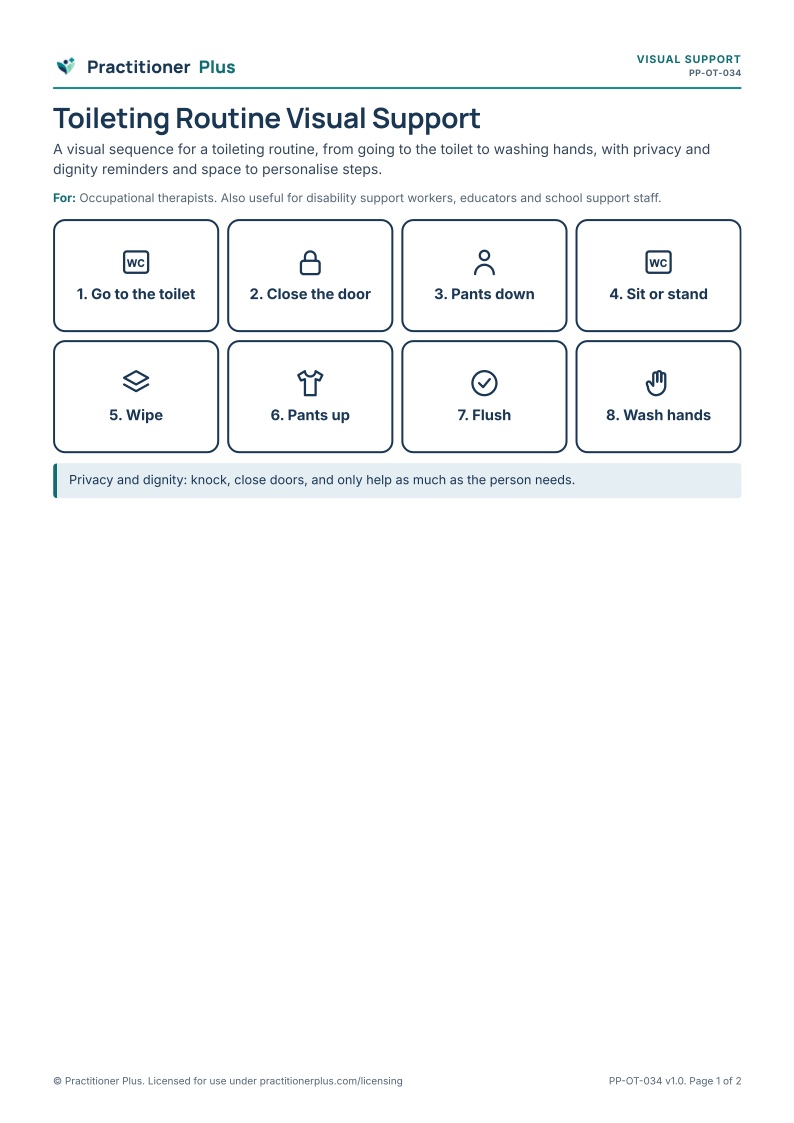
A clear visual sequence can support independence with toileting. This visual shows the steps from going to the toilet to washing hands, with reminders about privacy and dignity and space to add or change steps for the person.
Purpose
To support independence and dignity in toileting.
Who it is for
Primary profession: Occupational therapists. Also relevant for disability support workers, educators and school support staff.
Client or participant group: Children and adults learning or maintaining toileting routines.
Practice setting: Home, school and supported living, with occupational therapy input.
Suggested uses
- Toilet training
- Building independence
- Consistency across settings
- Supporting people with cognitive disability
Instructions for practitioners
- Personalise steps to the person and their bathroom.
- Protect privacy and dignity at all times.
- Use the same sequence across settings.
- Seek health advice for continence concerns.
Instructions for clients or participants
- Follow the pictures.
- Wash your hands at the end.
Accessibility considerations
Use photos of the person's own bathroom. Display at eye level.
Scope and limitations
A visual support. Continence concerns need health professional assessment.
Research basis
Visual schedules and other visual supports are established evidence-based practices for autistic children and young people, and are widely used with others who benefit from visual information.
- Knight, V., Sartini, E., & Spriggs, A. D. (2015). Evaluating Visual Activity Schedules as Evidence-Based Practice for Individuals with Autism Spectrum Disorders. Journal of Autism and Developmental Disorders, 45(1), 157–178. https://doi.org/10.1007/s10803-014-2201-z
- Steinbrenner, J. R., Hume, K., Odom, S. L., Morin, K. L., Nowell, S. W., Tomaszewski, B., Szendrey, S., McIntyre, N. S., Yücesoy-Özkan, S., & Savage, M. N. (2020). Evidence-based practices for children, youth, and young adults with autism. FPG Child Development Institute, University of North Carolina. https://ncaep.fpg.unc.edu/wp-content/uploads/EBP-Report-2020.pdf
What is included
A 2-page printable A4 PDF, including a practitioner notes page with the research basis (version 1.0).
Originality
Original Practitioner Plus content: wording, activity structure, layout and icons were created for this resource. No third-party worksheets, illustrations or text were reproduced. Symbols are original line drawings created for Practitioner Plus.


