
About this resource
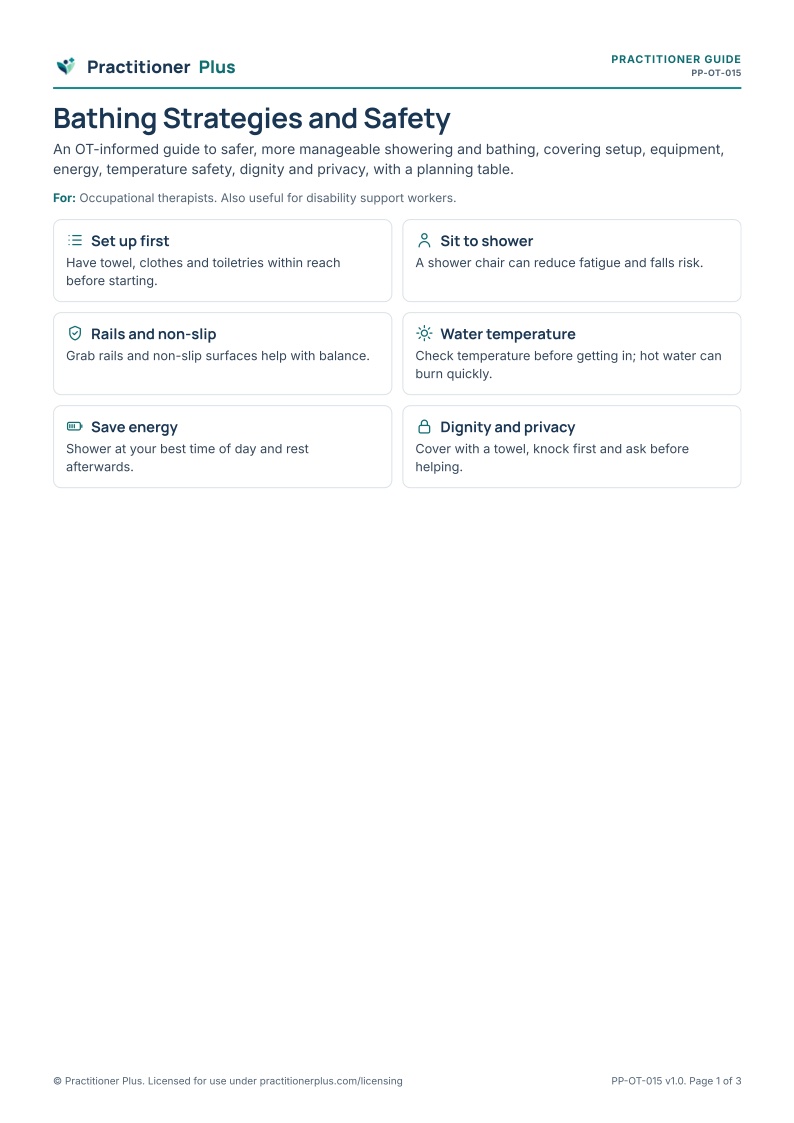
Showering can be tiring and the bathroom is a common place for falls. This guide covers setting up before starting, sitting to shower, equipment such as rails and shower chairs, water temperature safety, saving energy, and protecting dignity and privacy, with a table for planning what works for the person.
Purpose
To support safe, dignified and as independent as possible showering and bathing.
Who it is for
Primary profession: Occupational therapists. Also relevant for disability support workers.
Client or participant group: Adults with physical, sensory or cognitive changes, and their supporters.
Practice setting: Home and supported living, with occupational therapy input.
Suggested uses
- Following an OT bathroom assessment
- Planning personal care routines
- Training support workers
- After illness or a fall
Instructions for practitioners
- Observe the routine in the person's bathroom where possible.
- Prioritise safety and the person's preferences.
- Recommend equipment and modifications through individual assessment.
- Train support workers in the agreed routine.
Instructions for clients or participants
- Choose strategies to try.
- Tell your OT what helps.
- Ask for help if you feel unsteady.
Accessibility considerations
Large print. Can be paired with a visual sequence.
Scope and limitations
General information. Equipment and home modifications need individual occupational therapy assessment.
Research basis
Occupational therapy models describe how the person, their environment and their activities interact, and how a balance of meaningful activity supports health and participation. Exercise and home hazard reduction both reduce falls in older people living in the community.
- Clemson, L., Mackenzie, L., Ballinger, C., Close, J. C. T., & Cumming, R. G. (2008). Environmental Interventions to Prevent Falls in Community-Dwelling Older People: A Meta-Analysis of Randomized Trials. Journal of Aging and Health, 20(8), 954–971. https://doi.org/10.1177/0898264308324672
- Law, M., Cooper, B., Strong, S., Stewart, D., Rigby, P., & Letts, L. (1996). The Person-Environment-Occupation Model: A Transactive Approach to Occupational Performance. Canadian Journal of Occupational Therapy, 63(1), 9–23. https://doi.org/10.1177/000841749606300103
- Sherrington, C., Fairhall, N. J., Wallbank, G. K., Tiedemann, A., Michaleff, Z. A., Howard, K., Clemson, L., Hopewell, S., & Lamb, S. E. (2019). Exercise for preventing falls in older people living in the community. Cochrane Database of Systematic Reviews, Article CD012424. https://doi.org/10.1002/14651858.cd012424.pub2
- Wagman, P., Håkansson, C., & Björklund, A. (2012). Occupational balance as used in occupational therapy: A concept analysis. Scandinavian Journal of Occupational Therapy, 19(4), 322–327. https://doi.org/10.3109/11038128.2011.596219
- World Health Organization. (2001). International classification of functioning, disability and health (ICF). WHO. https://www.who.int/standards/classifications/international-classification-of-functioning-disability-and-health
What is included
A 3-page printable A4 PDF, including a practitioner notes page with the research basis (version 1.0).
Originality
Original Practitioner Plus content: wording, activity structure, layout and icons were created for this resource. No third-party worksheets, illustrations or text were reproduced.


