
About this resource
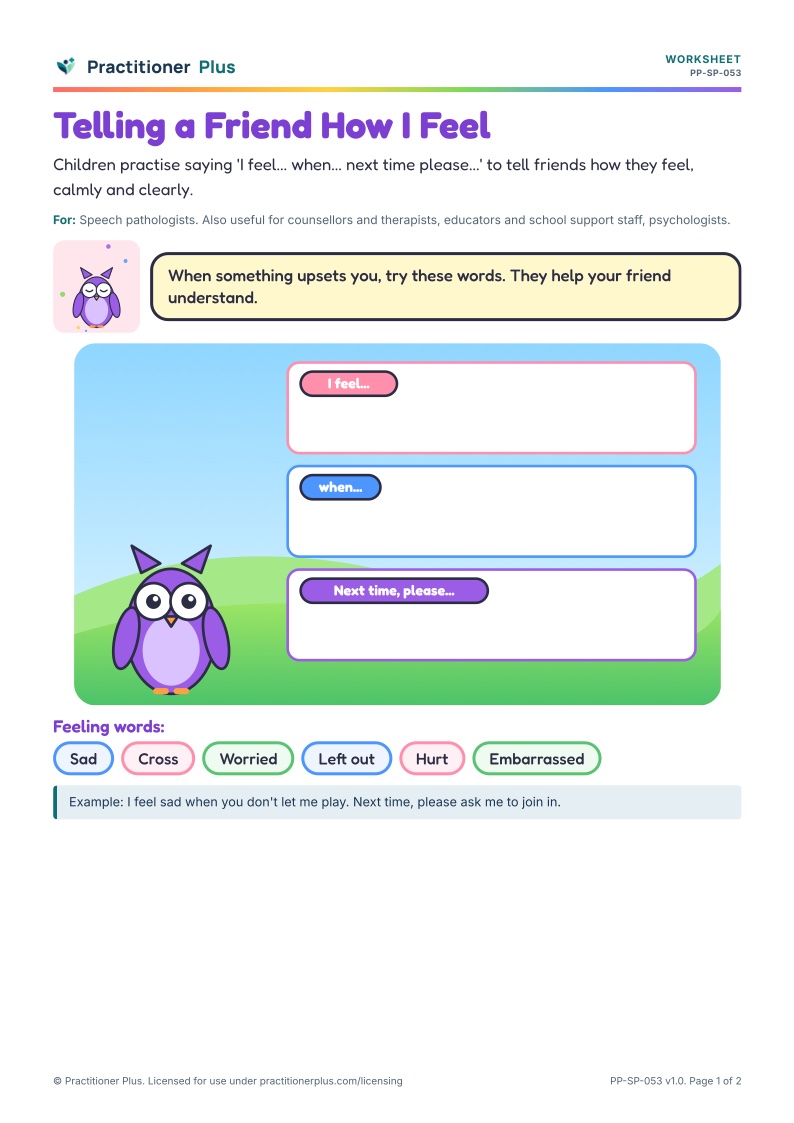
Using a simple sentence helps children say what they feel without blaming. This activity teaches the 'I feel... when... next time please...' pattern, with space to write or draw real examples and practise saying them.
Purpose
Children practise saying 'I feel... when... next time please...' to tell friends how they feel, calmly and clearly.
Who it is for
Primary profession: Speech pathologists. Also relevant for counsellors and therapists, educators and school support staff, psychologists.
Client or participant group: Children aged about 5 to 11, with a speech pathologist, teacher or counsellor.
Practice setting: Speech pathology, classrooms and counselling.
Suggested uses
- Individual play-based sessions
- Building a relationship with a child
- Talking about feelings without pressure
- Sharing ideas with parents or carers, with the child's agreement
Instructions for practitioners
- Model the sentence with an easy example.
- Help the child fill in a real example.
- Practise the words and a calm voice.
- Role-play with puppets or a peer.
- Talk about what to do if the friend doesn't listen.
Accessibility considerations
Big pictures and few words. Read it aloud, let the child draw or point, and use their own words for feelings. Print in colour if you can, or let the child colour it in.
Scope and limitations
A play-based activity that supports therapy. It is not a stand-alone treatment, a clinical assessment or a validated tool. Follow the child's lead, stop if they become distressed, and follow your child safety procedures if the child discloses harm.
Research basis
School-based social and emotional learning programs improve students' social skills, behaviour and academic results. Programs that teach adults to notice, name and accept children's emotions improve emotion coaching and can reduce children's behaviour difficulties.
- Durlak, J. A., Weissberg, R. P., Dymnicki, A. B., Taylor, R. D., & Schellinger, K. B. (2011). The Impact of Enhancing Students’ Social and Emotional Learning: A Meta-Analysis of School-Based Universal Interventions. Child Development, 82(1), 405–432. https://doi.org/10.1111/j.1467-8624.2010.01564.x
- Havighurst, S. S., Wilson, K. R., Harley, A. E., Prior, M. R., & Kehoe, C. (2010). Tuning in to Kids: improving emotion socialization practices in parents of preschool children – findings from a community trial. Journal of Child Psychology and Psychiatry, 51(12), 1342–1350. https://doi.org/10.1111/j.1469-7610.2010.02303.x
What is included
A 2-page printable A4 PDF, including a practitioner notes page with the research basis (version 1.0).
Originality
Original Practitioner Plus content: wording, activity structure, layout and icons were created for this resource. No third-party worksheets, illustrations or text were reproduced. Illustrations and activities were created for Practitioner Plus; no third-party worksheet or image was used.


