
About this resource
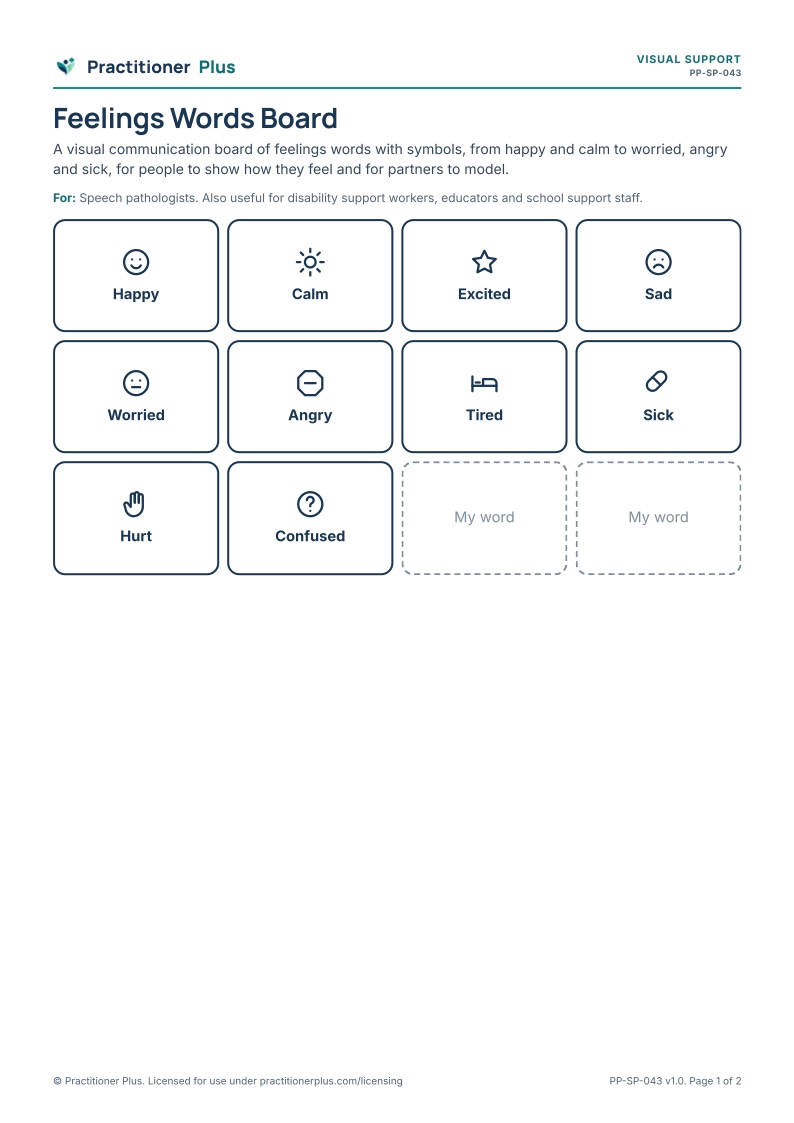
Feelings can be hard to say. This board provides feelings words with symbols, including happy, calm, excited, sad, worried, angry, tired, sick, hurt and confused, for people to point to and for partners to model during daily routines.
Purpose
To give people a way to communicate feelings.
Who it is for
Primary profession: Speech pathologists. Also relevant for disability support workers, educators and school support staff.
Client or participant group: Children and adults who benefit from visual supports to communicate feelings.
Practice setting: Home, school, day programs and health settings.
Suggested uses
- Daily check-ins
- Health appointments
- Emotional regulation support
- AAC users
Instructions for practitioners
- Model feelings words during real moments.
- Accept any way of indicating.
- Add personal feelings words.
- Pair with what helps for each feeling.
Instructions for clients or participants
- Point to how you feel.
Accessibility considerations
Print large. Laminate.
Scope and limitations
A visual communication support.
Research basis
Understanding, naming and choosing strategies for emotions are central to emotion regulation; putting feelings into words and finer emotion distinctions are linked to better regulation. Visual schedules and other visual supports are established evidence-based practices for autistic children and young people, and are widely used with others who benefit from visual information.
- Gross, J. J. (2015). Emotion Regulation: Current Status and Future Prospects. Psychological Inquiry, 26(1), 1–26. https://doi.org/10.1080/1047840x.2014.940781
- Kashdan, T. B., Barrett, L. F., & McKnight, P. E. (2015). Unpacking Emotion Differentiation: Transforming Unpleasant Experience by Perceiving Distinctions in Negativity. Current Directions in Psychological Science, 24(1), 10–16. https://doi.org/10.1177/0963721414550708
- Kircanski, K., Lieberman, M. D., & Craske, M. G. (2012). Feelings Into Words: Contributions of Language to Exposure Therapy. Psychological Science, 23(10), 1086–1091. https://doi.org/10.1177/0956797612443830
- Knight, V., Sartini, E., & Spriggs, A. D. (2015). Evaluating Visual Activity Schedules as Evidence-Based Practice for Individuals with Autism Spectrum Disorders. Journal of Autism and Developmental Disorders, 45(1), 157–178. https://doi.org/10.1007/s10803-014-2201-z
- Steinbrenner, J. R., Hume, K., Odom, S. L., Morin, K. L., Nowell, S. W., Tomaszewski, B., Szendrey, S., McIntyre, N. S., Yücesoy-Özkan, S., & Savage, M. N. (2020). Evidence-based practices for children, youth, and young adults with autism. FPG Child Development Institute, University of North Carolina. https://ncaep.fpg.unc.edu/wp-content/uploads/EBP-Report-2020.pdf
What is included
A 2-page printable A4 PDF, including a practitioner notes page with the research basis (version 1.0).
Originality
Original Practitioner Plus content: wording, activity structure, layout and icons were created for this resource. No third-party worksheets, illustrations or text were reproduced. Symbols are original line drawings created for Practitioner Plus.


